
Ultrasonic Spray Pyrolysis For Nanoparticles Synthesis
Ultrasonic spray pyrolysis for nanoparticles synthesis. This article presents new findings regarding the effects of precursor drop size and precursor concentration on product particle size and morphology in ultrasonic spray pyrolysis. Large precursor drops (diameter > 30 μm) generated by ultrasonic atomization at 120 kHz yielded particles with holes due to high solvent evaporation rate, as predicted by the conventional one particle per drop mechanism. Precursor drops 6–9 μm in diameter, generated by an ultrasonic nebulizer at 1.65 MHz and 23.5 W electric drive power, yielded uniform spherical particles 90 nm in diameter with proper control of precursor concentration and residence time. Moreover, air-assisted ultrasonic spray pyrolysis at 120 kHz and 2.3 W yielded spherical particles about 70% of which were smaller than those produced by the ultrasonic spray pyrolysis of the 6–9 μm precursor drops, despite much larger precursor drop size (28 μm peak diameter versus 7 μm mean diameter). These particles are much smaller than predicted by the conventional one particle per drop mechanism, suggesting that a gas-to-particle conversion mechanism may also be involved in spray pyrolysis.
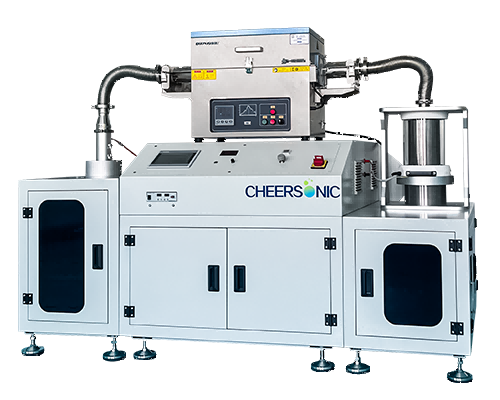
Ultrasonic spray pyrolysis is a scalable, versatile aerosol‑based technique for synthesizing functional nanoparticles with well‑controlled morphology, particle size and chemical composition. This method transforms precursor solution into fine micrometre‑sized droplets via high‑frequency ultrasonic atomization. Carrier gas transports these droplets into a high‑temperature reaction furnace, where solvent evaporates rapidly, precursors decompose and undergo chemical reactions to form solid nanoparticles, which are then collected by filters or electrostatic precipitators.
Compared with wet‑chemical precipitation and solid‑state calcination, it avoids complex centrifugation, washing and multi‑step post‑treatment. Each droplet acts as an independent micro‑reactor, favouring homogeneous element mixing, which is critical for multi‑component doped or composite nanoparticles. Particle size can be tuned by adjusting ultrasonic frequency, precursor concentration, gas flow rate and pyrolysis temperature.
This technology applies broadly to metal oxides, perovskite materials, metal salts and ceramic nanoparticles. It delivers continuous production, low impurity contamination and good batch‑to‑batch repeatability. Limitations include relatively broad initial particle size distribution and possible hollow particle structures under fast solvent evaporation. Optimising temperature gradient, droplet size and precursor formulation can mitigate these drawbacks. Given its easy scalability, ultrasonic spray pyrolysis becomes a promising route bridging laboratory nanoparticle research and industrial mass manufacture.
About Cheersonic
Cheersonic is the leading developer and manufacturer of ultrasonic coating systems for applying precise, thin film coatings to protect, strengthen or smooth surfaces on parts and components for the microelectronics/electronics, alternative energy, medical and industrial markets, including specialized glass applications in construction and automotive.
The Company’s solutions are environmentally-friendly, efficient and highly reliable, and enable dramatic reductions in overspray, savings in raw material, water and energy usage and provide improved process repeatability, transfer efficiency, high uniformity and reduced emissions.
Cheersonic’s growth strategy is focused on leveraging its innovative technologies, proprietary know-how, unique talent and experience, and global reach to further develop thin film coating technologies that enable better outcomes for its customers’ products and processes. For further information, visit https://cheersonic-liquid.com/.
