
Spraying EMI Shielding
Spraying EMI Shielding – Atomization Nozzle – Cheersonic
The EMI will come when electromagnetic energy from external sources affects the electrical systems.
Electromagnetic interference (EMI) can destroy the electronic equipment, equipment and systems which are widely used in the key Applications, such as medical, military and avionics; industrial touch screen; public transportation systems; and some functions in the vehicle. There are many factors for EMI including the man and nature. The results can range from data loss to system failure even beyond imagination.
Ultrasonic spraying technology provides a cost-effective and efficient spraying method for the package-level EMI shielding process. For EMI applications, Cheersonic has developed a special ultrasonic nozzle configuration to provide a more targeted spray area that can greatly reduce overspray.
As traditional spraying methods, electroplating and sputtering not only increase the cost, but the throughput is also moderate. The high-density silver paste provides excellent EMI shielding characteristics for package-level shielding. It can be used with Cheersonic’s ultrasonic spray equipment. Cheersonic can customize high-volume in-line conveyor configuration for customers.
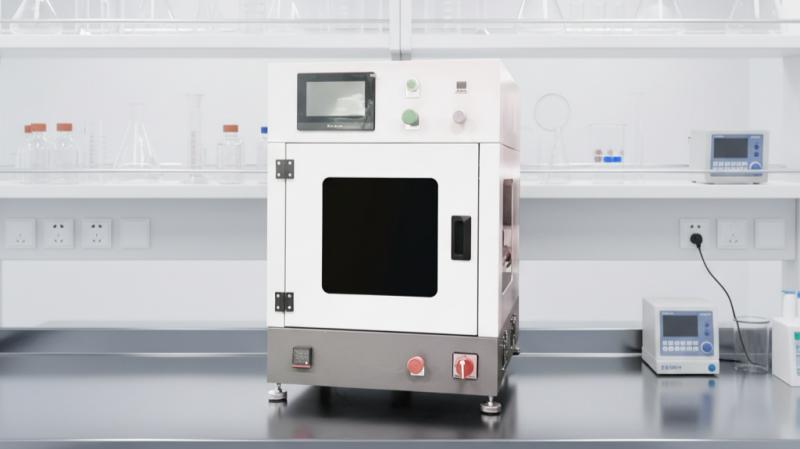
Ultrasonic Spraying EMI Shielding
As electronic systems keep shrinking and operating at higher frequencies, electromagnetic interference (EMI) becomes a growing challenge for modern microelectronics. Component‑level and package‑level shielding is urgently required to isolate signal crosstalk, protect sensitive chips, and maintain system stability. Ultrasonic spraying emerges as a competitive thin‑film deposition technology to manufacture high‑performance EMI shielding conductive coatings, offering a practical alternative to sputtering, electroplating and traditional pressure spraying.
Ultrasonic atomization relies on high‑frequency mechanical vibration to break conductive inks into fine, low‑velocity micro‑droplets. Silver‑based, copper‑based or carbon‑nanomaterial conductive suspensions are delivered by precision metering pumps, then atomized without high‑pressure orifice forcing. Gentle carrier gas guides droplets onto complex‑shaped substrates, including IC packages, PCB surfaces and plastic enclosures. After low‑temperature curing, a continuous conformal conductive network forms for electromagnetic shielding, working by reflecting incident electromagnetic waves and absorbing partial wave energy into heat dissipation.
This process brings obvious technical strengths for EMI shielding production. First, outstanding coating uniformity: droplet size distribution stays narrow, enabling film thickness precisely tuned from sub‑micron to several micrometres with thickness deviation below ±5%. It avoids pinholes, streaks and edge overflow defects common in conventional spraying, and conforms well to side walls and uneven 3D surfaces of micro‑components. Second, high material utilization. Minimal splash and rebound raise material efficiency above 85%, greatly cutting consumption of high‑cost silver or copper conductive ink compared with air‑spray solutions. Unlike vacuum sputtering, ultrasonic spraying needs lower capital investment and energy consumption for mass manufacturing. Third, broad material compatibility. The ultrasonic nozzle produces natural de‑agglomeration effects, restraining nanoparticle aggregation in suspensions. It adapts to diverse conductive slurries with different viscosity ranges, supporting flexible polymer substrates without mechanical damage from high‑impact atomization.
Nevertheless, proper parameter matching is essential. Operators need to optimize ultrasonic power, liquid feed rate, nozzle travel speed and carrier gas flow according to ink formula and target shielding effectiveness. Curing conditions must be strictly controlled to guarantee conductivity and substrate adhesion.
Ultrasonic sprayed EMI shielding coatings are widely adopted in semiconductor packaging, consumer electronics, automotive electronics and communication modules. It bridges laboratory research and large‑volume inline production. As electronic miniaturization advances, ultrasonic spraying will keep expanding its role in cost‑effective, high‑quality EMI shielding thin‑film fabrication for next‑generation electronic hardware.
About Cheersonic
Cheersonic is the leading developer and manufacturer of ultrasonic coating systems for applying precise, thin film coatings to protect, strengthen or smooth surfaces on parts and components for the microelectronics/electronics, alternative energy, medical and industrial markets, including specialized glass applications in construction and automotive.
The Company’s solutions are environmentally-friendly, efficient and highly reliable, and enable dramatic reductions in overspray, savings in raw material, water and energy usage and provide improved process repeatability, transfer efficiency, high uniformity and reduced emissions.
Cheersonic’s growth strategy is focused on leveraging its innovative technologies, proprietary know-how, unique talent and experience, and global reach to further develop thin film coating technologies that enable better outcomes for its customers’ products and processes. For further information, visit https://cheersonic-liquid.com/.
