
Design of Alkaline Electrolysis Hydrogen Production System
At present, the main technological routes for hydrogen production through electrolysis of water include alkaline water electrolysis (AWE), proton exchange membrane water electrolysis (PEMWE), solid oxide electrolysis cell (SOEC), and anion exchange membrane water electrolysis (AEMWE). Among numerous technologies, alkaline electrolyzed water technology has become the mainstream technology route in the field of large-scale hydrogen production due to its high maturity, relatively simple system structure, safe and stable operation, and low manufacturing cost, and has achieved large-scale production and application. This article will deeply analyze the process characteristics of alkaline electrolysis of water for hydrogen production, and focus on the calculation and research of energy balance during its operation, aiming to provide theoretical basis and practical reference for the design selection and operation optimization of related systems.
Overview and process flow of alkaline electrolysis water hydrogen production system
The alkaline electrolysis water hydrogen production system is a complex engineering integrated system, whose core components mainly include: electrolytic cell unit, gas-liquid separation and hydrogen purification processing unit, necessary auxiliary equipment (such as circulation pump, cooler, etc.), and power supply and control system. Among them, the electrolytic cell is the core of the entire system, which uses alkaline electrolyte (typically a certain concentration of potassium hydroxide solution) as the medium for conducting ions. Under the action of direct current, electrochemical reactions occur inside the electrolytic cell, decomposing water molecules into hydrogen gas (precipitated at the cathode) and oxygen gas (precipitated at the anode).

Detailed explanation of process flow:
1. Electrolytic reaction: In the electrolytic cell, direct current promotes the decomposition of water molecules dissolved in alkaline electrolyte, generating hydrogen and oxygen gas.
2. Preliminary gas-liquid separation: The generated hydrogen, oxygen, and entrained electrolyte mixture are respectively transported to specialized hydrogen and oxygen separators for preliminary gas-liquid separation.
3. Gas scrubbing and cooling dehumidification: After initial separation, hydrogen and oxygen enter the hydrogen scrubber and oxygen scrubber respectively, and further remove residual trace alkali mist in the gas through water washing and other methods. Subsequently, the gas flows through a hydrogen cooler and an oxygen cooler for cooling, while condensing and removing most of the water vapor, thereby obtaining hydrogen and oxygen with a certain purity.
4. Electrolyte circulation and replenishment: The electrolyte discharged from the bottom of the gas-liquid separator is driven by the alkaline solution circulation pump, first cooled by a cooler, then filtered to remove impurities, and finally transported back to the electrolytic cell to participate in continuous electrolytic reactions.
5. Automatic water replenishment: The water replenishment device in the system will automatically replenish pure water to the system (usually to the scrubber or circulation system) according to the liquid level changes in the gas-liquid separator.
6. Hydrogen refining (optional): If higher purity is required for hydrogen, further deoxygenation devices and deep drying equipment can be added to remove residual oxygen and deeply remove moisture, obtaining high-purity hydrogen that meets specific application requirements. If the separated oxygen is not utilized, it is usually directly discharged into the atmosphere.
Technical advantages and core system design
The alkaline electrolysis water technology, with its core advantages of maturity and reliability, relatively simple system structure, safe and stable operation, and low comprehensive cost, has firmly taken the leading position in the current large-scale industrial hydrogen production technology. The core content of its system engineering design includes key links such as energy balance calculation (evaluating system energy consumption and thermal management) and material balance calculation (ensuring accurate matching of reactant and product flow rates). This study is based on the typical process characteristics of alkaline electrolysis hydrogen production, and selects a representative system (with a designed hydrogen production capacity of 1000 cubic meters per hour) for in-depth analysis, aiming to provide valuable reference for the design optimization and energy consumption reduction of similar systems.
Energy consumption optimization critical path
In practical engineering design, the specifications of electrolytic cells need to be accurately calculated and selected based on the target hydrogen production rate. Reducing the overall energy consumption of the hydrogen production process through electrolysis of water is the core of improving economy, which can be mainly achieved through the following two technological paths:
1. Reduce unit electrolysis voltage: By optimizing electrode materials, catalyst activity, electrolytic cell structure design, and improving electrolyte conductivity, the minimum voltage required for electrolysis reaction (i.e. cell voltage) can be effectively reduced, thereby directly reducing the energy consumption per unit hydrogen production.
2. Implement heat recovery and utilization: The electrolysis process generates heat, especially during the electrolyte circulation process. By designing an efficient heat recovery system (such as using a heat exchanger), this waste heat that was originally carried away or lost to the environment by the cooling water can be recovered for preheating the electrolyte or makeup water entering the electrolytic cell, thereby reducing the system’s demand for external heat energy and indirectly reducing overall energy consumption (such as reducing the energy required for electrolyte cooling or reducing heating demand). This energy cascade utilization method is of great significance for improving system energy efficiency.
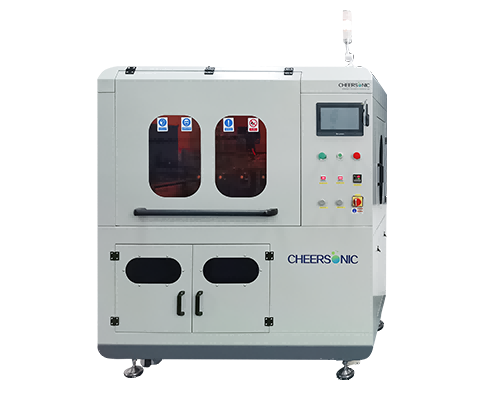
Cheersonic’s fuel cell catalyst coating system can prepare highly uniform, repeatable, and durable coatings, making it highly adaptable to such difficult application scenarios. From the research and development stage to the mass production stage, its anti clogging technology can accurately control the coating properties, significantly reduce material consumption, and lower maintenance costs and downtime.
In fuel cells and electrolysis processes, the Cheersonic ultrasonic spraying system can apply highly durable and uniform carbon based catalyst ink coatings to proton exchange membrane (PEM) electrolyzers such as perfluorosulfonic acid resin membranes (Nafion) without causing membrane deformation. A uniform catalyst coating can be deposited on the surfaces of proton exchange membrane fuel cells, gas diffusion layers (GDLs), electrodes, various electrolyte membranes, and solid oxide fuel cells. The suspension used includes carbon black ink, polytetrafluoroethylene (PTFE) binder, ceramic slurry, platinum, and other precious metals.
In addition, ultrasonic spraying technology can also be used to spray metal oxide suspensions containing platinum, nickel, iridium, ruthenium based and other metal alloys, in order to manufacture proton exchange membrane fuel cells, polymer electrolyte membrane (PEM) electrolyzers, direct methanol fuel cells (DMFCs) and solid oxide fuel cells (SOFCs), thereby achieving maximum load and high battery efficiency. Many large fuel cell manufacturers around the world are using ultrasonic nozzles to spray a uniform layer of catalyst ink film. The catalyst solution will not cause blockage of the ultrasonic nozzle, thus forming a uniform and homogeneous fuel cell catalyst coating, and precise control of droplet size can be achieved within the flow range from ultra-low flow to production scale. In addition, the Cheersonic ultrasonic nozzle is highly suitable for spraying polymer solutions such as polytetrafluoroethylene onto the gas diffusion layer to enhance the hydrophilic or hydrophobic properties during the electrolysis process.
About Cheersonic
Cheersonic is the leading developer and manufacturer of ultrasonic coating systems for applying precise, thin film coatings to protect, strengthen or smooth surfaces on parts and components for the microelectronics/electronics, alternative energy, medical and industrial markets, including specialized glass applications in construction and automotive.
Our coating solutions are environmentally-friendly, efficient and highly reliable, and enable dramatic reductions in overspray, savings in raw material, water and energy usage and provide improved process repeatability, transfer efficiency, high uniformity and reduced emissions.
Chinese Website: Cheersonic Provides Professional Coating Solutions
