
A Cost-Effective Alternative for Thin-Film Deposition
In today’s manufacturing landscape of photovoltaic technologies and advanced electronic devices, the performance and cost of thin-film deposition processes directly determine the market competitiveness of final products. Traditional vacuum deposition technologies represented by sputtering have long been widely used to fabricate functional layers for various thin-film solar cells, such as metal electrodes, transparent conductive oxides, and partial absorption layers. However, such vacuum-based equipment is inherently costly and typically operates in a batch mode, which not only limits productivity improvement but also lacks flexibility when adapting to emerging material systems (e.g., perovskites, organic semiconductors, or novel composites). To address these challenges, ultrasonic spray coating is emerging as a highly cost-effective alternative or complementary solution for large-scale production. It demonstrates distinct advantages especially for solution-processed functional layers—in particular, perovskite active layers and multilayer structures composed of mixed materials.
Limitations of Conventional Vacuum Deposition and the Need for Process Transition
First, it is critical to understand why the industry is actively seeking alternatives to vacuum deposition. Sputtering or chemical vapor deposition (CVD) equipment requires ultra-high vacuum levels, entailing expensive vacuum chambers, sophisticated pumping systems, energy-intensive operation and maintenance, and cleanroom environments. Such equipment not only demands an initial investment of tens of millions of yuan but also involves repetitive steps before and after each batch—including evacuation, venting, and chamber cleaning—resulting in discontinuous batch-based production. For teams engaged in R&D or small-scale production that require frequent adjustments to process parameters, target materials, or precursor formulations, the high inertia of vacuum equipment significantly prolongs experimental cycles. For instance, when developing next-generation perovskite materials, changes in composition ratios or solvent systems are often necessary, yet replacing targets or gas sources in vacuum equipment can take several days, directly hindering the efficient transition from laboratory R&D to pilot-line production.
Technical Principle and Cost Advantages of Ultrasonic Spray Coating
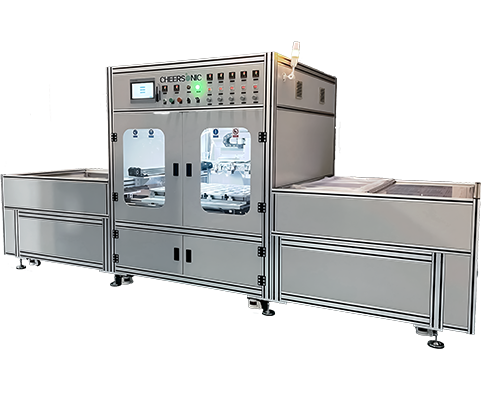
In contrast, ultrasonic spray coating relies on a completely different physical mechanism. This technology uses high-frequency ultrasonic vibration to atomize solution precursors into micro-scale or even submicron droplets, which are then uniformly delivered by carrier gas onto a heated substrate surface. The solvent evaporates rapidly, forming a dense solid thin film. Since the entire process is carried out under atmospheric pressure or near-atmospheric inert atmosphere, expensive vacuum systems are completely eliminated, reducing equipment investment costs by more than an order of magnitude. Meanwhile, ultrasonic spray enables continuous in-line production: substrates pass continuously through the spray station in roll-to-roll or linear transport mode, with film deposition proceeding without waiting for vacuum pumping or venting. This converts production tempo from “minutes per batch” to “meters per minute” continuous flow. Such continuity not only greatly improves output per unit time but also eliminates quality variations caused by fluctuations in vacuum conditions between batches.
Higher Material Utilization and Reduced Cost-per-Watt
Ultrasonic spray also excels in material utilization efficiency. During sputtering, target atoms are bombarded by high-energy ions, but only a portion deposits toward the substrate, while the rest strikes chamber walls or shields, resulting in typical material utilization of only 30%–50%. In ultrasonic spray, nearly all droplets are guided by gas flow to the effective area of the substrate. With precise spray path design, material utilization can exceed 90%. For perovskite layers using expensive precursors such as certain rare metal salts or organic ligands, this efficiency improvement directly translates into a significant reduction in manufacturing cost per watt. Furthermore, ultrasonic spray accommodates very dilute solutions or high-viscosity inks, without imposing extremely strict requirements on target purity, density, or gas purity as in vacuum processes, further lowering raw material barriers and supply chain costs.
Rapid Formula Adjustment and Seamless R&D-to-Production Transition
One of the most attractive advantages for R&D engineers is the process flexibility of ultrasonic spray. When exploring new perovskite compositions, solvent systems, or additives, only the spray solution needs to be changed, and a few parameters adjusted—including ultrasonic power, liquid flow rate, carrier gas flow, and substrate temperature. Formula switching and new deposition trials can typically be completed within minutes. This is a stark contrast to the lengthy process of vacuum sputtering, which requires chamber opening, target replacement, and re-evacuation. As a result, many startups and research teams use ultrasonic spray in the laboratory for rapid material screening, then directly scale the same process to pilot lines and even mass production. The hydrodynamics and mass transfer of ultrasonic spray exhibit excellent linear scalability across different nozzle widths and substrate sizes. This rapid transfer capability from R&D to production greatly shortens the commercialization cycle of new solar cell technologies.
Typical Applications in Perovskite and Tandem Solar Cells
In thin-film photovoltaics, perovskite active layers are highly sensitive to solvents, heat, and humidity. Conventional sputtering often causes ion bombardment damage or thermal stress, whereas ultrasonic spray is a soft deposition method: droplets contact the surface gently without damaging underlying structures. It has been validated that ultrasonic spray produces uniform, well-crystallized films when fabricating hole transport layers, perovskite intrinsic layers, and electron transport layers in regular or inverted perovskite cells. For more complex perovskite/silicon tandem cells or all-perovskite tandems, conformal coverage of multiple dissimilar materials on large-area textured or rough surfaces is required. Thanks to its non-line-of-sight deposition (droplets can flow around surfaces with gas) and superior step coverage, ultrasonic spray becomes an ideal process difficult to replace with vacuum sputtering. Many manufacturers now use sputtering for metal or transparent electrodes, while applying ultrasonic spray to perovskite light-absorbing layers and some interface modification layers, forming a “vacuum + non-vacuum” hybrid process route. This retains the high-quality electrode advantages of traditional technology while gaining the benefits of low-cost, continuous active-layer fabrication.
Summary and Outlook
In summary, ultrasonic spray coating is not intended to fully replace all vacuum deposition processes. Instead, it provides a highly cost-effective, continuously manufacturable, high material-utilization, and extremely flexible alternative or complementary solution for solution-processable functional layers—especially perovskite and multi-junction tandem structures. The key reasons for manufacturers to adopt this technology can be summarized in four points:
- Significantly lower equipment investment and operating costs compared to sputtering or CVD;
- Supports in-line continuous processing, free from the inefficiency of vacuum batch cycles;
- High precursor utilization, effectively reducing cost-per-watt;
- Convenient formula adjustment, with R&D parameters directly transferable to production, greatly accelerating the industrialization of new photovoltaic technologies.
As perovskite solar cells move toward gigawatt-scale production, ultrasonic spray is expected to become one of the core deposition methods, driving clean energy manufacturing toward a more economical, efficient, and flexible future.
About Cheersonic
Cheersonic is the leading developer and manufacturer of ultrasonic coating systems for applying precise, thin film coatings to protect, strengthen or smooth surfaces on parts and components for the microelectronics/electronics, alternative energy, medical and industrial markets, including specialized glass applications in construction and automotive.
Our coating solutions are environmentally-friendly, efficient and highly reliable, and enable dramatic reductions in overspray, savings in raw material, water and energy usage and provide improved process repeatability, transfer efficiency, high uniformity and reduced emissions.
Chinese Website: Cheersonic Provides Professional Coating Solutions
