
Development of Anti-Reflective Optical Coatings for PV Panels
Ultrasonic Atomization Coating Technology: Development of Anti-Reflective Optical Coatings for PV Panels
Against the backdrop of the global pursuit of clean energy and sustainable development, photovoltaic power generation technology is evolving at an unprecedented pace. Improving the photoelectric conversion efficiency of solar panels has always been a core focus for both scientific research and industry. In addition to optimizing the materials and structures of the cells themselves, a critical challenge lies in enabling more incident light to effectively reach the cell surface and be converted into electricity.
It is in this aspect that a thin-film deposition technology based on the ultrasonic atomization principle, combined with high-performance anti-reflective coating solutions, demonstrates enormous application potential. This article systematically explains how this technology significantly enhances the light-harvesting capability and overall efficiency of photovoltaic panels through the precision coating of specific optical functional layers.
First, this advanced coating preparation method uses high-frequency acoustic vibration to generate micron-scale droplets, thereby forming uniform, dense, and highly controllable thin films. Compared with traditional spraying or spin-coating processes, this technology achieves large-area, high-uniformity coating coverage with extremely low material consumption, making it particularly suitable for the mass production of flat photovoltaic modules.
Its core advantage is that by precisely adjusting atomization parameters and solution delivery rates, ultra-thin layers with thicknesses ranging from tens to hundreds of nanometers can be deposited on glass cover plates or cell surfaces. Such precise control not only eliminates material waste but also ensures the consistency and repeatability of the optical interface, laying a solid foundation for the full performance of the anti-reflective function.
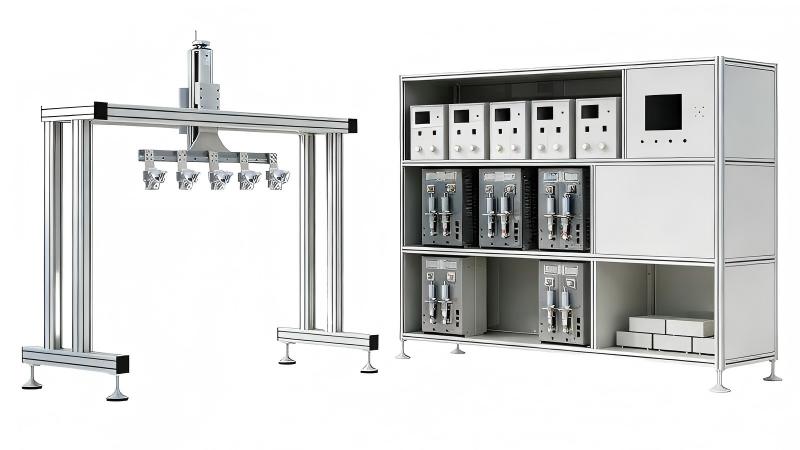
Secondly, in terms of material systems, current high-efficiency anti-reflection coatings mainly rely on specific metal oxides or composite dielectric materials. Among them, two typical materials represented by silicon-based oxides and titanium-based oxides are widely used in the design of multilayer film structures due to their excellent optical transparency, suitable refractive index, and good environmental stability. By alternately stacking materials with different refractive indices—such as low-refractive-index silicon oxide and high-refractive-index titanium oxide—engineers can construct an interference film system with a gradient refractive index. This structure can effectively reduce Fresnel reflection losses at the air-glass interface in the visible and near-infrared bands, allowing light that would otherwise be reflected back into the environment to be successfully transmitted into the solar cell.
In addition, for cells with different spectral response characteristics, anti-reflection coating formulations containing other functional components can be flexibly formulated. For example, trace impurities can be incorporated to adjust the absorption edge, or hydrophobic and self-cleaning groups can be introduced to extend the service life of the coating in outdoor environments.
Furthermore, these carefully designed optical functional layers are not limited to a single anti-reflection function. In fact, a complete light management scheme often needs to balance multiple objectives:
First, the most direct is to maximize the transmittance of incident light. Typically, within the operating wavelength range of 400 to 1100 nanometers, high-quality coatings can reduce the average reflectance from more than 4% for bare glass to below 1%. This means that previously wasted light energy can now contribute to the generation of photogenerated carriers.
Second, by adjusting the thickness and refractive index of each sublayer, the film system can also perform a “light-trapping” function—that is, bending light obliquely incident on the panel at a certain angle, thereby extending its propagation path inside the cell and increasing the probability of absorption.
Third, some advanced formulations can also provide surface passivation or anti-fouling effects, reducing shading losses caused by dust adhesion and slowing down chemical corrosion on the glass surface.
The combination of these effects ultimately results in a significant improvement in the actual output power of photovoltaic modules.
Finally, from the perspective of practical industrial application effects, after adopting the above-mentioned ultrasonic-assisted deposition process combined with multi-material composite film systems, the short-circuit current density of various crystalline silicon and thin-film solar cells can usually achieve a gain of 2% to 5%, corresponding to an overall efficiency improvement of 1 to 3 percentage points (relative value) for the module.
Especially under high-scattering light conditions such as dawn/dusk or rainy weather, the excellent wide-angle anti-reflection performance plays a prominent role, effectively extending the effective power generation duration throughout the day. In addition, since the process can operate continuously under ambient temperature and pressure, with a very high coating solution utilization rate (up to more than 95%), and avoids the high-energy consumption equipment required for traditional methods such as vacuum coating, it has significant cost and productivity advantages in large-scale production.
As the era of grid-parity photovoltaic power generation deepens, such cost-effective and high-precision light management coating technologies will surely become one of the key links in enhancing panel competitiveness.
In summary, the precision spraying method based on the principle of ultrasonic atomization, combined with a multilayer anti-reflection film system represented by silicon-based and titanium-based oxides, provides an efficient, economical, and scalable optical anti-reflection solution for photovoltaic modules.
Through multi-layer interference design, this optical functional layer effectively suppresses surface reflection, enhances light-harvesting capability, and integrates additional functions such as light trapping and self-cleaning, thereby comprehensively improving the power generation efficiency and long-term reliability of solar panels.
In the future, with the further integration of the Materials Genome Initiative and intelligent process control, we have reason to believe that such technologies will continue to drive the photovoltaic industry toward higher energy efficiency and lower costs.
About Cheersonic
Cheersonic is the leading developer and manufacturer of ultrasonic coating systems for applying precise, thin film coatings to protect, strengthen or smooth surfaces on parts and components for the microelectronics/electronics, alternative energy, medical and industrial markets, including specialized glass applications in construction and automotive.
Our coating solutions are environmentally-friendly, efficient and highly reliable, and enable dramatic reductions in overspray, savings in raw material, water and energy usage and provide improved process repeatability, transfer efficiency, high uniformity and reduced emissions.
Chinese Website: Cheersonic Provides Professional Coating Solutions