
How Do CGM Biosensors Work?
How Do CGM Biosensors Work? From Enzymatic Reactions and Electrochemical Signals to Sensor Lifetime
Continuous glucose monitoring (CGM) is becoming an important technology in diabetes management. Unlike conventional intermittent blood glucose testing, CGM continuously or periodically collects glucose-related signals from interstitial fluid, helping users observe glucose trends and identify hyperglycemia, hypoglycemia, and post-meal fluctuations.
For sensor developers, however, the central research question goes beyond how to measure glucose: How can a miniature, flexible sensor consistently deliver stable, interpretable, and calibratable signals during extended operation?
Understanding this challenge requires examining biological recognition layers, electrochemical transduction, mass transport, and long-term sensor stability.
1. What Does a CGM Sensor Measure?
Many common CGM systems use a sensor placed in subcutaneous tissue to detect glucose-related information in interstitial fluid. Interstitial glucose is related to blood glucose, but the two are not perfectly synchronized under all conditions.
The movement of glucose from blood into interstitial fluid, local physiological conditions, sensor response time, and algorithmic processing can all influence the relationship between sensor readings and changes in blood glucose.
CGM readings therefore do not result from simply “counting” glucose molecules. They are derived through sensing, signal processing, calibration, and algorithmic conversion to provide information that can be used to monitor glucose changes.
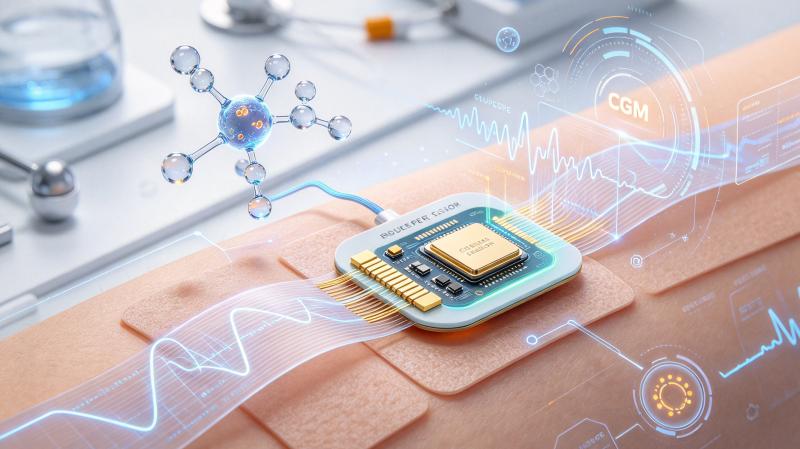
2. How Common Enzyme-Based Electrochemical Sensors Work
2.1 Biological Recognition: Glucose Oxidase
In sensors that use glucose oxidase (GOx), the enzyme catalyzes a reaction involving glucose. In the classical reaction pathway, glucose oxidation involves oxygen and can produce hydrogen peroxide.
Different sensor designs may use different electrode materials and signal transduction methods. Some detect relevant reaction products, while others generate measurable signals through specific electron-transfer systems.
It should therefore not be assumed that all CGM sensors use exactly the same enzyme, electrode, or reaction pathway.
2.2 Electrochemical Transduction: From Reaction to Electrical Signal
When the target reaction occurs, the electrode system converts the associated chemical changes into an electrical current or another electrochemical signal. Following appropriate signal processing, the device uses the sensor’s calibration relationship and algorithms to produce a glucose reading.
Several factors influence this process:
- Enzyme catalytic activity;
- Glucose diffusion into the reaction region;
- Effective reactive area and condition of the electrode;
- Membrane selectivity and mass-transport properties;
- Temperature, local conditions, and interfering substances;
- Electronics, calibration, and algorithm performance.
The sensor’s overall performance is therefore the combined result of multiple subsystems and cannot be assessed using a single material property.
3. Why Do Enzyme-Based Electrochemical Sensors Exhibit Signal Drift?
Signal drift generally refers to a change in sensor output over time when the target concentration and test conditions are comparable.
For enzyme-based electrochemical sensors, several factors may contribute.
3.1 Changes in Enzyme Activity
Temperature, the local chemical environment, immobilization methods, storage, and prolonged operating conditions can affect the enzyme, causing its catalytic capacity to change over time.
However, declining enzyme activity does not mean that the enzyme has been “used up.” An enzyme is a catalyst, not a substrate that is simply consumed in the reaction in the same way as glucose. In practice, enzymes may become inactive, undergo structural changes, leach out, or be affected by environmental conditions.
3.2 Changes in Sensor Membranes
Swelling, changes in adhesion or microstructure, and localized damage to sensing or protective layers may alter how glucose reaches the reaction region. These changes may also affect signal transmission.
In a multilayer structure, changes in one layer can influence the entire system, rather than only that layer’s individual performance.
3.3 Changes at the Biological Interface and in the Local Tissue Environment
For transcutaneous or implantable sensors, tissue responses, local mass transport, and interfacial conditions around the sensor may change over time. These factors can affect glucose access to the sensing region and alter the local sensing environment.
Stable performance in vitro therefore does not automatically imply equivalent long-term performance in vivo.
3.4 Effects of the Electrode and Signal Processing System
Electrode condition, electronics, calibration strategies, temperature compensation, and algorithmic processing can also influence readings. When analyzing signal drift, the contributions of biological materials, membranes, electrodes, and electronics should be distinguished as far as possible.
4. Why Do Many CGM Sensors Have a Specified Wear Duration?
The labeled wear duration varies among CGM products and depends on product design, validation data, regulatory requirements, and instructions for use.
Wear duration cannot simply be explained as “the enzyme being consumed within a specified number of days.” In practice, sensor design generally requires consideration of:
- Whether acceptable measurement performance can be maintained throughout the specified wear period;
- Whether sensitivity and signal drift remain within acceptable limits;
- Long-term stability of the enzyme layer and other functional layers;
- Changes at the sensor–tissue interface;
- Product reliability, safety, and clinical validation results;
- Operating conditions, calibration strategies, and product design limitations.
Consequently, even if a new coating process improves initial enzyme layer uniformity, this does not establish that it will extend CGM sensor wear duration.
Demonstrating an improvement in wear duration requires appropriate long-term performance testing of the complete sensor structure, together with the relevant safety and product validation requirements.
5. What Sensing Layer Questions Are Worth Investigating?
Sensor systems involve many interconnected elements, and materials and coating processes are important areas for systematic optimization.
Research Direction 1: The Relationship Between Enzyme Loading and Electrochemical Response
Enzyme loading affects the amount of enzyme available to participate in reactions within the sensing region. However, increasing enzyme loading does not necessarily produce a proportional increase in signal.
By keeping other conditions as consistent as possible, development teams can compare enzyme activity, response magnitude, response time, and repeatability across samples with different enzyme loadings to determine whether enzyme quantity is a limiting factor in the current system.
Research Direction 2: Coating Uniformity and Consistency Across Sensing Sites
For flexible substrates with multiple sensing regions or fine patterns, local coating variations may contribute to differences in initial performance.
Measuring film thickness, enzyme loading, and electrochemical response at different sites can help establish whether these metrics are correlated.
Uniformity metrics must be clearly defined. The coefficient of variation (CV) of film thickness, enzyme loading, and electrochemical response represents three different metrics that cannot be used interchangeably.
Research Direction 3: Balancing Enzyme Immobilization and Membrane Mass Transport
Immobilization affects more than whether the enzyme remains in the target location. It can also alter the enzyme’s microenvironment, substrate diffusion, and effective catalytic capacity.
Different matrices, immobilization conditions, or functional membrane structures can be compared by measuring enzyme activity, glucose response, and long-term stability under the same test conditions.
Research Direction 4: The Effect of Fabrication Processes on Long-Term Stability
If the objective is to extend stable operating time, comparing results immediately after spraying is insufficient. Enzyme activity, response sensitivity, drift, and failures should be tracked over time under clearly defined storage or operating conditions, with appropriate control groups.
This approach helps determine whether improvements arise from the coating process, material formulation, immobilization method, or other factors.
6. The Potential Role of Ultrasonic Spray Coating in Biosensor Development
Ultrasonic spray coating uses vibration to generate fine droplets and deposit liquid onto designated regions. For enzyme layer development on flexible PET films, this method can be used to investigate localized deposition, coating uniformity, and process repeatability.
Compared with certain methods that rely on high-pressure gas atomization, ultrasonic atomization can reduce dependence on high-pressure atomizing gas. Whether it better preserves the activity of a particular enzyme solution, however, must be established through comparisons using the actual formulation and process conditions.
Development work should focus on evaluating:
- Enzyme activity retention after spraying;
- Wetting on PET surfaces and coating continuity;
- Differences in enzyme loading and film thickness across sensing sites;
- Initial electrochemical response and repeatability;
- Changes in sensitivity and signal drift during long-term testing;
- Compatibility of the coating process with immobilization, protective layers, and subsequent assembly steps.
For continuous flexible-film manufacturing, further investigation is needed into differences between sheet-based spraying and roll-to-roll processing in material deposition, drying, tension control, and quality traceability.
7. How Can a Controlled Experiment Answer a Scientific Question?
If the research objective is to determine whether ultrasonic spray coating can improve CGM enzyme layer fabrication, the study can be divided into three stages.
Stage 1: Effects of the Process on Enzyme Activity
Compare unsprayed enzyme solution, spray-deposited enzyme layers, and samples prepared using different deposition methods but subjected to the same post-treatment. Material batch, holding time, and storage conditions should be controlled as closely as possible.
The central question is: Do spraying and post-treatment cause measurable changes in enzyme activity?
Stage 2: Coating Quality and Initial Sensing Performance
Using the same type of PET substrate and comparable electrode structures, compare coating coverage, film thickness or enzyme loading, and initial electrochemical response.
The central question is: Are differences in coating quality reproducibly associated with differences in sensing performance?
Stage 3: Long-Term Performance and Failure Analysis
Measure responses over time under specified storage or operating conditions, recording sensitivity, drift, background signals, and other predefined metrics.
The central question is: Do initial process advantages translate into improved long-term performance?
If the ultimate objective is to extend the wear duration of an actual CGM product, further research must be conducted using the complete sensor design within the applicable validation framework. Enzyme activity assays or short-term in vitro responses alone cannot establish that product wear duration can be extended.
8. Frequently Asked Questions
Q1: Does a CGM sensor reach the end of its wear period because its glucose oxidase has been used up?
This is an oversimplification. Glucose oxidase acts as a catalyst and is not simply consumed as it reacts with glucose. Changes in enzyme activity may be one contributing factor, but sensor wear duration also depends on membranes, interfaces, electrodes, system performance, and product validation.
Q2: Can improving enzyme layer uniformity extend sensor lifetime?
Improved uniformity may help reduce local variations in enzyme loading, but it does not automatically extend sensor lifetime. Long-term enzyme activity, membrane stability, signal drift, and the performance of the complete sensor must also be evaluated.
Q3: Can ultrasonic spray coating directly demonstrate that a CGM sensor will last longer?
No. The coating process must first be evaluated for material compatibility, enzyme activity, coating quality, and electrochemical performance. Any change in wear duration also requires long-term performance and relevant safety validation at the complete-product level.
Q4: Should development teams prioritize enzyme activity or coating uniformity?
Both are important, but experiments should be organized around the research hypothesis. If the focus is on initial differences caused by fabrication, both activity and coating quality should be measured. If the focus is on long-term stability, sensor performance must also be tracked over time rather than assessed only in initial samples.
9. Conclusion: Moving Beyond Individual Enzyme Layer Metrics to the Complete Sensing System
A CGM biosensor is a system that combines enzymatic reactions, mass transport, electrochemical transduction, material interfaces, and signal processing. Any individual process improvement must be evaluated within the operating mechanism of the complete sensor.
For researchers, the most valuable approach is to establish clearly defined controlled experiments: first determine whether the process affects enzyme activity and coating quality, then assess whether these changes influence the initial electrochemical response, and finally use long-term testing to determine whether stable operating performance improves.
If you are developing CGM biosensors, flexible PET substrates, or glucose oxidase sensing layers, contact Cheersonic to discuss your material and process requirements and arrange ultrasonic spray-coating trials using your samples.
Email: market2@cheersonic.com
Begin with representative PET substrates and the actual enzyme formulation. Complete process compatibility testing and preliminary performance validation before using the results to decide whether to proceed with larger-scale process development.
