
Why is SOFC Gaining Popularity?
In 2025, the hydrogen energy and fuel cell industry was experiencing a “winter,” a term that couldn’t be ignored—project streamlining and personnel optimization became commonplace, and the market as a whole entered a period of adjustment. However, amidst this bleak landscape, solid oxide fuel cells (SOFCs) defied the trend, not only seeing a continuous rise in market attention but also a significant acceleration in technology implementation. This unique strength is not accidental; more importantly, the rise of SOFCs is not driven by strong external policies but stems from the rigid support of real market demand. In particular, the energy supply contradictions triggered by the explosive growth of artificial intelligence computing power have highlighted the value of SOFCs in distributed power generation.
I. The Surge in AI Computing Power and Lagging Grid Expansion: Rigid Demand Creates a New Track for Distributed Power Generation
The explosive growth of generative artificial intelligence (GenAI) is reshaping the global energy demand structure. Data centers, as the core of computing power, are experiencing energy consumption increases that have exceeded industry expectations. A Goldman Sachs research report released in June 2025 presented alarming figures: by 2030, global electricity consumption related to AI will reach 1500–2000 terawatt-hours (TWh), nearly double Japan’s annual electricity consumption (approximately 900 TWh). In the US alone, leading tech companies have planned to build data centers with a total capacity exceeding 12 gigawatts (GW), equivalent to the power supply capacity of 12 large nuclear power plants to meet the demand.
However, the expansion speed of traditional power grid infrastructure is simply unable to keep up with this explosive growth in electricity demand. In practice, building a new substation requires a complex approval process and construction cycle, averaging 5–7 years; the planning and construction of transmission corridors often stalls due to land disputes, and the grid capacity in many areas is already nearing its limit. Even backup power sources such as gas turbines, intended as emergency solutions, typically require 2–3 years to deploy, completely failing to meet the rigid requirements of tech companies for “rapid power on-time.”

This contradiction between surging demand and lagging supply has created an urgent market need for a completely new energy solution—one that must be rapidly deployable, highly efficient and low-carbon, and capable of continuous 24/7 operation. The technological characteristics of SOFCs perfectly match these needs, opening a historic window for their application. The practice at a supercomputing center confirms this: while traditional gas-fired power plants require 18 months to build, SOFC modules, assembled in a modular fashion, can be installed in just 90 days, successfully meeting the stringent requirement of “production within 6 months.”
II. The Technological Core of SOFCs: The Triple Advantages of Efficiency, Flexibility, and Collaboration
SOFC (Solid Oxide Fuel Cell) is an electrochemical power generation device that operates at high temperatures (typically 700–1000°C). Its core component is a dense ceramic electrolyte (such as yttrium-stabilized zirconia YSZ). This special material can efficiently conduct oxygen ions (O²⁻) at high temperatures, thereby achieving a direct conversion of chemical energy into electrical energy.
1. Clear and Easy-to-Understand Energy Conversion Principle
SOFC power generation requires no combustion; energy conversion is achieved through electrochemical reactions. The entire process forms a closed loop with extremely low losses. Its core reaction mechanism is as follows:
– Cathode reaction: Oxygen (O₂) from the air gains electrons at the cathode, converting into oxygen ions (O²⁻), the reaction being O₂ + 4e⁻ → 2O²⁻;
– Anode reaction: Fuels such as hydrogen (H₂) combine with oxygen ions at the anode, undergoing an oxidation reaction to produce water and release electrons, the reaction being 2H₂ + 2O²⁻ → 2H₂O + 4e⁻;
– Overall reaction: Fuel and oxygen react electrochemically to produce water, simultaneously outputting electrical energy, the overall reaction being 2H₂ + O₂ → 2H₂O.
This combustion-free reaction mode fundamentally reduces energy loss and avoids the pollutant generation common in traditional power generation processes.
2. Core Technological Advantages Directly Addressing Needs
The popularity of SOFCs is not merely hype about technological concepts, but rather a result of their advantages being validated in real-world scenarios. These advantages are primarily reflected in three dimensions: efficiency, fuel adaptability, and energy synergy:
– Ultra-high energy efficiency, balancing power generation and waste heat utilization: Compared to the 30%-40% power generation efficiency of traditional internal combustion engines, SOFCs can achieve direct power generation efficiency exceeding 60%. More importantly, the waste heat generated during its high-temperature operation can be used for heating, steam supply, or driving steam turbines, forming a combined heat and power (CHP) system, with overall energy utilization efficiency even exceeding 90%. This characteristic is particularly valuable in data centers—after introducing SOFCs, one data center saw its Power Usage Effectiveness (PUE) decrease from 1.4 to 1.1, reducing the energy cost per kilowatt-hour of data processed by 21%.
– Flexible fuels, adaptable to diverse energy structures: SOFCs have far greater compatibility than similar technologies. They can not only use hydrogen but also directly utilize various carbon-based fuels such as natural gas, biogas, and methanol. Their high-temperature environment also enables internal reforming of hydrocarbons, eliminating the need for additional complex equipment and significantly reducing dependence on a single fuel. In the current context of an underdeveloped hydrogen supply, this flexibility allows SOFCs to quickly integrate into existing energy systems, accelerating commercialization.
– Rapid Deployment, Matching Emergency and Routine Needs: Compared to the construction cycle of traditional power sources, which often takes several years, the modular design of SOFCs shortens the deployment cycle to less than 3 months. Simultaneously, it starts up quickly—from shutdown to full power operation in just 90 seconds, with operating noise of only 50 decibels (equivalent to normal conversation), making it suitable as a routine supplementary power source for data centers and also as an emergency backup power source for critical locations such as hospitals. After introducing SOFCs, a top-tier hospital in Wuhan was able to ensure the normal operation of its operating rooms even during power outages, and could even undertake additional surgeries.
III. Demand Expansion: From Single Scenario to Comprehensive Penetration of Diverse Markets
The demand from AI data centers is just the starting point for the explosive growth of the SOFC market. With the maturity of the technology, its application scenarios have gradually expanded to multiple fields such as industry, healthcare, and power supply in remote areas. In industrial scenarios, SOFCs can utilize waste heat from factories to generate electricity, forming an energy recycling system; in remote areas, it can achieve stable power supply without relying on the power grid; in the transportation sector, its high efficiency is also beginning to be used in ship auxiliary power systems. This “scenario verification—replication and expansion” model has led to a continuous expansion of market demand for SOFCs. As of October 2025, several industrial parks and leading data centers in China had partnered with SOFC companies, and overseas orders had also achieved a breakthrough from zero to billions of yuan. The rise of SOFCs amidst the hydrogen energy industry’s downturn is not accidental, but rather an inevitable result of the precise match between technological advantages and market demand—it not only solves the current energy supply contradiction but also provides a feasible path for future clean energy transformation.
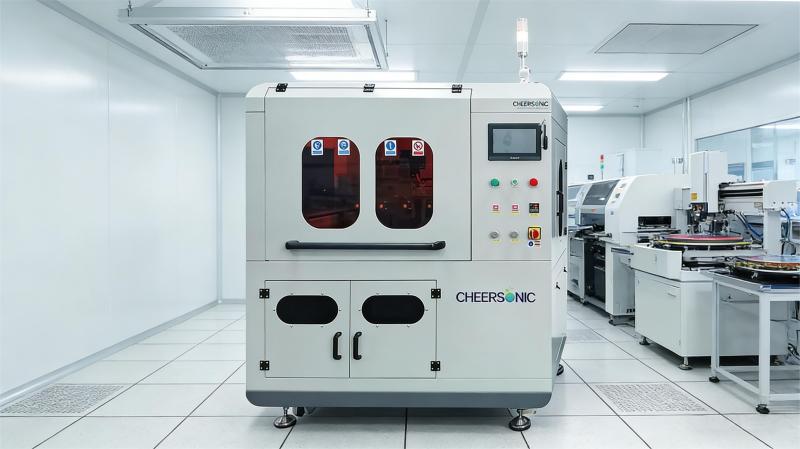
Ultrasonic spraying machines, with their advantages of uniform atomization and dense coating, have become core equipment for the preparation of electrodes and electrolyte layers in solid oxide fuel cells (SOFCs). Their principle is to atomize the slurry into micron-sized droplets through ultrasonic vibration, which, combined with carrier gas, is precisely deposited on the SOFC substrate surface, suitable for typical materials such as Ni-YSZ anodes, LSM cathodes, and YSZ electrolytes.
Precise parameter control is required during spraying: the slurry solid content is typically 5%-20% to balance atomization and coating thickness; the ultrasonic frequency is 20-120kHz to adapt to different particle size requirements; and the spraying distance is 5-15cm to adjust droplet deposition efficiency. This technology reduces the porosity problem of traditional coatings, allowing the electrode layer porosity to be stabilized at 30%-40% and the electrolyte layer density to reach over 95%, thus improving the ion conduction efficiency and long-term stability of SOFCs. It also boasts strong process compatibility, enabling multi-layer continuous spraying and contributing to improved performance consistency in the large-scale preparation of SOFCs.
About Cheersonic
Cheersonic is the leading developer and manufacturer of ultrasonic coating systems for applying precise, thin film coatings to protect, strengthen or smooth surfaces on parts and components for the microelectronics/electronics, alternative energy, medical and industrial markets, including specialized glass applications in construction and automotive.
Our coating solutions are environmentally-friendly, efficient and highly reliable, and enable dramatic reductions in overspray, savings in raw material, water and energy usage and provide improved process repeatability, transfer efficiency, high uniformity and reduced emissions.
Chinese Website: Cheersonic Provides Professional Coating Solutions