
Ultrasonic Spraying of Extremely Low-Loaded Iridium Layers
Ultrasonic Spraying of a Low-Load Iridium Layer onto a Titanium-Based PTL Creates a Multifunctional Interface to Enhance PEMWE Performance
Proton exchange membrane electrolysis (PEMWE) has become a core technology for the large-scale production of green hydrogen due to its advantages such as high hydrogen purity, fast response speed, and adaptability to renewable energy fluctuations. However, its anodic oxygen evolution reaction (OER) kinetics are slow, requiring a noble metal iridium (Ir)-based catalyst. Furthermore, titanium-based porous transport layers (PTLs) are prone to passivation under strong oxidation and high-potential conditions, leading to increased interfacial impedance and performance degradation. The high iridium content also severely restricts cost reduction and efficiency improvement in the industry. Using ultrasonic spraying technology to construct a low-load iridium layer on the surface of a titanium-based PTL, precisely building a multifunctional interface integrating catalysis, conductivity, and corrosion resistance, becomes a key path to overcome the performance and cost bottlenecks of PEMWE.

Titanium-based PTLs, due to their excellent conductivity, high mechanical strength, and resistance to acid corrosion, have become the mainstream mass transfer carrier for PEMWE anodes. However, in high-potential (>1.6 V vs RHE) and strongly oxidizing environments, a non-conductive TiOₓ passivation film spontaneously forms on the titanium surface, significantly increasing the contact resistance between the electrode and the catalyst layer, exacerbating ohmic losses, and reducing energy conversion efficiency. Traditional solutions rely on high-load noble metal (Ir, Pt, etc.) coatings to protect the PTL; commercial devices often have iridium loadings exceeding 1 mg·cm⁻². While this can suppress passivation, resource scarcity and high cost hinder the industrialization of PEMWEs. How to simultaneously reduce interfacial impedance, enhance catalytic activity, and improve structural stability under extremely low iridium loading is a core challenge that the industry urgently needs to overcome.
Ultrasonic spraying technology, with its precise atomization and controllable deposition characteristics, provides an ideal solution for the efficient preparation of extremely low-load iridium layers. This technology uses high-frequency ultrasonic vibration to atomize iridium-based catalyst slurry into micron-sized uniform droplets, which are then non-contactly sprayed onto the surface of a titanium-based PTL. This allows for precise control of coating thickness, microstructure, and iridium loading. Compared to traditional spraying and sputtering processes, ultrasonic spraying effectively avoids problems such as catalyst agglomeration, uneven coating thickness, and substrate pore blockage. Even within an extremely low iridium loading range of 0.025-0.1 mg·cm⁻², a continuous, dense, and uniform ultrathin iridium layer can still be formed. This precision coating method fully exposes iridium atoms at their active sites, increasing catalyst utilization to over 90%, far exceeding the 30%-50% of traditional processes, providing process support for achieving the goal of “low loading, high performance.”
After modifying titanium-based PTLs with an extremely low-load iridium layer, an optimized interface with multiple functions can be constructed, improving the overall performance of PEMWE from multiple dimensions. Firstly, it offers resistance to passivation and improves conductivity: the continuous ultrathin iridium layer isolates the titanium substrate from the strong oxidizing electrolyte, inhibiting the formation of the TiOₓ passivation layer at its source, reducing interfacial contact resistance by more than 60%, and significantly reducing ohmic overpotential. Secondly, it provides auxiliary catalysis: the iridium layer itself possesses excellent OER catalytic activity and can act as an “ultrathin active layer” synergistically with the traditional anode catalyst layer, widening the three-phase interface of the reaction, accelerating water decomposition and oxygen evolution processes, and reducing reaction kinetic overpotential. Thirdly, it optimizes mass transfer: the iridium layer prepared by ultrasonic spraying has a uniform pore structure and moderate surface roughness, ensuring efficient water transport and rapid oxygen desorption while avoiding the increased mass transfer resistance caused by traditional thick coatings, thus improving stability under high current density.
Experimental data confirm that when the iridium loading on the titanium-based PTL surface is only 0.025 mg·cm⁻², the electrode modified by ultrasonic spraying achieves interfacial impedance and battery performance comparable to traditional high-loading (1 mg·cm⁻²) electrodes. At a working voltage of 1.9 V, the electrolytic cell current density can reach over 3 A·cm⁻², and in a constant current stability test of 1 A·cm⁻², it can operate stably for over 300 hours without significant performance degradation. Compared with unmodified titanium-based PTLs, the multifunctional interface reduces the PEMWE cell voltage by 30-50 mV, improves energy conversion efficiency by 5%-8%, and reduces iridium usage by over 40 times, directly reducing catalyst costs by over 70%, achieving a dual breakthrough in performance and economy.
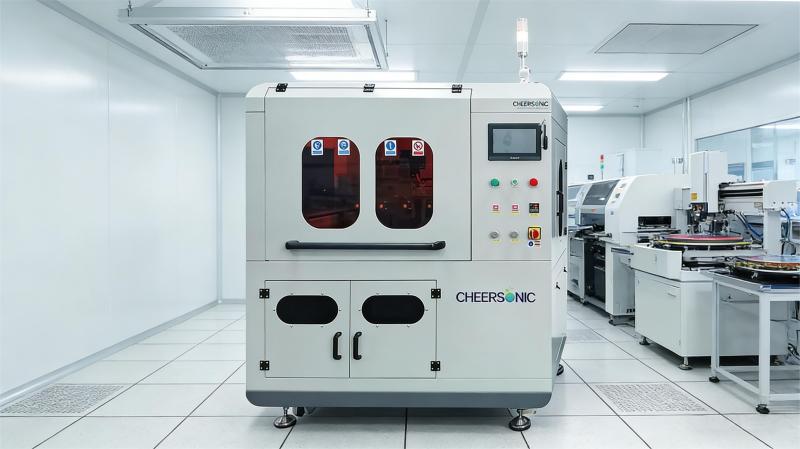
From an industrialization perspective, ultrasonic spraying technology has excellent scalability and can be integrated into roll-to-roll continuous production systems to meet the high-speed, stable coating requirements of wide-width titanium-based PTLs. This process has strong compatibility with slurries, adapting to various solvent systems such as water-based and alcohol-based solvents, and avoids high-pressure airflow impact, preventing deformation of the titanium substrate and film damage, ensuring batch product consistency. With the deep integration of low-iridium catalyst systems and interface engineering technology, the ultrasonic spraying technique for modifying titanium-based PTLs with extremely low iridium loading will further promote the commercial application of PEMWE in green hydrogen production and large-scale energy storage, providing key technological support for global energy transition and the achievement of “dual-carbon” goals.
In the future, research on this technology will focus on three aspects: first, developing iridium-based single-atom, alloyed catalysts to further reduce iridium loading and enhance intrinsic activity; second, optimizing ultrasonic spraying process parameters to precisely control the microstructure and interfacial bonding of the iridium layer; and third, exploring the degradation mechanism of multifunctional interfaces under long-term operating conditions to extend electrode lifespan through interface structure design. Through technological iteration and innovation, continuous breakthroughs will be made in PEMWE performance and cost bottlenecks, helping the green hydrogen industry move towards a new stage of efficient, low-cost, and large-scale development.
About Cheersonic
Cheersonic is the leading developer and manufacturer of ultrasonic coating systems for applying precise, thin film coatings to protect, strengthen or smooth surfaces on parts and components for the microelectronics/electronics, alternative energy, medical and industrial markets, including specialized glass applications in construction and automotive.
Our coating solutions are environmentally-friendly, efficient and highly reliable, and enable dramatic reductions in overspray, savings in raw material, water and energy usage and provide improved process repeatability, transfer efficiency, high uniformity and reduced emissions.