Research on the Application of Ultrasonic Spraying in Ultrathin Adhesive Coating of Separators
With the increasing demands for battery performance from the new energy industry, the precision of the surface coating process for separators, as a key component, directly affects the final performance of the product. Ultrasonic spraying technology, with its unique atomization mechanism and excellent coating uniformity, demonstrates significant advantages in the field of adhesive coating for separator surfaces. This paper systematically describes the entire process of ultrasonic spraying for adhesive application, covering aspects such as adhesive type selection, substrate characteristics, process parameter control, and quality indicators.
Adhesive Type Selection and Adaptation
In separator coating applications, the selection of adhesive type needs to be scientifically screened based on the performance requirements of the sample. Current processes mainly use water-based pressure-sensitive adhesives or PVDE adhesives. Water-based pressure-sensitive adhesives have advantages such as environmental friendliness, operational safety, and a wide range of adjustable bonding performance, making them suitable for scenarios requiring a balance between initial tack and holding power. Their water-based system is highly compatible with the low-temperature atomization characteristics of ultrasonic spraying, effectively avoiding environmental problems caused by solvent evaporation.

PVDE adhesives are known for their excellent chemical resistance and thermal stability, making them particularly suitable for applications requiring high long-term cycling stability of the diaphragm. Both types of adhesives have their strengths, and the actual selection requires comprehensive consideration of the diaphragm material, compatibility with subsequent processes, and the mechanical and electrochemical properties of the final product. Orthogonal experiments should be used to screen for the most suitable adhesive system.
Substrate Specifications and Process Challenges
The substrate used in this process is a diaphragm with a thickness controlled between 10 and 15 micrometers. This ultra-thin thickness places extremely high demands on the spraying process. The diaphragm itself has a porous structure and limited mechanical strength; traditional spraying methods easily cause substrate deformation, perforation, or pore blockage. Ultrasonic spraying technology uses high-frequency vibration to atomize the adhesive into micron-sized droplets. These droplets carry extremely low momentum and can gently deposit on the diaphragm surface, effectively avoiding physical damage to the substrate. Simultaneously, the uniform distribution of the atomized droplets helps to form a continuous and uniform adhesive layer while maintaining the original porous structure of the diaphragm.
On-site Adjustment of Adhesive Viscosity and Solid Content
Adhesive viscosity and solid content are two core process parameters that determine the final dry adhesive thickness. Optimal values must be determined on-site based on actual production conditions. Viscosity directly affects the droplet size distribution and deposition behavior. Excessive viscosity leads to difficulty in atomization and larger droplet sizes, thus affecting the uniformity of the adhesive layer; insufficient viscosity may cause excessive spread of the adhesive or penetration into the membrane pores. On-site adjustment, under preset ultrasonic power and liquid supply rate conditions, finding the viscosity range that achieves optimal atomization and controllable droplet deposition is a prerequisite for achieving the target dry adhesive thickness.
Solid content determines the proportion of effective film-forming substances in the adhesive per unit volume. Given a fixed spray volume, a higher solid content results in a thicker dry adhesive. Since the target dry adhesive thickness is less than 1 micrometer, falling into the category of ultra-thin coating, a lower solid content adhesive system is typically required, coupled with precisely controlled spray volume. During on-site adjustment, closed-loop feedback through multiple test sprays and thickness measurements is necessary to quickly converge to the optimal solid content range.
Dry Adhesive Thickness and Gap Control
Controlling the dry adhesive thickness to below 1 micrometer is one of the technical challenges of this process. Such a thin adhesive layer is extremely sensitive to the stability of the spraying process, environmental cleanliness, and the surface condition of the substrate. Ultrasonic spraying, with its excellent droplet size uniformity and deposition repeatability, can achieve precise control of sub-micrometer thickness deviations over a macroscopic area. In actual production, multiple thin layers can be stacked to avoid sagging or uneven thickness caused by excessive thickness in a single spray.
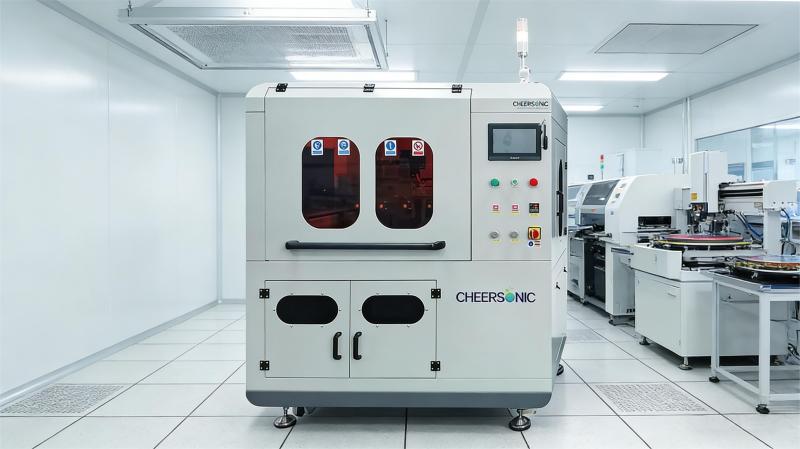
The adhesive gap is set at 10 to 12 micrometers, without strict control. This parameter reflects the periodic characteristics of the adhesive layer distribution on the diaphragm surface. In the ultrasonic spraying process, the deposition pattern of the adhesive on the substrate surface can be controlled by adjusting the nozzle movement speed, spray path overlap rate, and the guiding design of the atomized airflow, forming an adhesive dot or line distribution with certain spacing characteristics. A gap range of 10 to 12 micrometers helps to maintain sufficient ion conduction channels for the diaphragm while ensuring bonding reliability. This indicator is not subject to rigid control, meaning that adjustments can be made appropriately based on the specific performance of downstream processes in actual production, reflecting the flexibility and practicality of process design.
Process Advantages and Application Prospects
In summary, ultrasonic spraying technology exhibits the following core advantages in coating ultra-thin adhesive layers for diaphragms: First, low-damage atomized deposition, perfectly suited for 10-15 micrometer ultra-thin diaphragms; second, excellent coating uniformity, enabling precise control of dry adhesive thickness less than 1 micrometer; third, a wide range of adjustable process parameters, flexibly responding to different adhesive systems and requirements for solid content and viscosity. As coating technology continues to evolve towards higher precision, lower energy consumption, and greener practices, the application prospects of ultrasonic spraying technology in diaphragm modification and the preparation of special adhesive films will be even broader. Future key directions for process optimization include the development of online thickness closed-loop control systems, improving the efficiency of multi-nozzle collaborative operations, and constructing adaptive process models for different adhesive coefficients.
About Cheersonic
Cheersonic is the leading developer and manufacturer of ultrasonic coating systems for applying precise, thin film coatings to protect, strengthen or smooth surfaces on parts and components for the microelectronics/electronics, alternative energy, medical and industrial markets, including specialized glass applications in construction and automotive.
Our coating solutions are environmentally-friendly, efficient and highly reliable, and enable dramatic reductions in overspray, savings in raw material, water and energy usage and provide improved process repeatability, transfer efficiency, high uniformity and reduced emissions.