
Ultrasonic Spraying Equipment Application in LCD PI Process
Application of Ultrasonic Spraying Equipment in the PI Liquid Spraying Process of LCD Screens
In the display technology field, LCD screens, with their mature processes and stable performance, are widely used in various scenarios such as consumer electronics, industrial control, and automotive displays. The production of LCD screens is a precise and complex process system, among which the preparation of the alignment film is one of the key steps affecting the screen’s display effect. This step relies on ultrasonic spraying equipment to accurately spray the PI liquid, combined with substrates of specific specifications, to ensure the core performance of the LCD screen.
As a high-precision coating equipment, the core advantage of ultrasonic spraying equipment lies in achieving fine atomization and uniform deposition of the liquid using ultrasonic vibration technology. Compared with traditional spraying methods, it uses high-frequency ultrasonic vibration to act on the PI liquid (polyimide liquid), causing the liquid to form micron-sized uniform droplets at the nozzle. The droplet particle size distribution is concentrated, avoiding problems such as droplet agglomeration and splashing that are prone to occur in traditional spraying. Meanwhile, the equipment can precisely control parameters such as vibration frequency, spraying pressure, and nozzle movement speed to uniformly cover the substrate surface with PI liquid to a preset thickness. This not only reduces PI liquid waste and lowers production costs but also effectively avoids defects such as pinholes, bubbles, and uneven thickness in the coating, laying the foundation for the subsequent alignment film function.
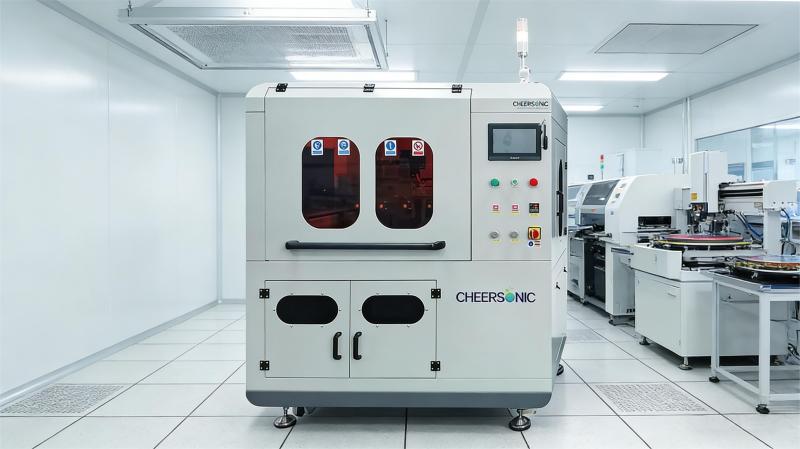
In the manufacturing process of LCD screens, PI liquid spraying plays a crucial role in “establishing the alignment benchmark for liquid crystal molecules.” The display principle of LCD screens utilizes the orientation changes of liquid crystal molecules under the influence of an electric field to control the transmission and blocking of light, thereby presenting an image. The polyimide film (alignment film) formed after PI liquid spraying has a specific micro-groove structure on its surface. This structure guides the liquid crystal molecules to align in a preset direction, ensuring the consistency and stability of the orientation changes of liquid crystal molecules before and after energization. If the alignment film coating is uneven or defective, it will lead to disordered liquid crystal molecule alignment, resulting in problems such as uneven brightness, image retention, and viewing angle deviation on the screen. Therefore, the quality of PI liquid spraying directly determines the display quality of the LCD screen.
The substrate used in this process is a 152mm × 152mm square substrate with a thickness of only 0.3mm. This design perfectly meets the production needs of small and medium-sized LCD screens. In terms of size, the 152mm × 152mm substrate is a typical small-to-medium-sized substrate, meeting the size requirements of display panels for smart wearable devices (such as smartwatches and wristbands), small in-vehicle control screens, and industrial control dashboards. It also allows for the cutting and processing of multiple panels in a single production run—through subsequent cutting and slitting processes, a single 152mm × 152mm substrate can be divided into multiple small-sized display panels suitable for end products, improving production efficiency.
In terms of thickness, the 0.3mm ultra-thin substrate aligns with the current trend of “thinner and lighter” electronic devices. As consumer electronics and industrial equipment increasingly demand smaller footprints and lighter weights, the thickness of LCD screens needs to be reduced accordingly. As the basic supporting component of the LCD screen, the thickness of the substrate directly affects the overall screen thickness. A 0.3mm substrate, while ensuring sufficient mechanical strength (able to withstand external forces during spraying, curing, and cutting processes, and not easily bent or broken), minimizes the overall thickness of the LCD screen, meeting the requirements of thin and light designs in end products.
In actual process applications, the compatibility of ultrasonic spraying equipment with this substrate size requires rigorous calibration. The equipment first precisely fixes the 152mm × 152mm substrate on the worktable using a positioning mechanism, ensuring the substrate does not shift during spraying. Then, based on the thin and light characteristics of the 0.3mm substrate, the suction force of the worktable is adjusted—using vacuum suction, a moderate suction force is used to stably fix the substrate, avoiding excessive suction force that could deform the substrate, or insufficient suction force that could cause the substrate to shift. During the spraying process, the equipment’s nozzles move along a preset path on the substrate surface, precisely controlling the spraying range based on the substrate size to ensure that the PI liquid only covers the effective display area of the substrate. Simultaneously, according to the thickness requirements of the alignment film (typically tens to hundreds of nanometers), parameters such as the number of sprays and nozzle movement speed are adjusted to control the PI liquid coating thickness within the error range.
After spraying, the substrate enters the subsequent curing process—high-temperature baking evaporates the solvent in the PI liquid, forming a stable polyimide film. Then, a friction alignment process is performed to create microscopic grooves on the film surface to guide the alignment of liquid crystal molecules. Throughout the process, the precise spraying of the ultrasonic spraying equipment provides a crucial guarantee for the high-quality formation of the alignment film, while the 152mm × 152mm, 0.3mm thick substrate, with its size and thickness advantages, perfectly meets the production needs of small and medium-sized LCD screens. The synergistic effect of these three elements jointly promotes the stable implementation of LCD display technology in various application scenarios.
About Cheersonic
Cheersonic is the leading developer and manufacturer of ultrasonic coating systems for applying precise, thin film coatings to protect, strengthen or smooth surfaces on parts and components for the microelectronics/electronics, alternative energy, medical and industrial markets, including specialized glass applications in construction and automotive.
Our coating solutions are environmentally-friendly, efficient and highly reliable, and enable dramatic reductions in overspray, savings in raw material, water and energy usage and provide improved process repeatability, transfer efficiency, high uniformity and reduced emissions.
Chinese Website: Cheersonic Provides Professional Coating Solutions
