
Ultrasonic Granulation Analysis
Ultrasonic granulation is a technology that uses ultrasonic energy to disperse liquids or molten materials and form particles. The following is a detailed introduction:
1. Basic Principle:
When ultrasonic waves propagate through a liquid, they create alternating areas of compression and rarefaction, forming an ultrasonic field. Under the influence of the ultrasonic field, the liquid undergoes periodic stretching and compression, generating strong shear forces and cavitation effects.
Shear forces can break up aggregates and large particles in the liquid or molten material into smaller particles. The cavitation effect occurs when tiny bubbles in the liquid rapidly expand and collapse under the influence of ultrasonic waves, generating localized high temperatures, high pressures, and intense shock waves, further promoting liquid dispersion and particle formation.
2. Main Equipment:
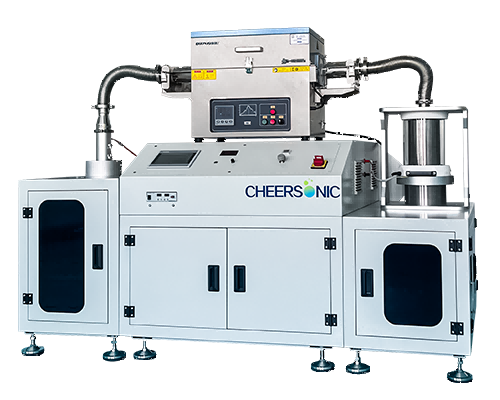
The ultrasonic generator is the core component of the ultrasonic granulation system, responsible for generating high-frequency electrical energy signals and converting them into ultrasonic signals. Its frequency, power, and other parameters can be adjusted to meet different granulation requirements.
The transducer converts the electrical energy generated by the ultrasonic generator into mechanical vibration energy and is typically made of materials such as piezoelectric ceramics. The performance of the transducer directly affects the ultrasonic energy conversion efficiency and granulation results. Atomizer or spray nozzle: Dispenses ultrasonically treated liquid or molten material in the form of tiny particles. Its structure and size affect the size, distribution, and shape of the particles.
Reaction vessel or granulation chamber: Contains the liquid or molten material to be processed and provides a relatively stable granulation environment. The material, shape, and size of the reaction vessel should be selected based on the specific granulation process and material characteristics.
3. Specific Applications:
Metal Powder Preparation: In the preparation of powders of non-ferrous metals such as aluminum, copper, and iron, ultrasonic granulation can break molten metal droplets into fine particles with high sphericity and a narrow particle size distribution, which improves the flowability and formability of the metal powder and can be used in powder metallurgy, 3D printing, and other fields.
Drug Formulation: In the pharmaceutical industry, ultrasonic granulation can be used to prepare drug particles, such as converting drug solutions or suspensions into uniform particles, thereby improving drug stability, solubility, and bioavailability. For example, ultrasonic granulation can improve the solubility of some poorly soluble drugs, facilitating their absorption by the body. Food Processing: In the food industry, ultrasonic granulation can be used to produce granular products for food additives, seasonings, and other applications. For example, substances such as spices and pigments can be made into uniform granules through ultrasonic granulation, facilitating their even dispersion in food, thereby improving food quality and taste.
Ceramic Material Preparation: Ultrasonic granulation can be used to prepare ceramic powders, improving the dispersibility and formability of ceramic particles, thereby enhancing the density and mechanical properties of ceramic materials. For example, ultrasonic granulation is an important powder preparation method in electronic ceramics and structural ceramics.
4. Process Advantages:
Controllable Particle Size: By adjusting parameters such as ultrasonic frequency, power, and treatment time, the particle size and size distribution can be precisely controlled to meet the particle size requirements of different application scenarios.
Regular Particle Shape: Particles produced by ultrasonic granulation typically have a high degree of sphericity and a regular shape, which improves the flowability, filling properties, and bulk density of the particles.
High Production Efficiency: The ultrasonic granulation process is fast and efficient, allowing large quantities of liquid or molten materials to be processed in a short period of time, thereby improving production efficiency. Simple operation and environmental protection: Ultrasonic granulation equipment is simple to operate and easy to control, and does not require the addition of additional chemical reagents and has no pollution to the environment.
About Cheersonic
Cheersonic is the leading developer and manufacturer of ultrasonic coating systems for applying precise, thin film coatings to protect, strengthen or smooth surfaces on parts and components for the microelectronics/electronics, alternative energy, medical and industrial markets, including specialized glass applications in construction and automotive.
Our coating solutions are environmentally-friendly, efficient and highly reliable, and enable dramatic reductions in overspray, savings in raw material, water and energy usage and provide improved process repeatability, transfer efficiency, high uniformity and reduced emissions.
Chinese Website: Cheersonic Provides Professional Coating Solutions
