
Ultrasonic Coating of Precursor Solutions
Process Principle
Ultrasonic coating utilizes high-frequency ultrasonic vibrations (typically 20–120 kHz) to atomize a precursor solution into micron-sized droplets (typically in the 1–50 μm range). These droplets are then directed onto the substrate surface using a carrier gas (e.g., nitrogen, argon, or other inert gases), ultimately depositing them into a uniform thin film. Its core advantages include:
– High-precision uniformity: Narrow droplet size distribution enables film thickness variation to be controlled within ±5%, making it particularly suitable for uniformity-sensitive precursor solutions such as perovskites and transparent conductive oxides (TCOs).
– High material utilization: Precise and targeted deposition of atomized droplets significantly reduces overspray waste, typically achieving precursor utilization rates exceeding 90% (compared to approximately 50% for conventional high-pressure spraying).
– Gentle processing: Ultrasonic energy is gently dispersed, minimizing damage to active components in the solution (e.g., nanoparticles, catalysts, etc.), making it suitable for heat-sensitive or easily agglomerated systems.
Key Operational Steps
1. Preparation and Optimization of Precursor Solutions
– Solution Preparation:
Based on the chemical composition of the target material (e.g., perovskite, metal oxide, conductive polymer, etc.), select an appropriate solvent system (e.g., alcohol, polar organic solvent, etc.) and solute concentration. The precursor must be fully dissolved or dispersed to avoid precipitation or agglomeration.
– Viscosity and Surface Tension Control:
Ultrasonic atomization is sensitive to solution viscosity (typically ≤50 mPa·s) and surface tension. Excessively high viscosity can lead to difficult atomization or nozzle clogging; excessively low viscosity can cause droplet runoff or uneven coating. Solution rheology can be optimized by adjusting the solvent ratio and adding an appropriate amount of dispersant (e.g., Triton X-100) or rheology modifier.
– Solids Content Control:
The slurry solids content must balance atomization efficiency and coating performance. A high solids content (e.g., >15 wt%) can easily lead to a surge in viscosity and nozzle clogging; a low solids content (e.g., <5 wt%) can cause solute migration or agglomeration. The recommended range is 8–12 wt% (for typical systems such as catalysts and electrode materials).
2. Substrate Pretreatment
– Cleaning and Activation:
Substrates (such as glass, silicon wafers, metal current collectors, and carbon materials) must be thoroughly cleaned of oil, dust, and oxides. Common methods include ultrasonic cleaning with organic solvents (ethanol, acetone), rinsing with deionized water, drying with nitrogen, or further plasma treatment to increase surface hydrophilicity and enhance coating adhesion.
3. Ultrasonic Coating Equipment Setup
– Nozzle Parameters:
The nozzle consists of an ultrasonic transducer and atomizing nozzle. The appropriate ultrasonic frequency (40–120 kHz is common) and power must be selected based on the characteristics of the solution. A high frequency (e.g., 120 kHz) helps break up agglomerates and refine droplets. The power must match the solution flow rate and atomization efficiency to avoid excessive cavitation, which can lead to nozzle corrosion or slurry contamination.
– Nozzle Position and Movement:
The distance between the nozzle and the substrate is typically maintained within a range of several centimeters to tens of centimeters (typically approximately ±50 mm). Excessive distance may result in excessive droplet drying or uneven deposition. The nozzle movement speed must be matched to the solution flow rate and atomization rate to ensure uniform coverage (reference velocity formula: V = 0.27 × Q / W, where Q is the flow rate and W is the nozzle width).
– Carrier Gas and Environmental Control:
An inert carrier gas (e.g., nitrogen) is used to guide the droplet deposition and adjust the spray pattern. Air pressure is typically maintained within the range of 0.01–0.2 MPa (approximately 0.1–2 bar). A too low pressure may result in poor droplet diffusion, while a too high pressure may cause splashing or coating defects. Ambient humidity must also be controlled (recommended 45% ± 5%) to minimize electrostatic adsorption and solvent evaporation.
4. Deposition and Drying Processes
– Multi-layer Thin-layer Deposition:
Using multiple thin passes instead of a single thick coating, with each layer dried and then stacked, can significantly improve thickness uniformity and structural density. For example, this strategy is often required for battery electrodes and photovoltaic device thin films to prevent cracking or compositional segregation.
– Gradient Temperature Drying:
The substrate can be preheated to 60–80°C (or higher in conjunction with pyrolysis) to control the solvent evaporation rate in stages. The bottom layer is dried at a lower temperature (to slow cracking), while the middle layer accelerates solvent evaporation and locks in solutes. The surface layer reduces thermal stress shrinkage, preventing cracking or flaking of the coating.
Process Optimization and Troubleshooting
1. Coordinated Parameter Adjustment
– Ultrasonic Frequency and Power: High frequencies (e.g., 120 kHz) are more suitable for dispersing aggregates. Appropriate medium power can reduce agglomeration of precious metal catalysts such as platinum. For low-viscosity solutions, lower frequencies (e.g., 40 kHz) can be used to maintain atomization stability.
– Flow Rate and Speed Matching: The solution flow rate must be strictly matched to the nozzle speed to avoid localized accumulation or missed coatings. Typical flow rates range from 0.1–2 mL/min (laboratory scale) to higher industrial-grade flow rates. An appropriate speed can be calculated using a formula.
2. Defect Prevention and Solutions
– Coffee Ring Effect (Edge Accumulation): This is typically caused by insufficient atomizing air pressure (droplet size > 80 μm) or uneven solvent evaporation. This can be suppressed by increasing the atomizing pressure to 0.8–1.2 bar, optimizing the substrate temperature gradient, or using a surfactant.
– Pinholes or Spattering: Excessive air pressure, too close a nozzle, or low solution viscosity can cause droplet impact and splashing. This requires reducing carrier gas pressure, increasing nozzle spacing, or fine-tuning the solution formulation. Agglomeration or uneven coating: These can occur when the precursor is not fully dispersed, the ultrasonic energy is insufficient, or the ambient humidity is abnormal (electrostatic adsorption). These issues can be addressed by optimizing the dispersion process, increasing the ultrasonic power, or improving environmental control (e.g., humidity adjustment, substrate grounding).
3. Material and System Compatibility
Protecting Sensitive Precursors: Air- and humidity-sensitive materials (e.g., perovskites and sulfides) should be processed in an inert atmosphere glove box or enclosed chamber to reduce the risk of solvent exposure.
Adaptability to Complex Substrates: Porous substrates (e.g., carbon felt and nickel foam) require higher carrier gas flow rates to penetrate the micropores, or optimizing the nozzle angle to improve three-dimensional coverage uniformity. Flexible materials require protection from mechanical stress damage to the nozzle, and suspended atomization deposition is preferred.
Applicable Scenarios and Advantages
Ultrasonic coating is widely used in fields requiring extremely high precision, uniformity, and material utilization:
– Energy Materials: Lithium Battery Electrodes (Anode and Anode Active Layers), Fuel Cell Catalytic Layers (Optimized for Ultra-Low Platinum Loading), Solar Cell Transparent Conductive Films (FTO Modification), and Perovskite Light Absorption Layers.
– Functional Coatings: Protective Layers for Electronic Devices, Sensor Sensitive Films, Biomedical Antibacterial/Antifouling Coatings (Textiles and Medical Devices), Thermoelectric Device Composites, etc. – Nanostructure Preparation: Utilizing the “microreactor effect,” in-situ reactions are achieved within atomized droplets, making this method suitable for the controlled synthesis and deposition of ultrafine powders, quantum dots, or core-shell precursors.
Laboratory and Industrial Operation Precautions
– Safety Precautions: When handling organic solvents or precursors, a fume hood, protective gloves, and goggles are required. Avoid running ultrasonic equipment without load for extended periods to prevent damage.
– Equipment Maintenance: Regularly clean the nozzle and piping to prevent clogging. Inspect the ultrasonic transducer surface for cavitation damage (titanium alloy probes should be shut down for inspection after operating for more than 2 hours). If necessary, replace the nozzle with a wear-resistant material (such as a sapphire nozzle).
– Solution Verification: Before applying a new process or material, it is recommended to conduct a small-scale trial spray and microscopy/film thickness meter inspection to evaluate droplet morphology, coverage, and defects, and gradually optimize the parameter window.
Summary
Ultrasonic coating is an efficient and controllable thin film deposition technology. Its core lies in the coordinated optimization of precursor solution properties, ultrasonic parameters (frequency, power), carrier gas system, and substrate treatment. By precisely controlling micron-sized droplet deposition, gentle energy input, and an inert process environment, the coating quality and economics of various sensitive materials (especially expensive or agglomerate-prone systems) can be significantly improved. The key lies in systematically adjusting viscosity, solids content, temperature gradient, and atomization conditions according to specific material requirements, while also focusing on details such as multi-layer deposition and environmental control to avoid common defects, ultimately achieving reliable production of high-performance films.
About Cheersonic
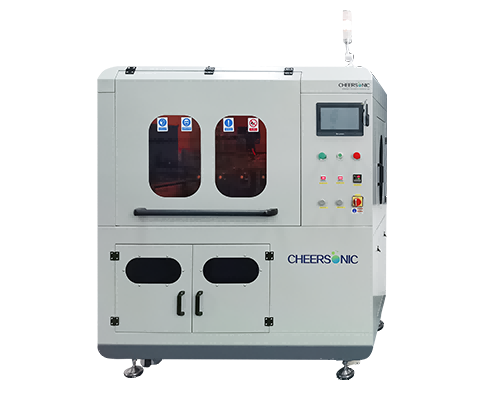
Cheersonic is the leading developer and manufacturer of ultrasonic coating systems for applying precise, thin film coatings to protect, strengthen or smooth surfaces on parts and components for the microelectronics/electronics, alternative energy, medical and industrial markets, including specialized glass applications in construction and automotive.
Our coating solutions are environmentally-friendly, efficient and highly reliable, and enable dramatic reductions in overspray, savings in raw material, water and energy usage and provide improved process repeatability, transfer efficiency, high uniformity and reduced emissions.
Chinese Website: Cheersonic Provides Professional Coating Solutions
