Ultrasonic Coating in the Preparation of Water Electrolysis Films
Application of Ultrasonic Spray Coating Machines in the Preparation of Water Electrolysis Films
Against the backdrop of the rapid development of the hydrogen energy industry, water electrolysis, as a highly efficient green hydrogen production technology, relies heavily on the performance of its core component, the water electrolysis film, which directly determines the efficiency and stability of hydrogen production. Ultrasonic spray coating machines, with their precise atomization and deposition capabilities, have become key equipment for preparing water electrolysis films from mixtures of organic monomers and inorganic catalysts. This effectively solves problems such as uneven coating and material waste in traditional spraying processes, providing crucial support for the upgrading of water electrolysis technology.

The core advantage of ultrasonic spray coating machines stems from their unique atomization principle. Unlike traditional pressure spraying, this equipment uses high-frequency ultrasonic vibration (typically 20–120 kHz) to form uniform droplets of micron or even submicron size at the nozzle. The concentrated droplet size distribution avoids droplet splashing and agglomeration. In the context of water electrolysis film preparation, this precise atomization capability is particularly crucial—the mixture of organic monomers and inorganic catalysts needs to form a functional coating with uniform thickness and consistent composition to ensure efficient proton or ion conduction and stable catalytic reactions. Ultrasonic spraying creates droplets that can be precisely deposited on the substrate surface, forming a dense and porous composite coating that provides ample active sites and smooth mass transfer channels for the water electrolysis reaction.
Ultrasonic spraying machines exhibit excellent adaptability to the characteristics of mixtures of organic monomers and inorganic catalysts. In these mixtures, the organic monomers act as a binder and film-forming matrix, requiring the preservation of the film’s structural integrity; the inorganic catalyst provides catalytic activity, and its dispersion uniformity directly affects reaction efficiency. During ultrasonic spraying, high-frequency vibrations not only atomize the mixture but also create a slight stirring effect, helping to prevent the inorganic catalyst from settling and agglomerating, ensuring its uniform distribution within the organic monomer matrix. Simultaneously, this process provides a gentle spraying environment, avoiding the shear force generated by high-pressure spraying that could damage the molecular structure of the organic monomers, thus ensuring the film quality and mechanical properties of the coating. Experimental data shows that composite coatings prepared using ultrasonic spraying improve the dispersion uniformity of the inorganic catalyst by more than 30% compared to traditional spraying, effectively increasing the exposure rate of catalytic active sites.
Ultrasonic spraying machines offer significant advantages in process control and performance optimization. The equipment allows for precise control of coating thickness by adjusting parameters such as ultrasonic frequency, spray flow rate, spray speed, and substrate temperature. The error can be controlled within the micrometer level, meeting the thickness requirements of various water electrolysis films (typically 200–600 μm). For example, when the spray flow rate is controlled at 0.4–10 ml/min and the spray speed at 10–200 mm/s, a proton exchange membrane catalyst layer with uniform thickness can be prepared. Furthermore, ultrasonic spraying achieves a material utilization rate of over 85%, far superior to traditional spraying processes, significantly reducing material losses of organic monomers and precious metal inorganic catalysts, and effectively controlling production costs. Simultaneously, this process enables continuous spraying, adapting to the industrial production needs of large-scale water electrolysis films and improving production efficiency.
In practical applications, water electrolysis films prepared by ultrasonic spraying exhibit excellent electrolysis performance. The porous structure formed by the organic monomers provides channels for ion conduction, while the uniform distribution of the inorganic catalyst reduces the overpotential of the electrolysis reaction, significantly improving hydrogen production efficiency. In alkaline water electrolysis or proton exchange membrane water electrolysis systems, these composite membranes not only possess excellent corrosion resistance and stability but also effectively isolate the anode and cathode gases, avoiding short-circuit risks and extending the electrolyzer’s lifespan. Especially in renewable energy hydrogen production scenarios, water electrolysis membranes prepared by ultrasonic spraying can adapt to the operating characteristics of fluctuating power supplies, ensuring the stability and reliability of system operation.
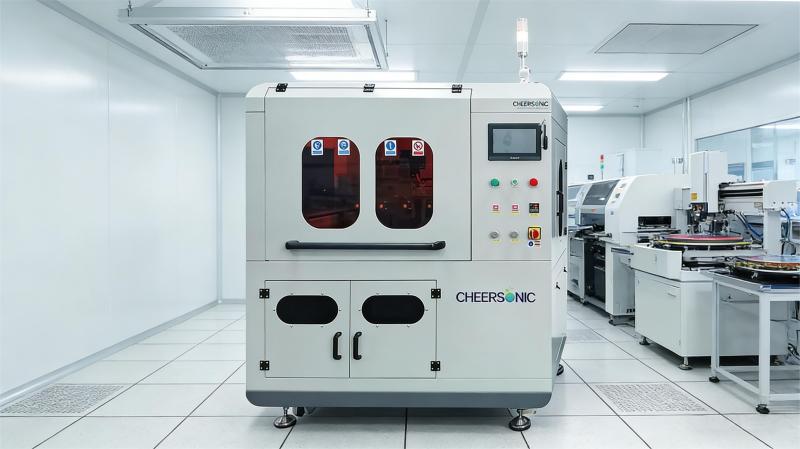
With the continuous upgrading of water electrolysis hydrogen production technology, the performance requirements for water electrolysis membranes are constantly increasing. Ultrasonic spraying machines, with their advantages of precise atomization, strong material adaptability, and high process controllability, occupy an important position in the preparation of water electrolysis membranes using a mixture of organic monomers and inorganic catalysts. In the future, by further optimizing process parameters and expanding the range of material adaptability, ultrasonic spraying technology will help prepare more efficient, stable, and low-cost water electrolysis membranes, providing core technological support for the large-scale development of the hydrogen energy industry and promoting the process of clean energy substitution.
About Cheersonic
Cheersonic is the leading developer and manufacturer of ultrasonic coating systems for applying precise, thin film coatings to protect, strengthen or smooth surfaces on parts and components for the microelectronics/electronics, alternative energy, medical and industrial markets, including specialized glass applications in construction and automotive.
Our coating solutions are environmentally-friendly, efficient and highly reliable, and enable dramatic reductions in overspray, savings in raw material, water and energy usage and provide improved process repeatability, transfer efficiency, high uniformity and reduced emissions.