
Spray Pyrolysis Granulation Process
The spray pyrolysis granulation process mainly includes the following steps:
1. Raw Material Preparation:
– Raw Material Selection: Based on the product needs and performance requirements, appropriate metal salts, oxides, organic compounds, etc. are selected as starting materials. For example, when preparing battery materials, a corresponding metal salt solution may be selected.
– Solution Preparation: The selected raw materials are dissolved in a solvent at a specific ratio to form a uniform solution. The choice of solvent should take into account factors such as volatility, solubility, and compatibility with the raw materials. Water, ethanol, and acetone are commonly used as solvents.
2. Spray Atomization:
– Atomizer Selection: Based on the production scale and product requirements, an appropriate atomizer is selected. Common atomizers include pressure atomizers, centrifugal atomizers, and ultrasonic atomizers.
– Atomization: The prepared solution is converted into fine droplets through the atomizer. Pressure atomizers use high-pressure gas or liquid to squeeze out a solution and break it into droplets; centrifugal atomizers use a high-speed rotating disk to swirl the solution into droplets; and ultrasonic atomizers use ultrasonic vibrations to break the solution into droplets. The size of the atomized droplets generally ranges from a few microns to tens of microns.
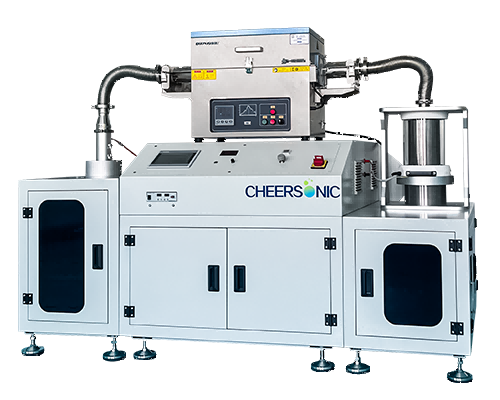
3. Pyrolysis Reaction:
– Choosing Pyrolysis Equipment: Tubular furnaces and fluidized bed reactors can be used as pyrolysis equipment. Tubular furnaces offer a simple structure and easy temperature control, making them suitable for small-scale production and laboratory research; fluidized bed reactors offer excellent heat and mass transfer performance, making them suitable for large-scale production.
– Pyrolysis Process: The atomized droplets are introduced into the pyrolysis equipment and undergo a pyrolysis reaction at high temperature. Pyrolysis temperature, time, and atmosphere are adjusted according to the properties of the raw materials and product requirements. During the pyrolysis process, the solvent evaporates rapidly, and the raw materials undergo chemical reactions such as decomposition, oxidation, and reduction, forming solid particles.
4. Particle Collection:
– Collection Device: A particle collection device, such as a cyclone separator, bag filter, or electrostatic precipitator, is installed at the outlet of the pyrolysis equipment to collect the particles generated by pyrolysis.
– Cooling: The collected particles are typically hot and require cooling. Natural cooling, air cooling, or water cooling can be used to reduce the temperature of the particles to room temperature or the desired temperature.
5. Post-Processing:
– Screening and Classification: The collected particles are screened and classified to remove oversized and undersized particles, resulting in a product with a uniform particle size distribution.
– Surface Treatment: Depending on the product requirements, the particles can be surface treated, such as by coating or modification, to enhance their performance and application range.
About Cheersonic
Cheersonic is the leading developer and manufacturer of ultrasonic coating systems for applying precise, thin film coatings to protect, strengthen or smooth surfaces on parts and components for the microelectronics/electronics, alternative energy, medical and industrial markets, including specialized glass applications in construction and automotive.
Our coating solutions are environmentally-friendly, efficient and highly reliable, and enable dramatic reductions in overspray, savings in raw material, water and energy usage and provide improved process repeatability, transfer efficiency, high uniformity and reduced emissions.
Chinese Website: Cheersonic Provides Professional Coating Solutions