PTFE Coatings for Medical Guidewires: Low Friction, Precision and Coating Technologies
1. Application Background
Medical guidewires are indispensable medical devices in vascular interventions, urological interventions, and other minimally invasive treatments. Guidewires typically need to pass through narrow, curved anatomical pathways to guide and support catheters, balloons, stent delivery systems, or other devices.
During use, guidewires must balance pushability, torque transmission, flexibility, trackability, and surface lubricity. Surface friction affects not only the feel of device manipulation but also relative movement between the guidewire and the catheter’s inner wall.
PTFE is one of the common low-friction coating materials for medical guidewires, particularly on certain stainless-steel core wires and guidewire shaft surfaces.
2. Core Functions of PTFE Coatings
Reducing frictional resistance
PTFE has a relatively low coefficient of surface friction. It can reduce friction between the guidewire and a catheter lumen or other contact surfaces, helping improve advancement and withdrawal performance.
Improving handling consistency
A continuous, uniform coating helps reduce local differences in friction, supporting relatively stable sliding behavior during guidewire movement.
Providing surface protection
PTFE has good chemical stability and can provide surface protection for certain metal substrates, but it cannot replace verification of the substrate’s own corrosion resistance.
Supporting functional designs in different regions
Some guidewires use different surface treatments in different regions, such as a low-friction PTFE coating proximally and a hydrophilic coating distally, to meet different operating requirements.
3. Typical Structure and Technical Parameters
Medical guidewires typically consist of a metal core wire, a flexible distal structure, radiopaque features, and surface coatings.
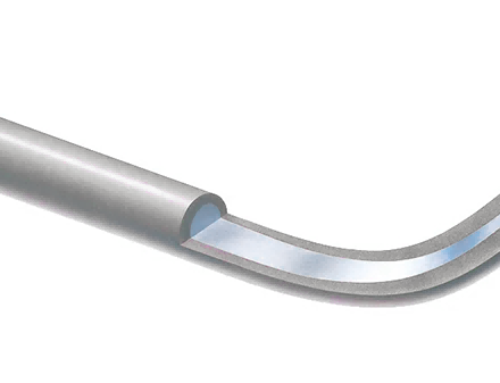
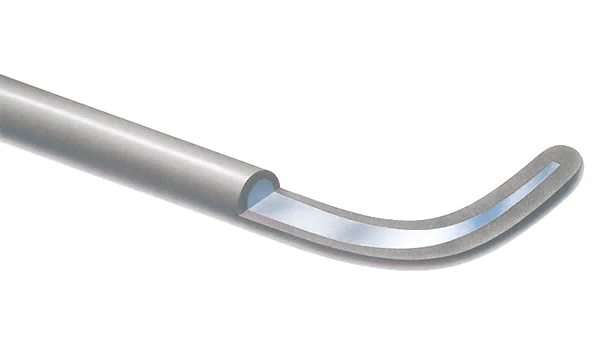
Schematic of a Medical Guidewire Structure (Not to Scale)
Simplified illustration: actual distal coils, polymer jackets, and coating zones vary according to product design.
| Parameter | Common Engineering Reference |
|---|---|
| Guidewire diameter | 0.014, 0.018, 0.025, 0.035, 0.038 inches, etc. |
| Core wire material | 304/316L stainless steel, nitinol |
| Coating type | PTFE, hydrophilic coating, or combined coatings |
| PTFE coating thickness | Micrometer scale, depending on formulation and design |
| Primary performance indicators | Friction, adhesion, wear resistance, coating integrity |
Coating thickness affects the guidewire’s final outer diameter and clearance within the catheter. Dimensional tolerance analysis is therefore necessary during design.
4. Mainstream PTFE Coating Preparation Processes
Conventional Spray Coating
Compressed air atomizes a PTFE dispersion and deposits it on the guidewire surface. The process is relatively mature, but thin, elongated substrates may present challenges in overspray, material utilization, and coating uniformity.
Dip Coating
The guidewire is immersed in the coating liquid and then withdrawn at a controlled speed. Dip coating suits certain continuous surface-treatment processes, but liquid runoff, end pooling, withdrawal speed, and drying must be controlled.
Ultrasonic Spray Coating
Ultrasonic spraying atomizes coating liquid through high-frequency nozzle vibration and uses low-velocity airflow to guide droplets onto the substrate.
For elongated guidewires, rotating fixtures, linear-motion mechanisms, and precision liquid-delivery systems can be combined to achieve controlled thin-film deposition.
5. Potential of Ultrasonic Spraying for Guidewire PTFE Coatings
Ultrasonic spray coating is particularly worth investigating in the following areas:
- Thin-film uniformity: Optimize coverage on cylindrical surfaces by controlling flow rate, spray speed, rotation speed, and number of passes.
- Selective coating: Coat specified lengths locally according to the guidewire’s functional design.
- Material utilization: Low-velocity atomization helps reduce overspray losses under certain process conditions.
- Automated production: Combine multi-axis motion systems and programmable parameters to improve process repeatability.
However, PTFE dispersions usually contain solid particles. Ultrasonic spraying requires validation of particle size, agglomeration tendency, nozzle compatibility, and dispersion stability. Some conventional PTFE coatings also require relatively high-temperature sintering, which not every guidewire structure can withstand.
Therefore, the suitability of ultrasonic spraying should be determined through formulation screening and sample validation rather than judging final coating performance solely by the spraying method.
6. Quality Control and Development Trends
Quality evaluation of PTFE coatings on medical guidewires typically includes coating thickness, visual integrity, friction performance, adhesion, wear resistance, particle shedding, and relevant biocompatibility requirements.
In the future, guidewire coating technology will increasingly move toward thinner films, region-specific functionality, precision automation, and traceable manufacturing.
Conclusion: PTFE coatings are an important technical route for improving the sliding performance of medical guidewires. As minimally invasive interventional devices demand greater dimensional precision and manufacturing consistency, ultrasonic spraying offers a coating process option worth evaluating for precision guidewire applications.
Explore Ultrasonic PTFE Coating with Cheersonic
Medical device manufacturers and R&D teams exploring functional PTFE coatings are invited to contact Cheersonic to discuss their coating projects and arrange coating sample feasibility testing. Learn more about our ultrasonic coating equipment solutions.