Minimally Invasive Medical Sensors — How Ultrasonic Polyimide Coating Supports Platinum-Iridium Wire Insulation
1. Why Do Minimally Invasive Medical Devices Need Miniature Sensors?
Minimally invasive medical technologies use catheters, miniature probes, and other compact instruments to access specific areas of the human body for diagnosis, monitoring, or treatment.
As medical devices become smaller and more multifunctional, some interventional instruments incorporate increasing numbers of miniature sensors and electronic components.
For example, certain devices may need to monitor local electrical signals, electrochemical parameters, or other physiological information.
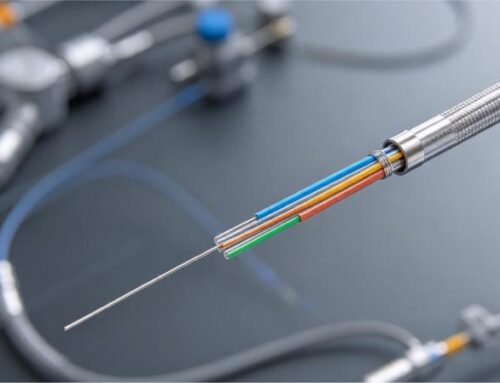
Connecting these sensors to external signal processing systems requires miniature conductive structures with reliable electrical insulation.
2. Potential Applications of Platinum-Iridium Wires in Medical Sensors
Platinum-iridium alloys offer good electrical conductivity, corrosion resistance, and electrochemical stability.
These properties make them potential materials for selected medical sensor electrodes and miniature conductive components.
In certain electrochemical sensor designs, platinum-iridium may serve as an electrode material.
In other applications, the wire may function only as an electrical interconnection.
These two applications have different insulation requirements.
If platinum-iridium is used as the sensing electrode, selected metal surfaces must remain exposed to the measurement environment.
If the wire functions as an electrical connection, most of its surface may require continuous insulation.

3. Why Are PI Coatings Relevant to Miniature Sensor Structures?
In miniature sensors, insulation coatings help prevent electrical short circuits and may also define the active electrode area.
Polyimide offers favorable dielectric properties and thin-film processing capabilities, making it a potential material for selected microsensor structures.
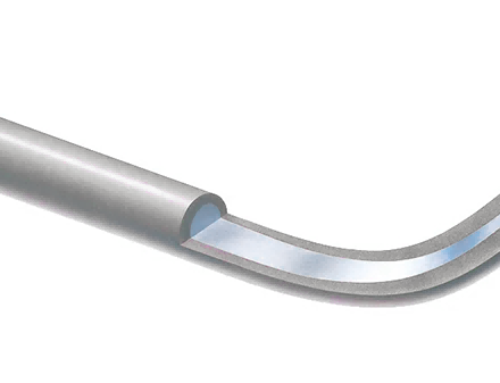
Applying a 5–10 μm radial PI insulation layer to an 80 μm platinum-iridium wire results in a theoretical finished diameter of approximately 90–100 μm.
Such dimensions may help accommodate conductive pathways within compact medical instruments.
However, PI suitability depends on the sensor’s operating principle, measurement environment, target analytes, and electrode design.
For example, electrochemical working electrodes must retain appropriately exposed active surfaces to interact with the surrounding medium.
4. Ultrasonic Spray Coating of PI on 0.08 mm Platinum-Iridium Wires
Ultrasonic spray coating is a precision coating technique that uses high-frequency vibration to atomize liquid coating materials.
For miniature medical sensor wires, ultrasonic spray coating can be investigated as a method of applying continuous PI insulation to platinum-iridium wires measuring 0.08 mm in diameter.
A precision liquid delivery system supplies the PI solution to an ultrasonic nozzle, where it is atomized into fine droplets and directed toward the moving wire.
To achieve a radial insulation thickness of 5–10 μm, the process may incorporate multiple coating stations, multi-angle spraying, and repeated thin-layer deposition.
A typical process includes:
- Cleaning and preparing the platinum-iridium wire surface.
- Transporting the wire through a low-tension precision feeding system.
- Atomizing the PI solution using an ultrasonic spray nozzle.
- Applying the coating from multiple directions to improve circumferential coverage.
- Using intermediate drying to minimize coating accumulation and flow defects.
- Curing the PI coating according to the material formulation.
- Inspecting coating thickness, insulation continuity, and adhesion.
If the sensor requires an exposed electrode region, a validated precision processing method may be used to create the necessary opening after insulation coating.
For miniature sensors, it is also important to evaluate whether the insulation affects response time, signal noise, and long-term stability.
5. Potential Manufacturing Advantages
Ultrasonic spray coating offers several potential benefits for miniature sensor wire manufacturing.
Precision Liquid Delivery
Microflow liquid delivery systems enable controlled coating solution supply.
Thin-Layer Deposition
Multiple coating passes can support the development of controlled insulation thicknesses.
Process Automation
The coating system can potentially be integrated with continuous wire feeding, drying, and inspection equipment.
Process Flexibility
Spray parameters can be adjusted for different coating materials and wire geometries.
However, because the wire diameter is only 80 μm, coating material utilization may be limited by spray dispersion and droplet capture efficiency.
Practical deposition efficiency must therefore be evaluated experimentally.
6. Future Applications
As minimally invasive medical devices continue to become smaller and more sophisticated, miniature sensors will require increasingly precise conductive materials, insulation coatings, and manufacturing technologies.
Combining platinum-iridium wires with PI insulation provides a potential material structure for selected miniature sensor applications.
Conclusion
Reliable electrical insulation is an important foundation for stable signal transmission in minimally invasive medical sensors.
Ultrasonic spray coating offers a potential process development approach for applying PI insulation to 80 μm platinum-iridium wires, creating additional manufacturing possibilities for advanced miniature medical sensor components.