
Production of Electrode Materials for Secondary Batteries
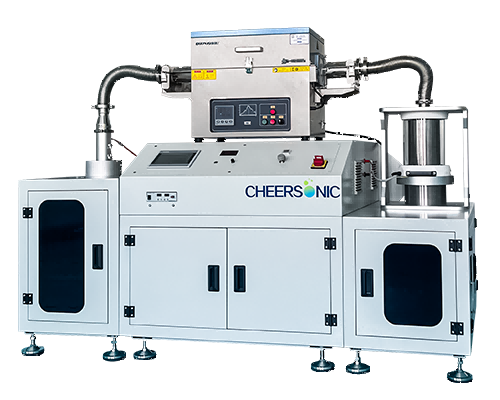
In order to solve the problem of using ultrasonic spray pyrolysis to produce secondary battery electrode materials (such as lithium ion battery anode/cathode), the furnace temperature is required to be~1000 ° C, and the powder output. The following system design and considerations are crucial:
Core equipment configuration
1. Ultrasonic atomization module
- Technology: High frequency ultrasonic transducers (such as 1.7-2.4 MHz) generate submicron droplets (500 nm-10 μ m) from precursor solutions (such as metal nitrates and acetates). This ensures uniform particle distribution and controllable morphology.
- Material compatibility: Corrosion resistant components such as PTFE and stainless steel are crucial for handling acidic/alkaline solutions such as lithium hydroxide and cobalt chloride.
2. High temperature furnace
- A furnace with a temperature range of 1000-1200 ° C is suitable.
- Atmospheric control: Inert gases (N ₂, Ar) or reducing/oxidizing environments (such as H ₂/CO used for carbon coating) are maintained through a mass flow controller.
3. Powder collection system
- Electrostatic precipitator: use high voltage field (e.g. 30-50kV) to collect nanometer/micron powder (efficiency>95%). MTI’s ESP design uses cross shaped electrodes to maximize the surface area for particle capture.
- Cyclone filtration: prevents clumping by separating particles by mass before the electrostatic precipitator.
Process Optimization
1. Thermal distribution
- Pyrolysis zone:
-Evaporation zone (200-400 ° C): Remove solvent.
-Decomposition zone (600-900 ° C): Decompose the precursor into oxides/carbonates.
-Sintering zone (800-1000 ° C): Improve crystallinity and particle densification. - Case study: Iron ∝ O ₄/C microspheres synthesized at 800 ° C exhibit excellent cycling stability (1030 mAh/g after 100 cycles) due to controlled pyrolysis.
2. Precursor parameters
- Concentration: 0.1-1.0 M solution equilibrium atomization efficiency and particle yield.
- Flow rate: 1-10mL/min (adjusted by injection pump) to control sedimentation rate and particle size.
3. Carrier gas
- Flow rate: 100-500 sccm (standard cubic centimeters per minute), used for transporting droplets and preventing backflow. Higher flow rates of mullite tubes can achieve faster throughput.
Material specific considerations
1. Anode material (such as iron ∝ O ₄/C)
- Carbon coating: In situ carbonization of organic precursors (such as glucose) during pyrolysis increases conductivity and buffer volume expansion.
- Hollow structure: achieved by adjusting the pyrolysis temperature and gas flow rate to improve the accessibility of electrolytes.
2. Cathode materials (such as LiCoO ₂)
- Doping agent: Introducing Al ³ ⁺ or Mg ² ⁺ through co precipitation to stabilize the crystal structure at high voltage.
- Surface modification: The ultrasonic spraying and pyrolysis of LiPO reduced the interfacial resistance of the film.

Security and scaling up
Ventilation: The exhaust system can remove toxic gases (such as NO ₂ from nitrate decomposition).
Pilot production: Scalable design (e.g., spray array) enables the production of laboratory (10g/day) to transition to industrial (>100kg/day) production.
Performance verification
- Feature:
-XRD: Confirm the crystal structure (such as spinel iron ∝₄ compared to hexagonal ZnO).
-SEM/TEM: Evaluate particle morphology (hollow spheres, nanorods).
-BET: Measurement of specific surface area (e.g. specific surface area of mesoporous materials is 50-100m2/g).
By integrating these components and parameters, ultrasonic spray pyrolysis provides a scalable, cost-effective method to synthesize high-performance battery electrode materials with customized nanostructures and electrochemical properties.
About Cheersonic
Cheersonic is the leading developer and manufacturer of ultrasonic coating systems for applying precise, thin film coatings to protect, strengthen or smooth surfaces on parts and components for the microelectronics/electronics, alternative energy, medical and industrial markets, including specialized glass applications in construction and automotive.
Our coating solutions are environmentally-friendly, efficient and highly reliable, and enable dramatic reductions in overspray, savings in raw material, water and energy usage and provide improved process repeatability, transfer efficiency, high uniformity and reduced emissions.
Chinese Website: Cheersonic Provides Professional Coating Solutions