
Photoresist Optical Coating
Ultrasonic coating machine: technical characteristics and scene implementation of photoresist optical coating
In the field of optical manufacturing, the uniformity, thickness accuracy, and transparency stability of photoresist coatings directly determine the performance limit of optical components. The ultrasonic coating machine provides an innovative solution for the functional coating of photoresist on optical component surfaces through high-frequency vibration atomization and precise deposition technology, especially breaking through the limitations of traditional coating processes in complex scenarios such as curved lenses and micro nano optical structures.
Core technology principles and optical adaptability
The core advantage of ultrasonic coating machine lies in its unique atomization coating mechanism. The equipment crushes the photoresist solution into micrometer sized uniform droplets through high-frequency mechanical vibration at 20~120kHz, and transports them to the surface of the optical substrate through a carrier gas to form a thin film coating without sagging or bubbles. This non-contact coating method avoids mechanical damage to fragile optical substrates (such as glass and polymer lenses) caused by traditional contact processes, while the corrosion resistance of titanium alloy nozzles ensures long-term stable operation, meeting the durability requirements of optical manufacturing equipment.
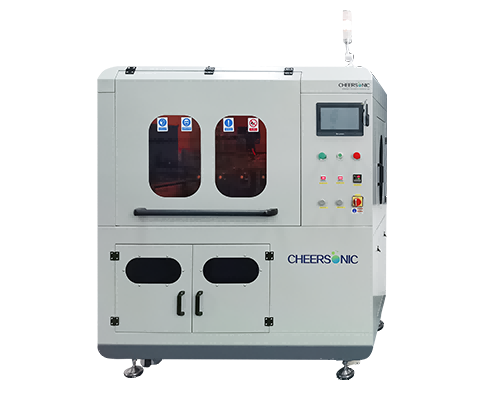
In response to the stringent requirements of optical coatings, this technology achieves triple precision control: firstly, the coating uniformity can reach over 95%, far exceeding traditional spin coating processes, effectively solving the thickness deviation problem during the coating of large-diameter curved lenses. The ultrasonic coating machine reduces thickness fluctuations from the source through physical atomization mechanism; Secondly, by adjusting the ultrasonic power and spraying rate, precise control of nanometer to micrometer thickness can be achieved, and the relative error of thickness can be stably controlled within 0.4%, matching the requirements of optical thin films for refractive index stability; Thirdly, the high consistency of the diameter of atomized droplets avoids particle contamination on the coating surface, ensuring that the high transmittance performance of photoresist coatings in the ultraviolet to visible light range is not affected.
Key performance indicators and process innovation
In optical photoresist coating, the adjustable parameters of the equipment provide flexible support for diverse applications. The coordinated control of spindle speed and spray pressure can be adapted to different substrate characteristics: for rigid glass lenses, a low speed of 400~800r/min is used in combination with high-pressure spraying above 0.6MPa to ensure high adhesion between the coating and the substrate; For flexible optical films, rapid dehydration is achieved at a high speed of 2000-3000r/min to reduce film shrinkage stress. This dynamic adjustment capability enables it to handle full specification requirements from 2-inch laboratory samples to 12 inch mass-produced optical wafers.
In terms of material compatibility, the equipment can be adapted to specialized photoresist systems in the field of optoelectronics, including high-performance materials such as polyimide based photoresist. Differentiated process configurations can be achieved for different optical functional requirements: when making diffraction gratings, high viscosity photoresist is used in conjunction with converging nozzles to achieve fine line patterns below 25 μ m through programmed path control; For the preparation of anti reflective coatings, a low surface tension formula is selected, and a wide width nozzle is used to achieve uniform coverage over a large area. This multi scenario adaptability stems from the programmable control of the entire process of the equipment, which can preset 12 key indicators such as liquid type, spraying time, and path parameters, forming a customized process plan.
Analysis of Typical Optical Application Scenarios
In the manufacturing of micro nano optical components, ultrasonic coating machines demonstrate unique technological value. When making a micro lens array, the directional liquid flow generated by the vortex nozzle can form a curvature controllable microstructure on the surface of the photoresist coating, which can be used in conjunction with subsequent exposure and development to achieve precise control of optical focusing performance. This process reduces material loss by more than 30% compared to traditional hot stamping technology, and the surface error of a single lens can be controlled within λ/20 (λ=632.8nm).
In the production of optical waveguide devices, the equipment solves the problem of traditional photoresist being difficult to form a uniform coating on the surface of three-dimensional structures through a layered coating process. For groove structures with undulations exceeding 50 μ m, a probing nozzle combined with a step-by-step spraying strategy is used to reduce the film thickness difference between the bottom and top of the groove to within 5%, significantly improving the efficiency of optical signal transmission. This ability enables it to be widely applied in emerging fields such as AR/VR optical modules.

For the photoresist patterning of OLED display devices, the equipment avoids thermal damage to organic luminescent materials through low-temperature spraying (<60 ℃) technology, while the precise atomization of isopropanol solvent ensures the clarity of the coating edge, controlling the pixel spacing below 10 μ m. This process has increased the production yield by 15% to 20% compared to traditional inkjet printing methods, providing a stable and reliable solution for high-resolution display panel manufacturing.
Technical Value and Industry Impact
The ultrasonic coating machine has redefined the technical standards for optical photoresist coating through process innovation. Its material utilization rate of over 90% is significantly lower than that of traditional spin coating processes (usually less than 20%), which greatly reduces the consumption of photoresist, especially for expensive special optical photoresist with significant economic value. Meanwhile, non-contact coating reduces the risk of substrate scratches by over 80%, making mass production of fragile optical components possible.
At the level of technological evolution, this device promotes the transformation of optical manufacturing from “experience dependent” to “precision controlled”. By quantifying and controlling key indicators such as coating thickness deviation and particle contamination, combined with computer-aided process design, the first-time trial production qualification rate of complex optical components has been increased to over 70%, shortening the development cycle by 50% compared to traditional trial and error methods. This transformation is not only applicable to precision scenes such as high-end lithography machine lenses, but also demonstrates the potential for large-scale applications in mass production fields such as consumer electronics optical modules and automotive optical sensors, providing a new technological path for the refinement and green development of optical manufacturing.
About Cheersonic
Cheersonic is the leading developer and manufacturer of ultrasonic coating systems for applying precise, thin film coatings to protect, strengthen or smooth surfaces on parts and components for the microelectronics/electronics, alternative energy, medical and industrial markets, including specialized glass applications in construction and automotive.
Our coating solutions are environmentally-friendly, efficient and highly reliable, and enable dramatic reductions in overspray, savings in raw material, water and energy usage and provide improved process repeatability, transfer efficiency, high uniformity and reduced emissions.
Chinese Website: Cheersonic Provides Professional Coating Solutions