
Operation Guide for Ultrasonic Spraying AB Resin Adhesive
Ultrasonic spraying of AB resin adhesive should follow the core logic of “equipment adaptation standard operation environmental control” to ensure stable bonding effect. The following is a detailed operation process and precautions:
Preliminary preparation: equipment and material adaptation
1. Selection of ultrasonic spraying machine
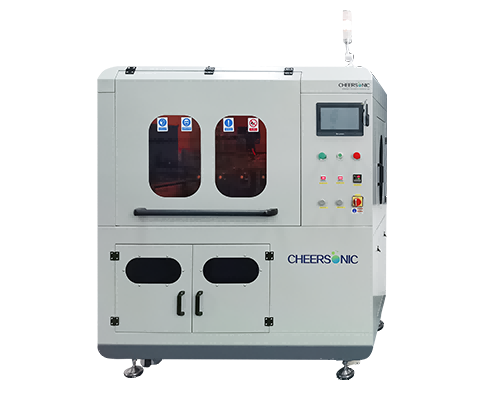
Equipment parameters need to be determined based on actual homework requirements, with the following core reference dimensions:
- Spray precision: If the bonding surface is a small-sized, high-precision component (such as electronic components), select equipment with a minimum spray particle size of ≤ 5 μ m and a positioning error of ± 0.1mm; If it is a large-area flat surface (such as a board), priority should be given to models with wide spraying (single spraying width ≥ 300mm) to improve efficiency.
- Adhesive viscosity adaptation: The viscosity of AB resin adhesive is usually between 500-5000cP, and it is necessary to choose equipment with a nozzle channel diameter that matches the ultrasonic frequency (such as adapting high viscosity adhesive to 10-20kHz low-frequency equipment to avoid blockage); Low viscosity adhesive liquid is suitable for 20-40kHz high-frequency equipment to reduce flying mist.
- Homework scenario: Automated production lines can be paired with conveyor belt spraying systems; Choose handheld or desktop devices for small-scale laboratory assignments, which are easy to adjust flexibly.
2. Pre treatment of AB resin adhesive
- Strictly control the ratio of components A and B according to the product manual (common ratios are 1:1 and 2:1, with an error margin of ≤± 2%, and imbalanced ratios can directly lead to curing failure).
- When mixing, use the method of “low-speed stirring+rotating along the container wall”, with a stirring time of 5-10 minutes, to avoid introducing bubbles during vigorous stirring (bubbles can cause gaps on the bonding surface and reduce strength).
- After mixing, spraying should be completed within the applicable period of AB glue (usually 15-60 minutes, subject to product instructions). The glue solution that exceeds the applicable period will gradually thicken and cannot be evenly sprayed.
3. Surface treatment of substrate
- Wipe the bonding surface with anhydrous ethanol or isopropanol to remove impurities such as oil stains, dust, and oxide layers (impurities can damage the adhesion between the adhesive layer and the substrate); If the substrate is a hard material such as metal or ceramic, it can be lightly sanded with sandpaper (400-800 mesh) to increase surface roughness and improve bonding effect.
- Ensure that the surface of the substrate is dry (moisture content ≤ 0.5%), as a humid environment can cause white frost or bubbles to appear after the adhesive layer solidifies.
Core operation: Spraying and bonding process
1. Ultrasonic spraying operation
- Parameter debugging: Set spraying parameters based on target thickness——
– Nozzle height: 10-30mm from the surface of the substrate (too close can cause glue accumulation, too far can cause uneven spraying and glue dispersion);
– Movement speed: 5-15mm/s (too fast speed can cause missed spraying, too slow speed can cause local glue accumulation);
– Ultrasonic power: adjusted according to the viscosity of the adhesive, usually 50-150W (the higher the viscosity, the higher the power needs to be appropriately increased to ensure uniform atomization of the adhesive). - Thickness control:
– If the target thickness is thin (5-20 μ m), it can be sprayed in one go; If the thickness is thick (20-100 μ m), it is recommended to use “multiple thin coatings” (with an interval of 3-5 minutes between each spraying, and wait for the previous layer of adhesive to preliminarily level before spraying the next layer) to avoid single thick coating causing shrinkage and cracking of the adhesive layer.
– The thickness can be monitored in real-time using the “weighing method” (difference in substrate weight before and after spraying ÷ spraying area) or the “thickness gauge” (non-contact laser thickness gauge with an accuracy of ± 1 μ m) to ensure compliance with requirements. - Uniformity guarantee: Maintain a straight and uniform nozzle movement path during spraying, and control the overlap between adjacent spraying trajectories within 30% -50% (to avoid missed spraying areas); If spraying irregular surfaces (such as curved surfaces and grooves), the nozzle angle needs to be adjusted (kept 90 ° perpendicular to the substrate surface) and the moving speed needs to be reduced.

2. Substrate bonding operation
- Timeliness: After the spraying is completed, the other substrate should be placed in the predetermined position on the bonding surface within 3-5 minutes (AB glue will quickly enter the initial bonding stage after spraying, and delayed placement will cause the surface of the adhesive layer to solidify and cannot be tightly adhered).
- Fitting technique: When placing, use the “translation and downward pressure” method to avoid lateral sliding that may cause misalignment of the adhesive layer; After bonding, a uniform pressure (0.1-0.5 MPa, which can be applied by heavy objects or fixed with fixtures) should be applied and held for 3-5 minutes to ensure complete contact between the adhesive layer and the substrate, and to eliminate residual bubbles.
Key control: solidification environment and safety
1. Control of curing conditions
The curing effect of AB resin adhesive depends on temperature and time, and product requirements must be strictly followed:
- Temperature range: The suitable curing temperature for most AB adhesives is 20-30 ℃. If the temperature is below 15 ℃, the curing time will be extended (such as 24 hours at 20 ℃ and 48 hours at 10 ℃); If the temperature is higher than 40 ℃, it may cause stress and cracking inside the adhesive layer.
- Humidity requirement: The curing environment humidity should be controlled between 40% -60%. When the humidity is higher than 70%, the adhesive layer is prone to absorbing moisture from the air, resulting in white mist on the surface or a decrease in bonding strength after curing.
- Curing after curing: Before complete curing (usually 24-72 hours), avoid vibration, impact, or external pulling on the substrate to prevent debonding when the adhesive layer is not fully crosslinked.
2. Key points for safe operation
- Environmental ventilation: AB resin adhesive may contain volatile components. When spraying, it is necessary to maintain good ventilation in the operating area (such as turning on the exhaust fan or working in a fume hood) to avoid inhaling harmful gases.
- Personal protection: Wear nitrile gloves (to avoid direct contact of the adhesive with the skin, if accidentally touched, immediately wipe with acetone or specialized cleaning agent, and rinse with clean water), goggles (to prevent the adhesive from fogging and splashing into the eyes).
- Storage of adhesive solution: Unused components A and B should be stored separately and sealed in a cool and dry place (temperature 5-25 ℃), avoiding direct sunlight to prevent premature curing or deterioration.
About Cheersonic
Cheersonic is the leading developer and manufacturer of ultrasonic coating systems for applying precise, thin film coatings to protect, strengthen or smooth surfaces on parts and components for the microelectronics/electronics, alternative energy, medical and industrial markets, including specialized glass applications in construction and automotive.
Our coating solutions are environmentally-friendly, efficient and highly reliable, and enable dramatic reductions in overspray, savings in raw material, water and energy usage and provide improved process repeatability, transfer efficiency, high uniformity and reduced emissions.
Chinese Website: Cheersonic Provides Professional Coating Solutions
