
MEMS Sensor Gas-Sensing Material Deposition Process
Advantages of Ultrasonic Spray Coating Machines for MEMS Sensor Gas-Sensing Material Deposition Process
MEMS gas sensors, with their small size, low power consumption, fast response speed, and mass production capability, are widely used in environmental monitoring, industrial safety, medical health, and smart wearables. The deposition quality of the gas-sensitive material directly determines the sensor’s detection performance, stability, and lifespan. Ultrasonic spray coating machines, as efficient and precise thin-film deposition equipment, demonstrate significant advantages in the deposition process of MEMS gas sensor gas-sensitive materials. They effectively solve problems such as material waste, insufficient accuracy, and poor compatibility inherent in traditional deposition processes, providing reliable support for the high performance, miniaturization, and mass production of MEMS gas sensors. Their core advantages are mainly reflected in the following six aspects:
Firstly, excellent material compatibility, adaptable to various gas-sensitive material systems. Commonly used gas-sensitive materials in MEMS gas sensors are mainly metal oxides. Different materials have different response characteristics to specific gases. Ultrasonic spray coating machines can flexibly adapt to various gas-sensitive material inks with viscosities up to 30 cps, completing deposition operations for different materials without significant equipment modifications. Specifically, whether it’s common metal oxide particle inks such as SnO₂, In₂O₃, and ZnO, or doped and modified composite metal oxide inks, uniform deposition can be achieved using an ultrasonic spray coating machine. This meets the deposition requirements of various metal oxide materials under different detection needs, greatly improving the flexibility of sensor design and providing material-level guarantees for the development of multi-gas detection, high-sensitivity MEMS sensors. Simultaneously, the equipment’s adaptability to inks eliminates the need for complex pretreatment processes, effectively reducing the cost of connecting material preparation and deposition.

Secondly, it possesses high-precision patterned deposition capabilities, enabling the fabrication of composite nanofilms. The core component of MEMS gas sensors is the micro-hot stage, which has a limited surface area, placing extremely high demands on the deposition accuracy and patterning of gas-sensitive materials. The ultrasonic spray coating machine can sequentially deposit different types of gas-sensitive materials on the same micro-hot stage, forming high-performance composite nanofilms by precisely controlling the deposition area, thickness, and uniformity of the materials. This composite film can combine the gas-sensitive properties of different materials, effectively broadening the types of gases that the sensor can detect. For example, by depositing two metal oxide materials sensitive to different gases, simultaneous detection of multiple harmful gases can be achieved. Simultaneously, by rationally matching the material ratios, the selectivity of the sensor for specific target gases can be significantly improved, reducing the influence of interfering gases on the detection results and further optimizing the sensor’s detection performance.
Thirdly, upgraded droplet control technology ensures consistency in sensor mass production. In mass production, the performance consistency of MEMS gas sensors is a core requirement, and droplet control precision directly affects the thickness uniformity and performance stability of the gas-sensitive layer. Ultrasonic spraying machines, by optimizing preparation parameters such as ultrasonic vibration frequency, liquid supply speed, and spraying distance, combined with precise droplet control technology, can flexibly adjust the size, speed, and distribution density of droplets, ensuring that the thickness error of the gas-sensitive layer on each sensor chip is controlled within a minimal range. Furthermore, the equipment can flexibly adjust the material composition ratio according to actual needs, achieving spraying of different ink formulations without changing core components. This improves production flexibility and effectively ensures the consistency of sensor performance during mass production, reducing the defect rate during mass production and laying the foundation for large-scale production. Fourth, ultra-high resolution deposition facilitates device integration and reduces costs. The core development trend of MEMS devices is integration and miniaturization, which requires the deposition of gas-sensitive materials to achieve precise coverage of minute areas. Ultrasonic spray coating machines can generate extremely fine atomized jets by adjusting the ultrasonic frequency, achieving material deposition with a minimum resolution of 1μm. This allows for precise deposition on designated areas of the micro-heating stage, avoiding material waste and effectively adapting to the deposition requirements of the microstructures of MEMS sensors. This ultra-high resolution deposition capability ensures perfect compatibility between the gas-sensitive layer and the sensor’s microcircuit, micro-heating stage, and other structures, facilitating high sensor integration and reducing the overall device size. Simultaneously, precise deposition control significantly reduces material loss, lowers production costs, and enhances the product’s market competitiveness.
Fifth, wide material applicability enhances the stability of the gas-sensitive layer. In addition to common metal oxide particle inks, ultrasonic spray coating machines can also be adapted to various colloidal inks, including high-viscosity, high-concentration solution systems. Compared to traditional spraying equipment, this method achieves stable spraying without diluting the ink to extremely low viscosity. It can spray a more viscous and concentrated solution, resulting in stronger adhesion between the deposited gas-sensitive layer and the micro-heated stage substrate. This effectively prevents problems such as gas-sensitive layer detachment and cracking during long-term sensor use, significantly improving the long-term operational stability and lifespan of the sensor. Furthermore, for some specially formulated gas-sensitive inks, the equipment can achieve stable atomization and uniform deposition without the need for additional dispersants or other auxiliary reagents, avoiding interference from these reagents on the performance of the gas-sensitive material.
Sixth, it meets the needs of micro-nano fabrication, driving the miniaturization of sensors. The core advantage of MEMS gas sensors lies in their miniaturization, making them adaptable to portable, wearable, and other small devices. The deposition process of the ultrasonic spraying machine perfectly matches the processing requirements at the micro-nano scale. The equipment is compact and can seamlessly integrate with MEMS micro-nano fabrication production lines. The deposition process does not damage the sensor’s microstructure and can precisely match the deposition requirements of tiny substrates. Meanwhile, its high-precision, low-loss deposition characteristics enable the deposition of high-performance gas-sensitive layers on extremely small substrate areas, further reducing the overall size of the sensor and facilitating the miniaturization and lightweighting of MEMS gas sensors. This expands their application scenarios in portable detection equipment, smart terminals, and other fields.
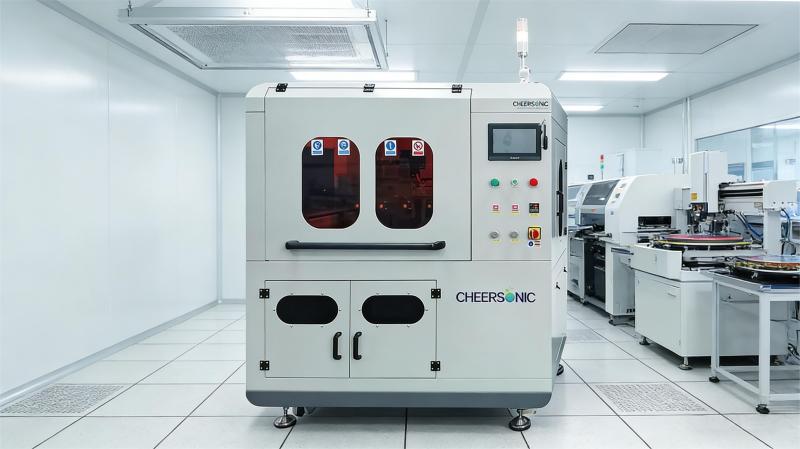
In summary, ultrasonic spraying machines, with their advantages of good material compatibility, high-precision patterning, precise droplet control, ultra-high resolution, wide material applicability, and suitability for micro-nano fabrication, effectively solve the core pain points in the deposition process of gas-sensitive materials for MEMS gas sensors. This not only improves the sensor’s detection performance and stability but also provides strong technical support for its mass production, miniaturization, and integration, making it irreplaceable in the field of MEMS gas sensor fabrication.
About Cheersonic
Cheersonic is the leading developer and manufacturer of ultrasonic coating systems for applying precise, thin film coatings to protect, strengthen or smooth surfaces on parts and components for the microelectronics/electronics, alternative energy, medical and industrial markets, including specialized glass applications in construction and automotive.
Our coating solutions are environmentally-friendly, efficient and highly reliable, and enable dramatic reductions in overspray, savings in raw material, water and energy usage and provide improved process repeatability, transfer efficiency, high uniformity and reduced emissions.
Chinese Website: Cheersonic Provides Professional Coating Solutions
