Hydrogen Production Pathway Electrolysis Water Technology
Electrolysis of water to produce hydrogen is a clean process that uses electrical energy to decompose water into hydrogen and oxygen. Its biggest advantage is that the electrolysis process does not produce harmful gases such as carbon dioxide. This technology can be traced back to the late 18th century, when two scientists validated its principles through experiments. Significant breakthroughs were made in the 19th century and industrial applications were realized by the end of that century. In the development process, innovation in key materials such as high-efficiency membranes, power systems, and ion conducting membranes has driven technological iteration. The milestones of modern electrolysis systems include the proton conducting membrane electrolysis device that emerged in the mid-20th century, the high-temperature solid electrolyte electrolysis cell developed in the 1980s, and the anion exchange membrane electrolysis technology that emerged in the early 21st century.
The current pattern of parallel development of multiple technological routes for hydrogen production through electrolysis of water mainly includes alkaline electrolysis, proton exchange membrane electrolysis, anion exchange membrane electrolysis, solid oxide electrolysis, microbial electrolysis, and acid-base electrolyte electrolysis.
Fundamentals of Technical Principles
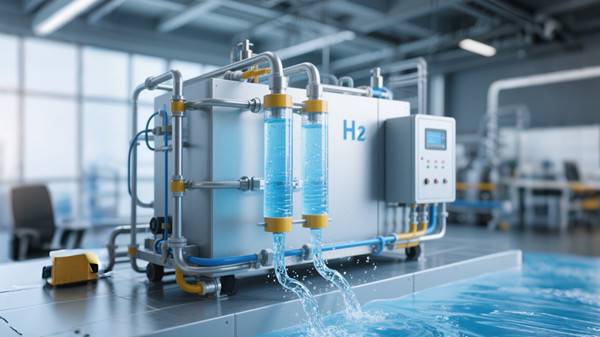
The electrolysis process uses water as raw material to convert electrical energy into chemical energy of hydrogen gas. The anode undergoes oxidation reaction to produce oxygen, while the cathode undergoes reduction reaction to produce hydrogen. Under standard conditions (25 ℃, atmospheric pressure), the theoretical voltage for water decomposition is 1.23 volts, but the actual operating voltage is usually higher than this value.
Characteristics of reaction mechanism
The electrolysis process includes two types of core reactions: anode and cathode reactions:
-Cathodic hydrogen evolution reaction (HER): a double electron transfer process that exists in both acidic and alkaline environments. The first step is the Volmer reaction: hydrogen atoms adsorb onto the active site of the electrode to form M-H * bonds; Subsequently, hydrogen gas is generated through desorption via Heyrovsky or Tafel pathways.
-Anodic oxygen evolution reaction (OER): a complex process of four electron transfer. Going through four steps of reaction: firstly, M-OH * and M-O * intermediates are generated, then M-O * combines with oxygen-containing groups to form M-OOH *, and finally M-OOH * decomposes to release oxygen.
Alkaline electrolysis technology
As the most mature electrolysis solution, this technology has a hundred years of industrial application history. Its advantages lie in high reliability, low cost, and stable operation, usually using mineral fiber membranes and specific concentration alkaline electrolytes. However, there are bottlenecks such as gas permeation, limited product purity, strong corrosiveness of electrolyte, low working pressure, insufficient current density, and lack of operational flexibility. The current research focuses on improving energy efficiency consistency through multimodal self optimization strategies and developing nickel cobalt based porous catalytic coatings to reduce overpotential.
Proton exchange membrane electrolysis technology
This solution has the advantages of rapid response, high energy efficiency, good dynamic performance, and compact structure, and can prepare ultra-high purity hydrogen gas (>99.99%) at high current densities. Its core adopts fluorosulfonic acid ion conductive membrane, combined with precious metal catalyst. However, expensive membrane materials and catalysts limit their large-scale applications. Research shows that high-pressure systems (without independent compressors) are significantly more energy-efficient than atmospheric systems, but there are still engineering barriers for ultra-high pressure technologies exceeding 300 bar.
Anion exchange membrane electrolysis technology
By using low-cost ion membranes and weakly alkaline/pure water electrolytes, combined with non precious metal catalysts, it combines the advantages of economy, low corrosion, and compact structure. The current bottleneck lies in low power density and insufficient membrane stability. The main breakthrough directions include developing high-performance non precious metal catalysts, improving the conductivity and durability of ion exchange membranes, and optimizing system structures. The development of platinum group metal free catalysts is expected to significantly reduce costs.
Solid oxide electrolysis technology
The high-temperature solution based on solid ceramic electrolyte (500-1000 ℃) has the characteristics of compact structure and fast response. However, it faces challenges such as low technological maturity, high energy consumption, high cost, and insufficient durability. Innovation focus: advanced manufacturing processes (such as strip casting), doping modification of electrode materials (such as strontium doped perovskite), and applications in seawater electrolysis. Nanocomposite electrodes and layered perovskite designs demonstrate potential for enhancing catalytic stability.
Acidic alkaline electrolyte electrolysis technology
This emerging solution uses acid/alkali composite electrolytes and operates at room temperature (20-60 ℃) and moderate voltage (about 2.0V), with outstanding energy efficiency performance. However, the application of bipolar ion membranes leads to complex system structures and increased membrane resistance, which also increases the difficulty of managing two electrolytes simultaneously.
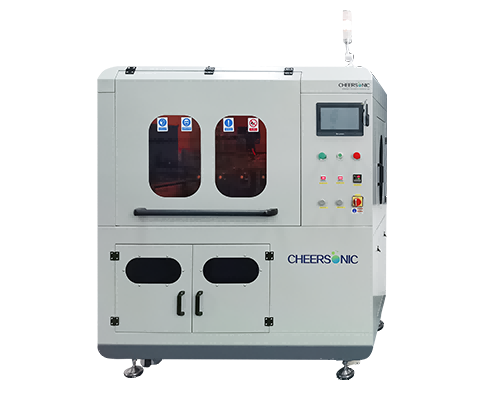
Cheersonic’s fuel cell catalyst coating system can prepare highly uniform, repeatable, and durable coatings, making it highly adaptable to such difficult application scenarios. From the research and development stage to the mass production stage, its anti clogging technology can accurately control the coating properties, significantly reduce material consumption, and lower maintenance costs and downtime.
In fuel cells and electrolysis processes, the Cheersonic ultrasonic spraying system can apply highly durable and uniform carbon based catalyst ink coatings to proton exchange membrane (PEM) electrolyzers such as perfluorosulfonic acid resin membranes (Nafion) without causing membrane deformation. A uniform catalyst coating can be deposited on the surfaces of proton exchange membrane fuel cells, gas diffusion layers (GDLs), electrodes, various electrolyte membranes, and solid oxide fuel cells. The suspension used includes carbon black ink, polytetrafluoroethylene (PTFE) binder, ceramic slurry, platinum, and other precious metals.
In addition, ultrasonic spraying technology can also be used to spray metal oxide suspensions containing platinum, nickel, iridium, ruthenium based and other metal alloys, in order to manufacture proton exchange membrane fuel cells, polymer electrolyte membrane (PEM) electrolyzers, direct methanol fuel cells (DMFCs) and solid oxide fuel cells (SOFCs), thereby achieving maximum load and high battery efficiency. Many large fuel cell manufacturers around the world are using ultrasonic nozzles to spray a uniform layer of catalyst ink film. The catalyst solution will not cause blockage of the ultrasonic nozzle, thus forming a uniform and homogeneous fuel cell catalyst coating, and precise control of droplet size can be achieved within the flow range from ultra-low flow to production scale. In addition, the Cheersonic ultrasonic nozzle is highly suitable for spraying polymer solutions such as polytetrafluoroethylene onto the gas diffusion layer to enhance the hydrophilic or hydrophobic properties during the electrolysis process.
About Cheersonic
Cheersonic is the leading developer and manufacturer of ultrasonic coating systems for applying precise, thin film coatings to protect, strengthen or smooth surfaces on parts and components for the microelectronics/electronics, alternative energy, medical and industrial markets, including specialized glass applications in construction and automotive.
Our coating solutions are environmentally-friendly, efficient and highly reliable, and enable dramatic reductions in overspray, savings in raw material, water and energy usage and provide improved process repeatability, transfer efficiency, high uniformity and reduced emissions.
Chinese Website: Cheersonic Provides Professional Coating Solutions