
What Is an Electrochemical Cell?
An electrochemical cell is a system in which chemical reactions and electrical energy are linked through electron transfer and ion transport. It contains at least two electronic conductors (electrodes) in contact with an ion-conducting medium called an electrolyte. Depending on the cell design and reaction, an electrochemical cell can generate electrical energy or use an external power supply to drive a chemical change.
For research laboratories, understanding electrochemical cell design is essential when studying batteries, fuel cells, water electrolysis, corrosion, sensors, electrosynthesis and catalytic electrode materials. Cell geometry, electrode composition, electrolyte chemistry and operating conditions all affect the measurements researchers obtain.
How Does an Electrochemical Cell Work?
Most electrochemical cells rely on an oxidation–reduction (redox) reaction. Oxidation is the loss of electrons, while reduction is the gain of electrons. These processes occur at electrode–electrolyte interfaces and are coupled so that charge can move through both an external electronic pathway and an ionic pathway.
Electrons travel through the external circuit when the reaction and cell configuration allow current to flow. Ions move through the electrolyte to maintain charge balance. In a divided cell, a separator or ion-conducting membrane may help limit mixing between compartments while allowing selected ions to pass. In other designs, both electrodes may share a single electrolyte compartment.
The driving force and direction of the reaction depend on electrode potentials, the chemical activities of the species involved, temperature, concentration and the applied electrical conditions. A cell may also be used for measurements at essentially zero current, such as certain potentiometric measurements.
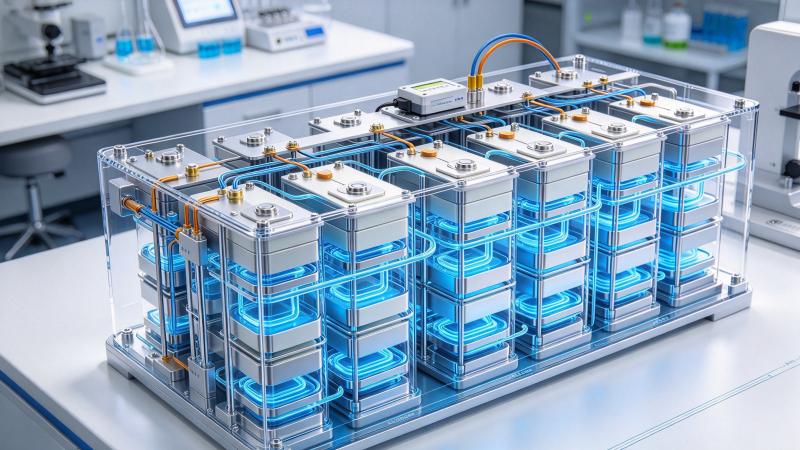
What Are the Main Components of an Electrochemical Cell?
1. Working and counter electrodes
The working electrode is the surface at which the reaction or measurement of interest takes place. Its material, exposed area, surface condition and preparation method can strongly influence the measured response. The counter electrode, also called the auxiliary electrode, completes the circuit and carries current in many controlled electrochemical experiments.
2. Reference electrode
A reference electrode provides a stable potential against which the working-electrode potential is measured. It is particularly important in three-electrode experiments, where the potentiostat controls the potential between the working and reference electrodes while current passes between the working and counter electrodes.
3. Electrolyte
The electrolyte transports ions within the cell. It may be an aqueous or non-aqueous liquid, a gel, a polymer electrolyte or a solid ionic conductor. Electrolyte composition, concentration, conductivity, pH and purity should be selected to suit the research question and reported clearly for reproducibility.
4. Separator, membrane and cell body
Some experiments require a separator or membrane to reduce unwanted mixing, manage ion transport or keep reaction products apart. The cell body, seals, current collectors and electrical connections must also be compatible with the electrolyte and operating conditions to reduce leakage, contamination and parasitic reactions.
Galvanic Cells vs. Electrolytic Cells
The two major operating categories are galvanic cells and electrolytic cells. The key difference is the direction of energy conversion.
| Feature | Galvanic cell | Electrolytic cell |
|---|---|---|
| Energy conversion | Chemical energy to electrical energy | Electrical energy to chemical energy |
| Reaction conditions | Overall reaction is spontaneous under the operating conditions | External electrical energy drives the desired reaction |
| Typical research examples | Battery discharge, fuel-cell power generation | Water electrolysis, electrodeposition, electrosynthesis |
| Electrode polarity | Anode is negative; cathode is positive during discharge | Anode is positive; cathode is negative under conventional electrolytic operation |
In both cell types, oxidation occurs at the anode and reduction occurs at the cathode. The electrode names are defined by the reactions taking place, while their electrical polarity depends on the operating mode.
Two-Electrode and Three-Electrode Cell Configurations
A two-electrode setup uses two electrodes to operate or measure the cell. It can be suitable for device-level testing and some practical systems, but the measured voltage includes contributions from both electrode interfaces and other cell components.
A three-electrode setup adds a reference electrode. This arrangement allows researchers to control and measure the working-electrode potential more precisely, which is useful for investigating reaction kinetics, catalyst activity and electrode stability. The reference electrode should be positioned appropriately, and its condition and calibration should be checked when accuracy is important.
Common Electrochemical Techniques Used in Laboratories
- Cyclic voltammetry (CV): Sweeps the working-electrode potential forward and backward to investigate redox behavior, electrochemical windows and reaction mechanisms.
- Linear sweep voltammetry (LSV): Sweeps potential in one direction and measures current, often to evaluate electrocatalytic reactions.
- Chronoamperometry: Applies a potential step or fixed potential and records current over time to study kinetics, transport or stability.
- Electrochemical impedance spectroscopy (EIS): Measures the response to a small alternating perturbation over a range of frequencies to examine interfacial and transport processes.
- Open-circuit potential (OCP) measurement: Monitors the cell potential when no externally imposed current flows, helping assess equilibration or changes at the interface.
For meaningful comparisons, researchers should document the electrode area, catalyst loading, electrolyte composition, temperature, scan rate, reference-electrode scale, iR compensation and conditioning procedure. Report how current density and overpotential are calculated, and use repeat measurements or appropriate controls to assess variability.
Why Electrode Materials and Coating Quality Matter
Electrochemical results depend not only on the active material but also on how it is distributed, attached and connected to the current collector. Important variables include catalyst composition, particle-size distribution, layer thickness, porosity, adhesion, wetting, electrical contact and ionic transport. These factors affect the accessible active surface, mass transfer, resistance and long-term stability.
For catalyst-coated membranes, gas-diffusion electrodes and other porous substrates, uneven deposition can lead to local differences in catalyst loading and transport behavior. Excessive loading may block pores or increase material consumption, while insufficient loading may leave parts of the substrate underused. Researchers should therefore assess physical coating characteristics alongside electrochemical performance.
When preparing catalyst inks or functional suspensions, control formulation, solids content, viscosity, substrate condition, deposition rate and drying conditions. Where appropriate, combine mass-loading or thickness measurements with microscopy and electrochemical testing. No deposition process guarantees a specific performance result without validation under the intended experimental conditions.
Applications of Electrochemical Cells
- Energy storage: Investigating battery electrodes, electrolyte compatibility, degradation and charge-storage mechanisms.
- Fuel cells and water electrolysis: Evaluating catalysts, membrane-electrode assemblies, gas-diffusion electrodes and reaction interfaces.
- CO₂ electrolysis: Studying catalyst layers and electrode structures for electrochemical carbon dioxide conversion.
- Corrosion research: Measuring corrosion rates, protective-film behavior and the influence of environmental conditions.
- Electrochemical sensors: Converting chemical or biological interactions into measurable electrical signals.
- Electrosynthesis and electrodeposition: Using controlled current or potential to produce compounds or modify material surfaces.
How to Choose an Electrochemical Cell for Research
Start by defining the target reaction, the quantity to be measured and the operating environment. Then select a suitable cell configuration, electrode material, electrolyte and reference scale. Check chemical compatibility, temperature limits, gas management, sealing and whether the experiment requires separated compartments.
For reproducible research, standardize electrode preparation and exposed area, document catalyst loading and conditioning, minimize contamination, and keep measurement parameters consistent across samples. When comparing electrode coatings, record both the deposition conditions and the electrochemical test protocol. These details help distinguish genuine material improvements from differences caused by cell setup or sample preparation.
Frequently Asked Questions
What is the main function of an electrochemical cell?
An electrochemical cell enables coupled oxidation and reduction reactions to exchange energy through electron transfer and ion transport. It can produce electrical energy or use electrical energy to drive a chemical reaction.
What is the difference between an electrochemical cell and an electrolytic cell?
An electrochemical cell is the general term. An electrolytic cell is a type of electrochemical cell that uses electrical energy to drive a chemical change.
Why is a reference electrode used in laboratory experiments?
A reference electrode provides a stable potential for measuring and controlling the working-electrode potential, especially in three-electrode experiments.
Can electrode coating uniformity affect electrochemical performance?
Yes. Coating thickness, catalyst distribution, porosity and adhesion can affect active-site accessibility, transport, resistance and stability. Their influence should be verified with physical characterization and electrochemical measurements.
Explore More Electrochemistry Research
For a broader introduction to redox reactions and laboratory methods, read What Is Electrochemistry? and visit the Electrochemistry Knowledge Center.
