
What Is Electrochemistry?
Electrochemistry is the branch of chemistry that studies the relationship between chemical reactions and electrical energy. It explains how electron-transfer reactions generate electricity in batteries and fuel cells, and how an applied voltage can drive reactions in electrolysis, electrosynthesis, corrosion control and electrochemical manufacturing.
For researchers developing energy materials, catalysts, sensors or functional electrodes, electrochemistry provides the framework for understanding reaction pathways, measuring performance and improving electrode–electrolyte interfaces.
How Does Electrochemistry Work?
At the center of electrochemistry are oxidation–reduction (redox) reactions. Oxidation involves the loss of electrons, while reduction involves the gain of electrons. In an electrochemical system, these processes occur at electrode surfaces and are coupled through an external electronic circuit and an ion-conducting electrolyte.
An electrochemical cell typically contains at least two electronic conductors (electrodes) in contact with an electrolyte. Electrons move through the external circuit, while ions move through the electrolyte to maintain charge balance. The cell design, electrode composition, electrolyte chemistry and operating conditions together determine the observed voltage, current and reaction selectivity.
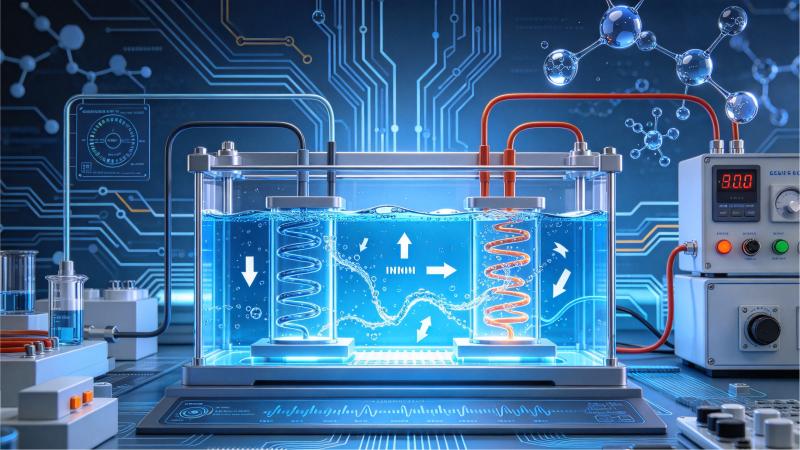
Key Components of an Electrochemical Cell
- Working electrode: The surface where the reaction or measurement of interest takes place.
- Counter (auxiliary) electrode: Completes the electrical circuit and carries current in many experimental setups.
- Reference electrode: Provides a stable potential against which the working-electrode potential is measured.
- Electrolyte: A liquid, gel, polymer or solid medium that transports ions between reaction regions.
- Separator or membrane (when required): Allows selected ionic transport while helping prevent unwanted mixing between compartments.
In laboratory research, a three-electrode configuration is commonly used when precise control of working-electrode potential is important. A potentiostat controls the potential relative to the reference electrode and measures the resulting current through the working and counter electrodes.
Galvanic Cells vs. Electrolytic Cells
Galvanic (voltaic) cells convert energy released by a spontaneous chemical reaction into electrical energy. Batteries and fuel cells operate through electrochemical reactions of this type during discharge or power generation.
Electrolytic cells use an external electrical supply to drive a chemical reaction. Examples include water electrolysis for hydrogen production, electrodeposition, and many forms of electrochemical synthesis. In both cases, oxidation occurs at the anode and reduction occurs at the cathode; the electrode polarity depends on whether the cell is galvanic or electrolytic.
Common Electrochemical Techniques in Research Laboratories
- Cyclic voltammetry (CV): Evaluates redox behavior and helps investigate reaction mechanisms, electrochemical windows and catalyst activity.
- Chronoamperometry and chronopotentiometry: Track current or potential over time under controlled conditions.
- Electrochemical impedance spectroscopy (EIS): Uses a small alternating perturbation over a range of frequencies to investigate processes such as charge transfer, interfacial capacitance and transport limitations.
- Linear sweep voltammetry (LSV): Measures current while potential is swept in one direction, often for studying catalytic reactions such as hydrogen or oxygen evolution.
Reliable comparisons require controlled and reported experimental conditions, including electrode geometric area, catalyst loading, electrolyte composition, temperature, scan rate, reference-electrode calibration and any iR compensation. Current density and overpotential should be defined consistently, and stability tests should state their duration and operating conditions.
Why Electrode Materials and Coating Quality Matter
Electrochemical performance depends not only on the active material but also on how that material contacts the current collector and electrolyte. Catalyst composition, particle distribution, porosity, adhesion, layer thickness and ion/electron transport can influence accessible active sites, mass transfer, resistance and durability.
For catalyst-coated electrodes, membranes and porous substrates, uneven deposition may create regions with different catalyst loading or transport behavior. Excessive loading can obstruct pores or increase material cost, while insufficient loading may leave parts of the substrate underutilized. Researchers therefore evaluate coating uniformity alongside electrochemical metrics rather than treating deposition as a separate, purely cosmetic step.
Ultrasonic spray coating is one option for depositing formulated catalyst inks and functional suspensions as thin layers. Atomization and process parameters must be matched to the ink’s solids content, solvent system, viscosity, substrate geometry and drying behavior. The resulting layer should be validated by appropriate thickness or mass-loading measurements, microscopy and electrochemical testing; no coating method guarantees a particular performance without application-specific trials.
Applications of Electrochemistry
- Batteries and supercapacitors: Study charge storage, electrode degradation and electrolyte compatibility.
- Fuel cells and water electrolyzers: Investigate catalysts, gas-diffusion electrodes, membrane-electrode assemblies and reaction interfaces.
- CO₂ electrolysis: Develop catalysts and electrodes for converting carbon dioxide into useful chemicals or fuels.
- Corrosion and surface engineering: Understand metal degradation, protective films and electrochemical surface treatments.
- Sensors and analytical chemistry: Convert chemical interactions into measurable electrical signals.
- Electrosynthesis and industrial processing: Use controlled electrochemical reactions to produce or refine chemical compounds and materials.
Getting Started with Electrochemistry Experiments
Begin with a clearly defined research question and select a cell configuration, electrode material and electrolyte suitable for the reaction. Establish reproducible preparation procedures, document the active area and catalyst loading, and include appropriate controls. Calibrate the reference electrode when needed, check for contamination and gas-bubble effects, and repeat measurements to assess variability. When comparing coatings, keep test conditions consistent and report both electrochemical results and relevant physical characterization.
Explore Electrochemical Materials and Coating Research
Electrochemistry connects fundamental redox science with practical advances in energy conversion, storage and sensing. For related topics, visit the Electrochemistry Knowledge Center and explore research on ultrasonic spray-coated platinum–titanium anodes.
For authoritative terminology, see the IUPAC Gold Book definitions of the electrochemical cell, electrode and galvanic cell.