Ultrasonic Spray Coating for Carbon Capture
Precision Ultrasonic Spray Coating: A Game-Changer for Carbon Capture Technology
As the world accelerates its transition toward a low-carbon economy, carbon capture, utilization, and storage (CCUS) has emerged as one of the most critical technological frontiers. The global carbon capture equipment market is projected to grow at a compound annual growth rate of approximately 7.5% through 2032, driven by tightening emissions regulations and ambitious net-zero commitments. At the heart of this expansion lies a fundamental manufacturing challenge: how to produce high-performance catalyst-coated membranes with the precision, uniformity, and durability required for efficient CO₂ separation.
Traditional coating methods—such as air spraying, blade coating, and screen printing—often fall short when applied to the demanding requirements of carbon capture electrolysis. These techniques struggle with issues like non-uniform film thickness, material waste from overspray, substrate deformation, and the dreaded “coffee ring effect” that compromises membrane performance. What the industry urgently needs is a coating solution that can deliver nano-scale precision while maintaining cost-effectiveness and scalability. Enter the ultrasonic spray coating platform—a technology that is fundamentally reshaping how carbon capture membranes are manufactured.
The Science of Ultrasonic Spray Coating
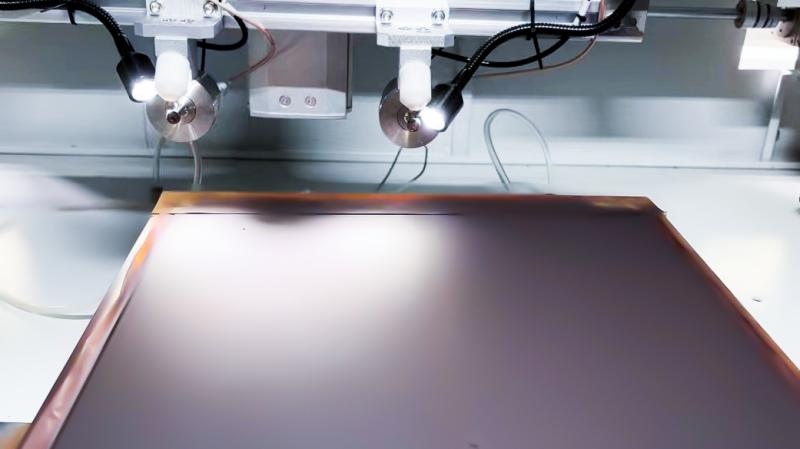
Unlike conventional pressure-driven spray systems, ultrasonic spray coating operates on a fundamentally different principle. High-frequency ultrasonic vibrations break the coating liquid into a mist of micron-sized, uniformly distributed droplets. These droplets are carried by a gentle carrier gas stream to the substrate, where they form a dense, porous, and highly uniform coating layer. The result is a film with thickness uniformity of ±2%—a level of precision that traditional methods simply cannot match.
For carbon capture applications, this precision translates directly into performance. In CO₂ electrolysis systems, the catalyst layer deposited on proton exchange membranes must be both ultra-thin and perfectly uniform to facilitate selective CO₂ permeation while minimizing ionic resistance. Ultrasonic spray technology meets this challenge by producing coatings that are not only uniform but also highly durable and stable under harsh industrial operating conditions.
Key Advantages for Carbon Capture Manufacturing
The ultrasonic spray coating platform offers several distinct advantages that make it particularly well-suited for carbon capture applications:
First, exceptional material utilization. The soft, low-velocity spray plume virtually eliminates overspray, achieving material usage ratios exceeding 95%. This is especially critical when working with expensive catalyst materials such as platinum, iridium, and other precious metals. By depositing material precisely where it is needed, the technology can reduce coating material consumption by up to 80% compared to conventional methods.
Second, superior coating quality. The ultrasonic atomization process produces droplets with a tight size distribution, resulting in pinhole-free films with thickness deviations of less than ±5%. This eliminates common defects like edge buildup, agglomeration, and the coffee ring effect that plague other coating techniques. The result is a membrane with enhanced CO₂ selectivity and improved electrochemical reaction efficiency.
Third, substrate protection. Because the spray is generated by ultrasonic vibration rather than high-pressure propulsion, the coating process exerts minimal mechanical stress on delicate membrane materials. This is particularly important for proton exchange membranes like Nafion, which can be deformed by conventional spray methods. The gentle nature of ultrasonic spraying ensures membrane integrity while achieving superior coating adhesion.
Fourth, operational reliability. The self-cleaning ultrasonic nozzle design prevents clogging—a common issue with catalyst inks and slurries—thereby reducing maintenance downtime and ensuring consistent, repeatable performance. The system supports continuous or intermittent precision spraying at ultra-low flow rates, providing researchers and manufacturers with the flexibility to optimize their specific coating processes.
A Platform for Research and Production
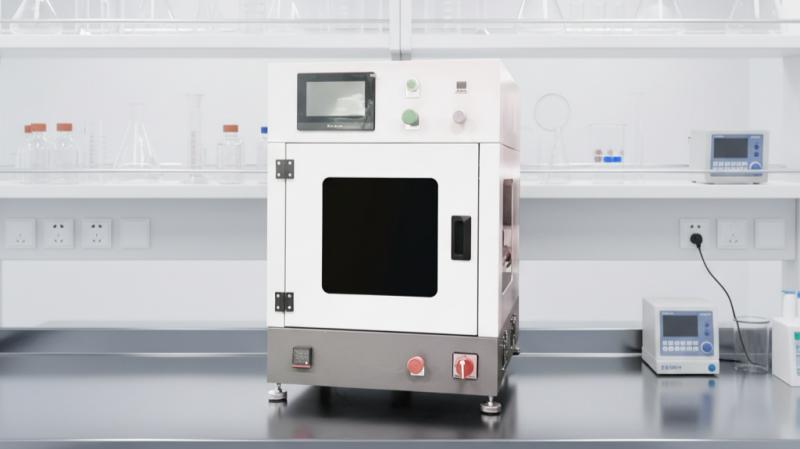
The desktop ultrasonic spray system is specifically engineered for research and development as well as low-volume production. Its compact footprint and programmable three-axis motion system provide exceptional flexibility for laboratory environments. With a maximum spray area of 200×200 mm and the ability to accommodate various ultrasonic nozzle types with spray widths ranging from 1 mm to 60 mm, the system can handle a wide spectrum of coating applications—from small-scale catalyst screening to pilot production runs.
Driving the Future of Carbon Capture
As governments worldwide accelerate investment in CCUS infrastructure—with national energy authorities calling for breakthroughs in carbon capture technologies—the demand for high-quality, cost-effective membrane manufacturing will only intensify. Ultrasonic spray coating technology stands ready to meet this challenge. By enabling the production of membranes with superior CO₂ selectivity, enhanced durability, and reduced energy requirements for the electrolysis process, this coating platform is helping to make carbon capture not just environmentally necessary but economically viable.
The captured carbon, once separated, can be converted into valuable products such as fuels and chemicals—transforming a climate liability into an economic opportunity. And at the foundation of this transformation lies a seemingly simple but profoundly impactful technology: precision ultrasonic spray coating. For researchers, engineers, and manufacturers working at the forefront of the carbon capture revolution, this is the tool that turns vision into reality.
About Cheersonic
Cheersonic is the leading developer and manufacturer of ultrasonic coating systems for applying precise, thin film coatings to protect, strengthen or smooth surfaces on parts and components for the microelectronics/electronics, alternative energy, medical and industrial markets, including specialized glass applications in construction and automotive.
Our coating solutions are environmentally-friendly, efficient and highly reliable, and enable dramatic reductions in overspray, savings in raw material, water and energy usage and provide improved process repeatability, transfer efficiency, high uniformity and reduced emissions.
If you have any technical questions, customization demands, or procurement inquiries about ultrasonic atomization nozzles, feel free to contact our professional sales and technical team for detailed parameters, customized solutions, and industry application support.
Email: market2@cheersonic.com
