
Ultrasonic Spray Pyrolysis Granulation for Nano-Tin Oxide
Ultrasonic Spray Pyrolysis Granulation for Nano-Tin Oxide – Cheersonic
In the forefront of modern materials science, nanomaterial preparation technology remains a core driver of industrial progress. Nano-tin oxide, a functional material with exceptional properties, demonstrates immense application potential in fields such as gas sensors, transparent conductive films, anodes for lithium-ion batteries, and high-performance catalysts. Its performance depends heavily on the precise control of particle size, morphology, purity, and dispersion during the preparation process. Among the various manufacturing methods, ultrasonic spray pyrolysis—characterized by its unique one-step synthesis, continuous operation, and superior controllability—has emerged as a key technology for producing high-quality nano-tin oxide powders; the core platform for this process is the specialized ultrasonic spray pyrolysis granulation system.
I. Technical Principle: The Precise Transformation from Solution to Nanoparticles
Ultrasonic spray pyrolysis is essentially a continuous preparation process that ingeniously combines solution chemistry with high-temperature physical reactions. The system is not merely a “granulator” but a precision apparatus integrating atomization, reaction, shaping, and crystallization.
Its workflow can be summarized into the following core stages:
1. Precursor Solution Preparation and Ultrasonic Atomization:
First, high-purity tin-based salts (such as stannous chloride or tin(IV) chloride pentahydrate) are dissolved in deionized water or specific organic solvents to prepare a precursor solution with uniform dispersion and precise concentration. This solution is fed into the equipment’s core component: the ultrasonic atomizer. Driven by high-frequency ultrasonic energy (typically in the megahertz range), intense capillary waves form on the solution’s surface, shattering the liquid into billions of extremely fine, uniform droplets. The excellent monodispersity of the droplets produced by this method lays a solid foundation for obtaining nanoparticles with uniform particle sizes.

2. Aerosol Transport and High-Temperature Pyrolysis:
The generated micron-sized droplets are carried by a stable, clean stream of carrier gas (such as air, nitrogen, or argon) into a reaction furnace tube preheated to a set temperature (typically several hundred degrees Celsius). In this high-temperature environment, the droplets undergo a rapid series of complex physicochemical changes: solvent evaporation, precursor salt decomposition, oxidation, and final crystallization. Each tiny droplet acts as an independent “micro-reactor,” facilitating the transformation from a solution state to a solid spherical particle.
3. Particle Formation and Collection:
Following a brief heat treatment (typically lasting a few seconds), the newly formed tin oxide nanoparticles—possessing a specific crystal structure—exit the high-temperature zone with the gas flow and enter the system’s collection unit. High-efficiency cyclone separators, combined with electrostatic precipitators or bag filters, are typically employed to achieve efficient, non-destructive recovery of the final powder product.
II. Technical Advantages: Why Choose This Approach?
Compared to traditional methods such as co-precipitation, sol-gel, or hydrothermal synthesis, the ultrasonic spray pyrolysis approach utilized by this equipment offers several significant advantages for the production of tin oxide nanoparticles:
- Excellent Control Over Particle Morphology and Size: Due to the uniformity of the droplets, the resulting tin oxide nanoparticles are typically regular spheres with a narrow particle size distribution. By precisely adjusting parameters such as precursor solution concentration, ultrasonic power and frequency, and carrier gas flow rate, the final particle size can be accurately engineered to range from tens of nanometers to the micron scale.
- High Product Purity and Crystallinity: The entire process takes place within a sealed pipeline system, effectively preventing contamination by external impurities. The continuous, one-step synthesis method ensures complete precursor decomposition, while the high-temperature environment promotes the formation of products with high crystallinity—a factor crucial for the electrical and sensing performance of the tin oxide nanoparticles.
- Continuous processing and easy scale-up: The technology operates as a continuous flow process from feed to discharge, making it highly suitable for industrial-scale mass production. It resolves the challenge of maintaining product quality consistency between batches and enables an efficient transition from laboratory research to industrial-scale production.
- Compositional uniformity and doping flexibility: This method offers inherent advantages for producing modified nano-tin oxide that requires doping with other metal elements (such as antimony or fluorine) to tune electrical properties. By simply co-dissolving different metal salts in the precursor solution at precise ratios, one can ensure that every generated particle possesses a highly consistent chemical composition.
III. Core components and innovative design considerations of the equipment system
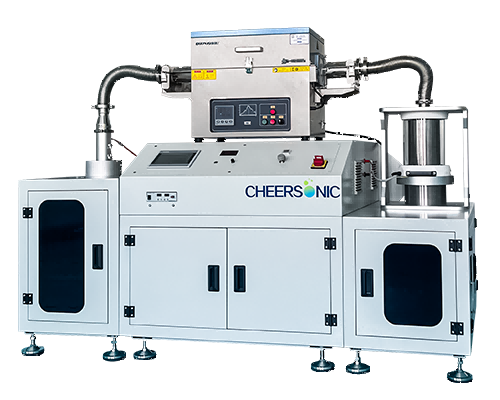
A high-performance ultrasonic spray pyrolysis granulation system serves as the physical foundation for realizing these technical advantages. Far from being a mere assembly of simple units, it is a highly integrated system comprising the following key modules:
- Precision feeding and atomization system: High-precision peristaltic pumps or liquid chromatography pumps are employed to ensure a stable flow rate of the precursor solution. The core ultrasonic atomizer features a wide, adjustable range of frequency and power settings to accommodate solutions with varying viscosities and surface tensions.
- Customized reaction furnace system: Typically, a tube furnace with zoned temperature control is used to provide a precise, stable temperature field and a controllable heating profile, ensuring complete and uniform pyrolysis reactions. Furnace tube materials (e.g., quartz, corundum) are selected based on the reaction temperature and atmosphere (oxidizing or inert).
- High-efficiency gas delivery and particle collection system: Carrier gases undergo rigorous filtration and drying. The design of the collection unit directly impacts product yield and operational convenience; multi-stage collection schemes (such as a combination of cyclone separators and high-efficiency filters) are often utilized to maximize collection efficiency.
- Intelligent control system: Modern equipment integrates PLC or computer-based control systems, enabling digital setting, real-time monitoring, and data logging of all critical process parameters—such as temperature, flow rate, and pressure—thereby ensuring process repeatability and stability. IV. Application Prospects and Outlook
Nanostructured tin oxide powders produced via ultrasonic spray pyrolysis are highly favored in high-end application sectors due to their excellent controllability and consistency. For instance, in semiconductor-based gas sensors, their high specific surface area and uniform particle size ensure rapid and highly sensitive responses; in the field of transparent conductive oxide films, they serve as an ideal raw material for producing films characterized by low electrical resistance and high optical transparency.
Looking ahead, as performance requirements for nanomaterials become increasingly stringent, ultrasonic spray pyrolysis equipment and technology will evolve toward greater intelligence and multifunctionality. Examples include integrating in-line monitoring tools (such as laser particle size analysis) to enable real-time process feedback control, or developing multi-source precursor co-spraying techniques to fabricate more complex core-shell structures or multi-component composite nanomaterials.
In summary, ultrasonic spray pyrolysis equipment has transcended the role of a mere tool, emerging as a pivotal platform for transitioning nano-tin oxide materials from conventional “production” to “intelligent manufacturing.” Through precise process control, continuous production capabilities, and superior product performance, this technology injects powerful momentum into the R&D and industrialization of functional nanomaterials, demonstrating broad application prospects and immense market potential.
About Cheersonic
Cheersonic is the leading developer and manufacturer of ultrasonic coating systems for applying precise, thin film coatings to protect, strengthen or smooth surfaces on parts and components for the microelectronics/electronics, alternative energy, medical and industrial markets, including specialized glass applications in construction and automotive.
Our coating solutions are environmentally-friendly, efficient and highly reliable, and enable dramatic reductions in overspray, savings in raw material, water and energy usage and provide improved process repeatability, transfer efficiency, high uniformity and reduced emissions.
Chinese Website: Cheersonic Provides Professional Coating Solutions