
Protective Interfacial Layer Construction for Stabilized Zinc Anodes
Study on Construction of Protective Interfacial Layer and Its Regulation Mechanism on Zinc Anode Stability
In aqueous zinc-ion batteries, metallic zinc anodes suffer from severe drawbacks including dendrite propagation, hydrogen evolution corrosion and accumulation of by-products, which drastically shorten cell cycle lifespan and deteriorate Coulombic efficiency. Fabrication of artificial protective interfacial layers has been recognized as a promising route to mitigate these critical issues. In this work, an even, compact and thickness-tunable protective coating (~6 μm) is successfully fabricated on zinc foil via ultrasonic spray coating technology. Relying on high-frequency vibration, the precursor solution is atomized into micron-sized droplets, which are uniformly deposited onto preheated zinc substrates driven by carrier gas. Different from conventional blade coating and spin coating prone to uneven film thickness and pinhole defects, this technique is highly compatible with large-scale manufacturing of large-area electrodes.
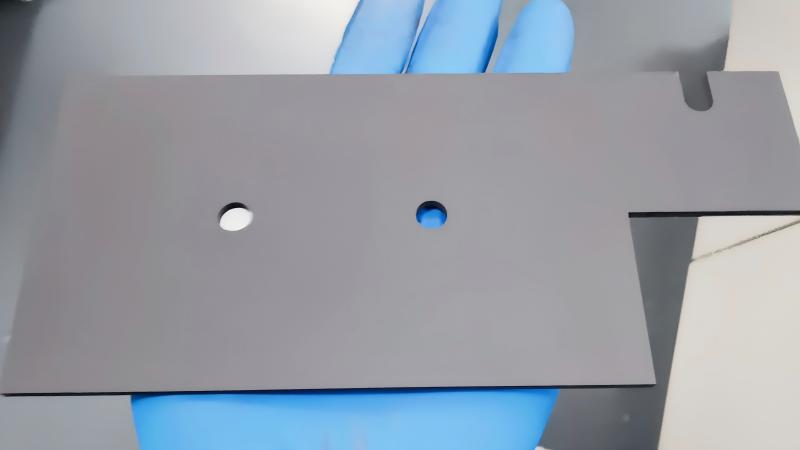
Multiple characterization techniques are employed to systematically verify the structural integrity and electrochemical functionality of the as-prepared protective layer. X-ray diffraction (XRD) results reveal characteristic diffraction peaks well consistent with the target crystalline phase without miscellaneous impurity peaks, verifying high phase purity of the coating. Scanning electron microscopy (SEM) observations demonstrate a crack-free and pore-free compact coating tightly bonded to the zinc substrate; cross-sectional SEM images further confirm the average coating thickness of ~6 μm with a laminated stacking structure beneficial for homogenizing ionic transport pathways. Contact angle measurements manifest greatly enhanced surface hydrophobicity after coating modification, with water contact angle elevated from approximately 70° for bare zinc to above 110°. Such hydrophobic interfacial environment blocks direct contact between active water molecules in hydrated zinc ion coordination shells and electrode surface, therefore restraining hydrogen evolution and generation of by-products such as basic zinc sulfate.
Chloride penetration resistance serves as a vital criterion to evaluate coating compactness. Chloride ions commonly exist as electrolyte additives or inherent impurities and readily trigger localized pitting corrosion owing to strong penetration capability. Chronoamperometry and penetration tests verify outstanding chloride blocking performance of the protective layer, whose penetration current density is nearly two orders of magnitude lower than that of pristine zinc, proving the dense coating effectively isolates corrosive chloride anions and preserves interfacial chemical stability.
First-principles calculations based on density functional theory (DFT) are performed to uncover the underlying working mechanism of the protective layer at atomic scale, with emphasis on interfacial interactions between the core coating component (denoted as ZA) and various electrolyte ions. Calculation data show the adsorption energy of ZA toward Cl⁻ reaches −1.27 eV, considerably superior to bare zinc and mainstream interfacial materials including graphene and MXene. The highly negative adsorption energy indicates intense repulsion between ZA substrate and Cl⁻, preventing stable chloride adsorption and effectively repelling corrosive Cl⁻ away from the electrode to eliminate chloride-induced pitting corrosion, which is essential for long-term electrode durability under chloride-containing electrolyte surroundings.
Meanwhile, the binding energy between ZA and Zn²⁺ is calculated to be −9.85 eV, remarkably higher than that of unmodified zinc surface. The robust Zn²⁺ binding affinity enables effective capture of free Zn²⁺ from bulk electrolyte and facilitates desolvation by stripping coordinated water molecules and anions from Zn²⁺ solvation shells. Desolvation is widely acknowledged as the rate-determining step during zinc electroplating, and accelerated desolvation kinetics reduces zinc nucleation overpotential significantly. Benefiting from the protective coating, Zn²⁺ gains reduced energy barrier for electrochemical reduction and consequently undergoes homogeneous nucleation.
Further investigation on ionic migration behavior demonstrates the Zn²⁺ diffusion energy barrier inside ZA crystal lattice is merely 0.11 eV, far lower than those on bare zinc or conventional inorganic coatings such as TiO₂ and ZnO. The low diffusion barrier enables rapid Zn²⁺ transportation across the protective layer and homogenizes interfacial ionic concentration distribution, suppressing dendrite formation originating from localized ion depletion or excessive enrichment. Coupled with optimized desolvation kinetics, continuous Zn²⁺ flux penetrates through the coating and realizes dense, dendrite-free zinc deposition on underlying zinc foil.
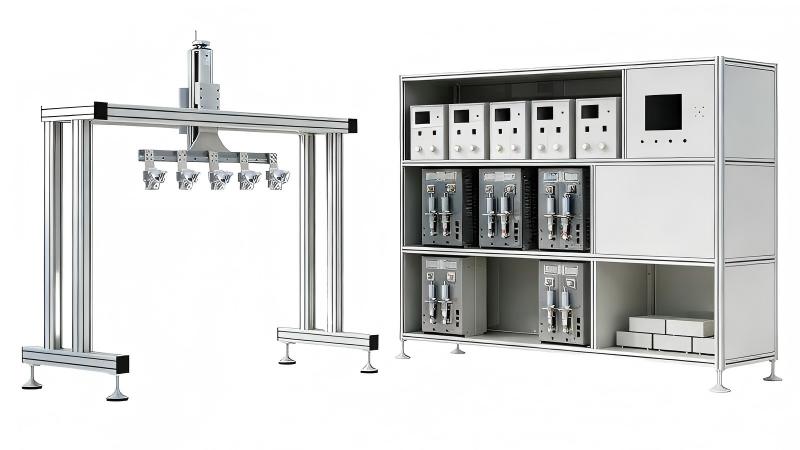
In summary, the ZA protective layer fabricated via ultrasonic spray coating integrates superior hydrophobicity, outstanding chloride shielding capability, strong Zn²⁺ anchoring effect and low ionic diffusion barrier, synergistically modulating interfacial electrochemistry of zinc anodes from multiple dimensions. This interfacial engineering strategy provides a feasible design philosophy for developing high-stability and long-lifespan aqueous zinc batteries. In addition, the scalable ultrasonic spray coating process renders this modification method promising for practical industrial applications.
About Cheersonic
Cheersonic is the leading developer and manufacturer of ultrasonic coating systems for applying precise, thin film coatings to protect, strengthen or smooth surfaces on parts and components for the microelectronics/electronics, alternative energy, medical and industrial markets, including specialized glass applications in construction and automotive.
Our coating solutions are environmentally-friendly, efficient and highly reliable, and enable dramatic reductions in overspray, savings in raw material, water and energy usage and provide improved process repeatability, transfer efficiency, high uniformity and reduced emissions.
Chinese Website: Cheersonic Provides Professional Coating Solutions
