
Application and Value of Ultrasonic Spraying in Electrolytic Cells
Ultrasonic spraying technology, as a precision coating process, has played a key role in the field of electrolytic cell manufacturing due to its unique atomization principle and performance advantages, especially providing effective solutions for the large-scale and high-quality production of electrolytic cells such as proton exchange membranes (PEM) and anion exchange membranes (AEM).
The core principles and characteristics of ultrasonic spraying technology
Ultrasonic spraying technology is based on ultrasonic atomization, and its workflow differs fundamentally from traditional spraying. Firstly, liquid coatings (such as solutions, sols, suspensions, etc.) are transported to the ultrasonic nozzle. The piezoelectric transducer inside the nozzle converts high-frequency electrical signals (usually 20-180kHz) into mechanical vibrations, causing the liquid to form capillary waves on the nozzle surface; When the vibration amplitude reaches the critical value, the liquid breaks down into uniform micrometer sized droplets, which are then precisely coated onto the surface of the substrate by a small amount of carrier gas to form a dense film.
Compared with traditional single/two fluid spraying, the core feature of this technology is that it does not require air pressure assisted atomization, which can significantly reduce paint splashing and waste, and the material utilization rate is more than 4 times that of traditional processes; At the same time, the droplet size is precisely controlled by the vibration frequency (the higher the frequency, the smaller the droplet), and the nozzle vibration can disperse the particle aggregation in the coating, avoiding blockage problems and laying the foundation for precision coating of key components of the electrolytic cell.
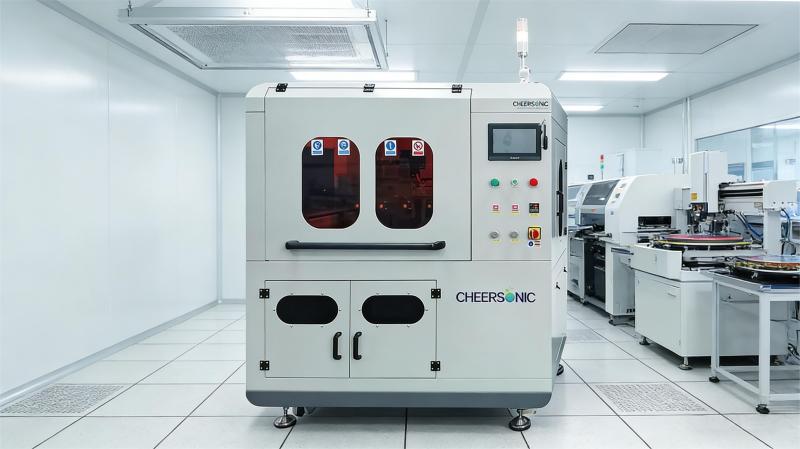
The core advantages of ultrasonic spraying technology
In the context of electrolytic cell manufacturing, the advantages of ultrasonic spraying technology are mainly reflected in four dimensions: efficiency, quality, cost, and environmental protection:
1. High coating efficiency and consistency: It can achieve large-area rapid spraying and is equipped with an automated control system that can monitor spraying parameters in real time (such as flow rate, temperature, and motion path), ensuring the uniformity of coating thickness and distribution in mass production, and avoiding common defects such as edge effects and dry stripes in traditional manual or high-speed coating.
2. Accurate and controllable coating quality: It can generate ultrafine droplets (several micrometers to 100 micrometers), forming ultra-thin and dense coatings. This not only optimizes the electrochemical reaction interface (such as three-phase interface) inside the electrolytic cell, but also improves the adhesion and structural strength of the coating, reducing the risk of catalyst layer cracking and peeling.
3. Excellent cost and material economy: For commonly used precious metal catalysts in electrolytic cells (such as platinum and iridium), this technology can accurately control the coating loading, reduce overspray, and reduce material consumption by up to 50%; At the same time, automated operations reduce labor costs and adapt to the full scenario requirements from research and development trials to mass production.
4. Strong green environmental protection and safety: no need to rely on organic solvents or high-pressure gases, reducing harmful substance emissions; And the spraying process is gentle, which can avoid mechanical damage (such as swelling and deformation) to fragile substrates such as PEM, ensuring the integrity of the core components of the electrolytic cell.
Specific application scenarios in electrolytic cell manufacturing
Ultrasonic spraying technology has been deeply adapted to the coating requirements of key components in PEM and AEM mainstream electrolytic cells, addressing their performance and lifespan pain points in a targeted manner
Application of Coating in PEM Electrolytic Cells
PEM electrolysis cells need to operate in strong acid and highly oxidizing environments, with extremely high requirements for the corrosion resistance, conductivity, and uniformity of coatings. The application of ultrasonic spraying is focused on three core components:
1. Catalyst coating: Uniformly coating carbon based, platinum based, or iridium based catalyst slurry on the electrode surface to form an ultra-thin active layer can improve catalyst utilization (up to 90%), optimize hydrogen/oxygen evolution reaction efficiency, directly improve hydrogen purity and yield, while reducing the amount of precious metals used to control costs.
2. Bipolar plate and gas diffusion layer (GDL) coating: Coating platinum, gold, or carbon based conductive anti-corrosion materials on the surface of bipolar plates and GDLs to form a dense protective layer, resist electrolyte corrosion, and extend component life; At the same time, the hydrophilicity/hydrophobicity of GDL can be adjusted by coating PTFE adhesive, optimizing the gas-liquid transmission efficiency.
3. Proton exchange membrane coating: Non contact spraying is used to precisely deposit the catalyst on the surface of the proton membrane, avoiding swelling and deformation of the membrane body; The formed catalytic layer is tightly bound to the membrane, which can optimize the ion conduction path and further enhance the overall performance of the electrolytic cell.
Application of Coating in AEM Electrolytic Cells
The coating requirements for AEM electrolytic cells focus on improving conductivity and reaction efficiency: on the one hand, spraying a uniform and dense catalyst coating on the electrode surface to ensure the adequacy of electrochemical reactions; On the other hand, coating conductive materials inside the electrolyte channel reduces interfacial resistance, improves overall conductivity, and ultimately achieves dual optimization of electrolysis efficiency and hydrogen purity.
Actual application effects and future prospects
From practical applications, ultrasonic spraying technology has been validated for its industrial value: in mass production scenarios, some spraying systems can achieve a catalyst spraying rate of 0.8 square meters per hour (equivalent to producing 120000 pieces of 250cm ² membrane electrodes annually), and can operate continuously for 7 days; At the same time, the electrolytic cell coated with this technology not only significantly improves corrosion resistance and lifespan, but also reduces unit hydrogen production energy consumption, meeting the economic needs of green hydrogen production.
As the hydrogen energy industry advances towards gigawatt scale, the application prospects of ultrasonic spraying technology will further expand: on the one hand, the technology will iterate towards higher precision (such as nanoscale coating control) and lower cost (such as multi nozzle integrated systems), adapting to the coating needs of larger sized electrolytic cell components; On the other hand, its environmental protection and high efficiency characteristics will help electrolytic cell manufacturing overcome the limitations of traditional processes and become one of the key equipment technologies to promote the large-scale and low-carbon development of the hydrogen energy industry.
About Cheersonic
Cheersonic is the leading developer and manufacturer of ultrasonic coating systems for applying precise, thin film coatings to protect, strengthen or smooth surfaces on parts and components for the microelectronics/electronics, alternative energy, medical and industrial markets, including specialized glass applications in construction and automotive.
Our coating solutions are environmentally-friendly, efficient and highly reliable, and enable dramatic reductions in overspray, savings in raw material, water and energy usage and provide improved process repeatability, transfer efficiency, high uniformity and reduced emissions.
Chinese Website: Cheersonic Provides Professional Coating Solutions
