
MEMS Gas Sensor Technology White Paper (2026 Edition)
Abstract
MEMS gas sensors, characterized by miniaturization, low power consumption, high integration, and mass production capabilities, have become key sensing devices in fields such as industrial safety, environmental monitoring, new energy, consumer electronics, and healthcare. This white paper systematically reviews the technical principles, mainstream approaches, process capabilities, typical applications, and development trends of MEMS gas sensing, providing a reference for industry selection, solution design, and technology implementation. The entire document is brand-neutral and focuses on general technologies and industry value.
Industry Background and Core Value
1. Upgraded Sensing Needs
Safety supervision, dual-carbon control, air quality management, new energy safety, and the popularization of the Internet of Things are driving gas detection from fixed-point, offline, and large-scale instruments to distributed, online, miniaturized, and intelligent systems.
2. The Irreplaceability of MEMS
Based on silicon-based micro-nano fabrication, MEMS achieves unparalleled reductions in size, power consumption, cost control, and batch consistency compared to traditional sensors, supporting battery-powered, wearable, automotive, home, and high-density sensor networks.
3. Industry Positioning
MEMS gas sensors serve as a digital sensing entry point, connecting the physical environment with data systems, and are fundamental hardware support for intelligent equipment, smart cities, and the Industrial Internet.
Technical Principles and Core Mechanisms
2.1 Basic Working Logic
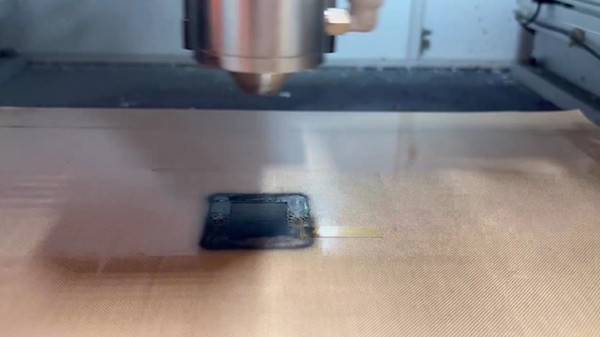
MEMS gas sensors fabricate sensitive thin films and micro-heating/microfluidic units on a micrometer-scale structure. When the target gas interacts with the sensitive layer, it generates changes in resistance, capacitance, frequency, optical, or thermal signals. These changes are read out by circuitry and compensated by algorithms to output concentration and state information.
2.2 Mainstream Technology Routes
– Metal Oxide Semiconductor (MOS)
High sensitivity, mature technology, wide gas coverage; relies on micro-heating, suitable for detecting most combustible/toxic/VOCs.
– Thermal Conductivity (TC)
Strong stability, long lifespan, anti-interference, suitable for gases with significant differences in thermal conductivity, such as hydrogen, methane, and inert gases.
– Optical MEMS
High selectivity, low drift, simultaneous detection of multiple components; rapidly iterating towards miniaturization and low power consumption.
– Electrochemical Miniaturization
Operates at room temperature with high precision, primarily used for toxic and harmful gases such as CO, NO₂, and H₂S.
– Novel Sensitive Materials
Graphene, carbon nanotubes, MOFs, and two-dimensional materials enhance specific surface area, selectivity, and response speed, moving closer to single-molecule-level trace detection.
2.3 Key MEMS Structures
– Micro-hotplate/suspended micro-heater: Low power consumption, rapid heating, and rapid recovery
– Microcavity and gas chamber structure: Improved gas contact efficiency
– Wafer-level integration: Integrated sensing unit + ASIC + algorithm
– Integrated temperature and humidity compensation: Improved stability in complex environments
Key Performance Indicators (General Selection Reference)
– Detection range: Trace levels from ppm/ppb to percentage-level explosion limits
– Response/recovery time: Milliseconds to seconds
– Power consumption: In the mW range, supporting pulse operation and battery power
– Size: Chip-level millimeters/micrometers, module-level centimeters
– Stability: Low drift, high humidity resistance, dust resistance, and poisoning resistance
– Consistency: Silicon-based process supports controllable batch-to-batch variation
– Interfaces: I²C, UART, analog, and digital outputs
Typical Application Scenarios
4.1 Industrial Safety and Process Control
– Petrochemical, gas, and mining: Leakage monitoring and explosion-proof early warning
– Chemical industrial parks: Grid-based monitoring of toxic and hazardous gases
– Metallurgy/Spraying: Online monitoring of VOCs and combustible gases
4.2 New Energy Safety
– Energy storage power stations, power batteries: Early warning of characteristic gases of thermal runaway
– Hydrogen energy scenarios: Rapid detection of hydrogen leaks
– Lithium battery production environment: Trace gas and solvent monitoring
4.3 Environmental Monitoring and Smart Cities
– Indoor air quality (CO₂, VOCs, formaldehyde)
– Urban atmospheric grid system, micro-monitoring stations
– Odor, ammonia from livestock farming, environmental control in livestock farms
4.4 Consumer Electronics and Smart Homes
– Automatic control of air conditioners, fresh air systems, and air purifiers
– Wearable and portable detectors
– Vehicle cabin air quality and leak warning
4.5 Healthcare
– Non-invasive exhaled breath detection (acetone, NO, etc.)
– Gas monitoring for respiratory equipment and anesthesia machines
– Chronic disease management and health screening
Technical Challenges and Solutions
1. Cross-sensitivity
Solutions:
1. Array Sensing + Pattern Recognition/Machine Learning, Temperature Modulation, Material Screening
2. High Humidity and Dust Interference
Solutions: Encapsulation Protection, Hydrophobic Layer, Real-time Temperature and Humidity Compensation
3. Long-Term Drift and Aging
Solutions: Self-calibration, Self-cleaning, Material Stabilization, Algorithm Compensation
4. Balance Between Low Power Consumption and Accuracy
Solutions: Pulse Heating, Intermittent Sampling, Low-Power ASIC
Future Trends (2026-2030)
1. Multi-Parameter Single-Chip Integration
Integration of multiple gases + temperature and humidity + pressure + flow rate, reducing system costs.
2. Intelligentization and Intrinsic Algorithms
On-chip AI, self-calibration, self-diagnosis, gas identification and traceability.
3. Scalable Deployment of New Materials
Two-dimensional materials, MOFs, and aerogels improve sensitivity and selectivity.
4. Heterogeneous Integration
MEMS + CMOS + Microfluidics + Microchromatography, realizing a “lab-on-a-chip.”
5. Low Carbon and Reliable Sensing
Ultra-low power consumption, energy harvesting, long lifespan, and data traceability. 6. Standardization and Mature Ecosystem
Unified interface, calibration, and reliability standards lower the application threshold.
Conclusion
MEMS gas sensors are evolving from single detection devices into intelligent sensing units, supporting upgrades in safety, environmental protection, energy, health, and digital industries. In the future, with higher integration, lower power consumption, greater intelligence, and greater reliability, they will become the fundamental sensing infrastructure for the era of the Internet of Things.
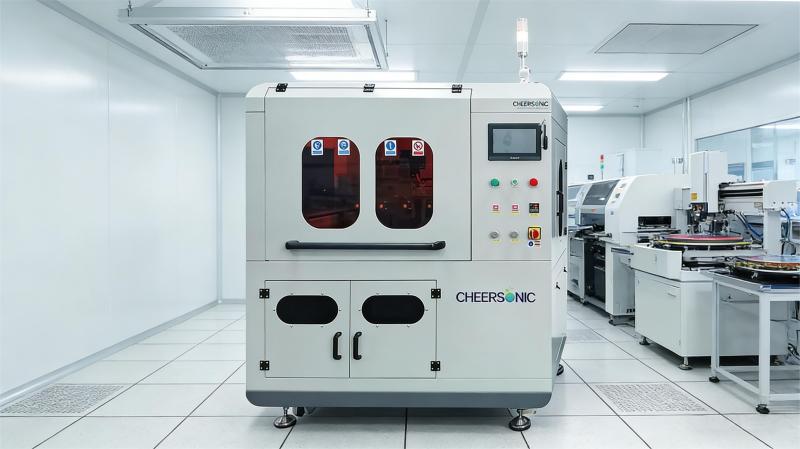
Ultrasonic spraying is a core precision process for fabricating gas-sensitive thin films in MEMS gas sensors. It uses high-frequency vibration to atomize sensitive slurries such as metal oxides and carbon nanotubes into uniform microdroplets, which are then gently deposited onto the surface of MEMS micro-heated electrodes. This non-contact, low-impact process allows for precise control of nanoscale film thickness and pore structure, significantly improving the uniformity and specific surface area of the sensitive layer, thereby enhancing sensor sensitivity, response speed, and consistency. Compared to traditional spin coating and spraying, material utilization exceeds 80%, effectively reducing costs. It is suitable for wafer-level mass production and widely used in environmental monitoring, industrial security, smart homes, and other scenarios, contributing to the miniaturization, low power consumption, and high-performance mass production of MEMS gas sensors.
About Cheersonic
Cheersonic is the leading developer and manufacturer of ultrasonic coating systems for applying precise, thin film coatings to protect, strengthen or smooth surfaces on parts and components for the microelectronics/electronics, alternative energy, medical and industrial markets, including specialized glass applications in construction and automotive.
Our coating solutions are environmentally-friendly, efficient and highly reliable, and enable dramatic reductions in overspray, savings in raw material, water and energy usage and provide improved process repeatability, transfer efficiency, high uniformity and reduced emissions.
Chinese Website: Cheersonic Provides Professional Coating Solutions
