SOFC Zirconia Electrolyte Thin Film Casting Technology
Solid oxide fuel cells (SOFCs) are all-solid-state power generation devices that directly convert the chemical energy of fuel into electrical energy through electrochemical reactions at high temperatures. With its outstanding advantages such as high energy conversion efficiency, wide fuel compatibility, and clean, pollution-free products, this technology is widely considered one of the most promising new energy directions of the 21st century. In the core components of SOFCs, the electrolyte is mostly made of oxide ceramic materials, specifically sintered solid solution electrolytes—fully stabilized zirconia (ZrO₂), among which yttrium-stabilized zirconia (YSZ) is currently the most widely used electrolyte material.
To reduce ohmic polarization losses during ion diffusion, the electrolyte layer needs to be as thin as possible, typically controlled at the millimeter or even micrometer level. Therefore, how to prepare YSZ thin films that meet performance standards and application requirements has become a research hotspot and technical challenge in related fields. Casting, as a mature process for preparing ceramic sheets or ceramic-polymer composite sheets in the electronics industry, has also become one of the mainstream methods for preparing zirconia electrolyte preforms.
I. Working Principle of Tape Casting
The tape casting process can be divided into several key steps: First, ceramic powder and dispersant are added to a solvent (water or organic solvent). Initial ball milling breaks up particle agglomeration, ensuring the solvent fully wets the powder. Then, binder and plasticizer are added, and a second ball milling process prepares a stable and uniform slurry. This slurry is fed into a tape casting machine and formed into a green body under the machine’s action. Next, a drying process evaporates the solvent, during which the binder forms a network support structure between the ceramic particles, resulting in a green body film with a certain strength. Afterward, the green body film is cut and processed according to requirements to obtain a specific shape. Finally, debinding and sintering are performed to obtain the finished product.
When applying this process to SOFC preparation, a YSZ electrolyte layer and anode layer with uniform thickness and no obvious defects need to be prepared separately through tape casting. These two layers are then stacked and subjected to temperature pressing. A co-firing process is then used to obtain a semi-finished product. Finally, screen printing technology is used to prepare the cathode layer, completing the assembly of the single cell. Due to the low mechanical strength of YSZ ceramic films, cracking, blistering, and delamination are prone to occur during the lamination and thermoforming process. Currently, the industry often uses a double-layer casting process for optimization—directly casting the electrolyte layer onto the anode layer surface to simplify subsequent lamination and thermoforming processes and improve preparation stability.

II. Core Performance Indicators of Zirconia Films
Among the performance indicators of zirconia films, ionic conductivity is the most critical, followed by the density and gas tightness of the electrolyte layer. Mechanical strength must also meet usage requirements. Specifically:
1. Ionic Conductivity
High oxygen ion conductivity not only improves the output performance and operating power of SOFCs but also enhances the long-term stability of the battery, a fundamental indicator for ensuring the core functions of the battery.
2. Density and Gas Tightness
YSZ electrolyte films have stringent requirements for density and gas tightness. The core reason is the need to prevent the interpenetration and reaction between fuel gas on the anode side and oxygen on the cathode side. Insufficient electrolyte layer density and poor gas tightness can easily lead to gas leakage, potentially causing a short circuit in the battery, ultimately resulting in a drop in open-circuit voltage and overall performance degradation.
3. Mechanical Strength
To ensure the structural safety of SOFCs during long-term operation, the zirconia film must possess sufficient mechanical strength to withstand structural impacts from temperature cycling, pressure changes, and other operating conditions.
III. Key Factors Affecting Electrolyte Film Performance
1. Slurry Composition
The slurry composition is a core parameter determining the performance of the cast green tape, directly affecting key indicators such as tensile strength, flexibility, and density. Ceramic powder, as the functional core component of the green tape, directly determines the upper limit of the final zirconia electrolyte film’s performance. Theoretically, a higher solid content in the zirconia ceramic slurry is more beneficial for improving film performance; however, excessively high solid content leads to a sharp increase in slurry viscosity, which negatively impacts the molding effect. Therefore, a balance between slurry performance and subsequent molding requirements must be achieved through reasonable adjustment of solid content, solvents, binders, and other components. Among these, sintering aids, binder systems, and dispersant types are the core factors affecting the slurry’s solid content, rheological properties, and final film performance.
2. Casting Process Parameters
Casting process parameters encompass multiple aspects, including casting speed, drying environment, debinding, and sintering processes. During the casting stage, the slurry, driven by a moving substrate, forms a composite flow pattern of pressure and drag flow. The gap between the squeegee and the substrate directly determines the initial thickness of the cast film, while the surface tension of the slurry itself affects the smoothness of the film surface. To obtain uniformly thick zirconia green tape, precise control is required through methods such as uniformly mixing the slurry, maintaining the viscosity within a reasonable range, accurately adjusting the squeegee gap, and keeping the slurry surface height stable.
The drying process of zirconia green tape is essentially a comprehensive process of polymer chain contraction, particle sedimentation, and rearrangement. Since the slurry contains a large amount of solvent, the solvent evaporation rate directly affects the quality of the green tape—if the evaporation rate is too fast, defects such as curling, deformation, and cracking can easily occur. Therefore, it is necessary to precisely control the temperature, relative humidity, and airflow velocity of the drying environment based on parameters such as the thickness of the green sheet, the volume fraction of the solid phase, and the organic content to ensure slow and uniform solvent evaporation.
The core purpose of the binder removal process is to decompose the binder and remove it from the preform through high-temperature treatment. Its mechanism is similar to the drying process, mainly including three stages: high-temperature decomposition of the binder, diffusion of decomposition products to the preform surface, and volatilization. The key difference from the drying process is that the temperature required for binder removal is significantly higher, necessitating gradient heating and other methods to avoid damage to the preform due to thermal stress.
IV. Optimization Directions for Zirconia Thin Film Performance
Currently, SOFCs mostly adopt a “fuel electrode support layer + YSZ electrolyte film” structural design. This structure ensures safe battery operation and effectively reduces the negative impact of ohmic resistance. Researchers mainly optimize the performance of zirconia thin films from two dimensions: first, by reducing the thickness of the electrolyte layer to reduce ohmic resistance; second, by adjusting the electrolyte structure to improve ionic conductivity.
1. Electrolyte Thickness Optimization
The ohmic resistance of SOFCs mainly originates from the electrolyte layer. Therefore, reducing the electrolyte thickness is an effective means to reduce ohmic resistance and electrode polarization resistance, which can directly improve the output performance of the fuel cell. In industrial production, the thickness of the electrolyte layer is precisely controlled by adjusting the height of the casting machine blade. However, there are technical limitations to reducing electrolyte thickness. While excessive thinning can further reduce ohmic resistance, it significantly decreases the mechanical strength and airtightness of the electrolyte layer. When the thickness falls below a critical value, long-term operation is prone to cracking. Therefore, the electrolyte layer thickness needs to strike a balance between “high conductivity” and “structural safety” to ensure that both performance and reliability requirements are met.
2. Electrolyte Structure Optimization
Ionic conductivity directly determines the power density and open-circuit voltage of SOFCs and is a core performance indicator of the electrolyte film. Currently, the ionic conductivity of YSZ electrolyte films is low at medium and low temperatures, requiring the operating temperature to be increased to 800–1000℃ to ensure sufficient ionic conductivity. However, high-temperature operation causes a series of problems: firstly, it limits the range of battery materials and increases the difficulty of material adaptation; secondly, it significantly increases the cost of battery manufacturing and operation; and thirdly, it accelerates material aging and shortens battery life. Therefore, improving the medium and low-temperature ionic conductivity of YSZ electrolyte through structural design optimization has become a key direction for reducing SOFC operating temperatures and promoting technology implementation.
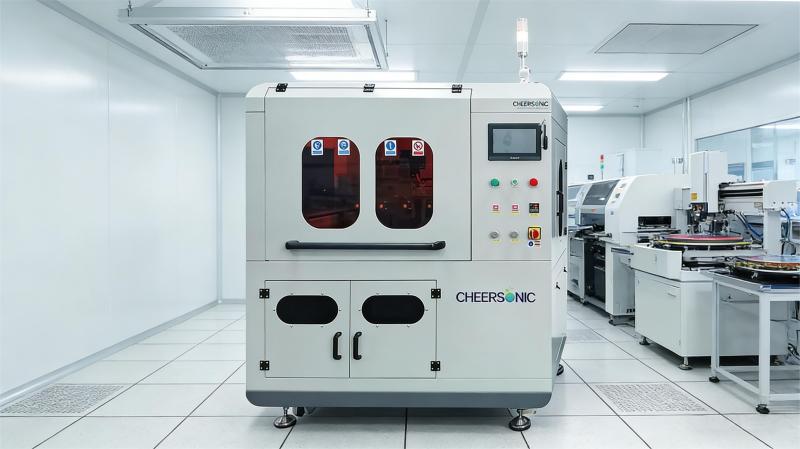
Ultrasonic spraying technology, as a novel thin film preparation process, has shown significant advantages in the preparation of electrolyte and electrode layers in SOFCs, providing a new technical path for SOFC thin film preparation. This technology utilizes the atomization effect of ultrasound to transform the prepared slurry into tiny, uniform droplets. These droplets are then precisely transported to the substrate surface via a carrier gas, followed by drying, sintering, and other subsequent processing to form a dense and uniform thin film.
About Cheersonic
Cheersonic is the leading developer and manufacturer of ultrasonic coating systems for applying precise, thin film coatings to protect, strengthen or smooth surfaces on parts and components for the microelectronics/electronics, alternative energy, medical and industrial markets, including specialized glass applications in construction and automotive.
Our coating solutions are environmentally-friendly, efficient and highly reliable, and enable dramatic reductions in overspray, savings in raw material, water and energy usage and provide improved process repeatability, transfer efficiency, high uniformity and reduced emissions.
Chinese Website: Cheersonic Provides Professional Coating Solutions