
Summary of the core content of RuO₂ catalysts in PEMWE
Summary of the core content of RuO₂ catalysts in PEMWE – Ultrasonic Spray Catalysts – Cheersonic
Proton exchange membrane electrolysis (PEMWE) is a highly efficient and compact hydrogen production technology. The oxygen evolution reaction (OER) at the anolyte is a key bottleneck limiting overall efficiency. Due to its superior performance, RuO₂ has become a research focus for acidic OER catalysts in this field. The following summarizes its core information from multiple perspectives.
I. Reasons Why RuO₂ is a Key Material for PEMWE Anode OER
RuO₂’s suitability as a key material for PEMWE anode OER stems from three main advantages: First, high intrinsic activity; in acidic OER environments, its activity is typically superior to other noble metal oxides such as IrO₂. Second, suitable oxygen binding energy; located near the apex of the “volcano diagram,” it can balance the adsorption and desorption processes of intermediates such as O, OH, and *OOH, ensuring smooth reaction. Third, good conductivity; as a metal oxide, it can efficiently transport charge, providing favorable electron transfer conditions for the reaction.
II. Catalytic Mechanism of RuO₂ in Acidic OER
Under acidic conditions, the overall OER reaction involves the conversion of water into oxygen, protons, and electrons. This process follows the adsorbate evolution mechanism (AEM), primarily accomplished through four proton-electron coupling reactions: The first step is water adsorption and dissociation, where the active site reacts with water to generate *OH, protons, and electrons; the second step is the oxidation of *OH, converting it into *O, protons, and electrons; the third step is the reaction of *O with water to form *OOH, protons, and electrons; and the fourth step is the release of oxygen from *OOH, restoring the active site to its initial state.

From the perspective of active sites and electronic structure, the active sites of RuO₂ are mostly coordinatingly unsaturated Ru sites (such as Ru⁴⁺ and Ru⁵⁺), especially predominantly low-coordination Ru atoms on the surface. At the electronic level, the 4d orbitals of Ru hybridize with the 2p orbitals of O, forming a suitable band structure that facilitates intermediate adsorption and conversion. Furthermore, a suitable amount of oxygen vacancies can regulate the oxidation state of Ru, promoting *OOH formation and oxygen desorption, further optimizing the catalytic process.
III. Challenges and Attenuation Mechanisms of RuO₂ in Practical PEMWE
Although RuO₂ exhibits high catalytic activity, it suffers from poor stability in the strongly acidic, high-potential, and oxidizing environments of PEMWE. The main attenuation mechanisms are threefold: First, the dissolution and increased oxidation state of Ru. At high potentials (>1.5 V vs. RHE), Ru is easily oxidized to soluble substances, and its oxidation state may increase from +4 to +5 or even +6, exacerbating lattice oxygen loss. Second, the lattice oxygen participation mechanism (LOM) and structural reconstruction. During the reaction, amorphous substances may form on the RuO₂ surface, and in some cases, lattice oxygen directly participates in the reaction, destroying the oxide structure and accelerating dissolution. Third, the support effect and agglomeration. Nano-sized RuO₂ readily agglomerates and grows, reducing the active surface area. If loaded on a conductive support, support corrosion or interfacial delamination problems may also occur.
IV. Strategies and Modification Mechanisms for Enhancing RuO₂ Stability
To improve the stability of RuO₂, researchers have proposed several modification strategies: First, alloying or doping with other metals, such as Ir-Ru mixed oxides which can stabilize high-valence states of Ru and inhibit peroxidation, while SnO₂ or Ta₂O₅ doping can enhance the stability of the oxide framework and reduce Ru dissolution; Second, constructing core-shell or heterostructures, such as in the RuO₂@IrO₂ core-shell structure, where the IrO₂ shell protects the RuO₂ core and reduces its direct contact with the electrolyte. In RuO₂/TiO₂ heterojunctions, TiO₂ serves as both a stabilizing support and provides electronic modulation effects. Thirdly, crystal plane engineering and defect control are crucial; RuO₂ with exposed (110) crystal planes exhibits superior activity and stability. Introducing oxygen or cation vacancies can regulate local electron density and enhance intermediate adsorption, but the relationship between this and stability must be balanced. Fourthly, amorphous or hydrated ruthenium oxide is employed; these materials typically have more active sites, which can alleviate lattice oxygen loss to some extent, but long-term stability still needs improvement.
V. Actual Performance and Optimization Directions of RuO₂ in PEMWE Membrane Electrode (MEA)
In practical MEA applications, the catalyst layer design needs to be well-mixed with Nafion ionomers to construct continuous proton, electron, and gas transport channels. Furthermore, the RuO₂ loading needs to be controlled at 1–3 mg/cm² to balance activity and cost. In terms of durability, pure RuO₂ typically has a lifetime of only tens to hundreds of hours at 1 A/cm² and 80℃, while modified Ru-Ir mixed oxides (e.g., Ru:Ir = 7:3) can operate stably for thousands of hours.
Future optimization directions mainly include: developing Ru-based high-entropy oxides to stabilize the structure using multi-metal synergistic effects; constructing Ru single-atom or cluster catalysts to improve atom utilization and reduce dissolution; and combining in-situ characterization and theoretical calculations to clarify the decay path and provide guidance for material design.
VI. Conclusion
RuO₂ is one of the most active OER catalysts in current PEMWE, but its insufficient stability is the main bottleneck restricting its commercial application. Modification methods such as doping, structural design, and interface engineering can improve its durability to some extent. However, to achieve a high-efficiency, long-life, and low-cost PEMWE hydrogen production system, synergistic optimization is still needed in material design, electrode engineering, and system operation strategies.
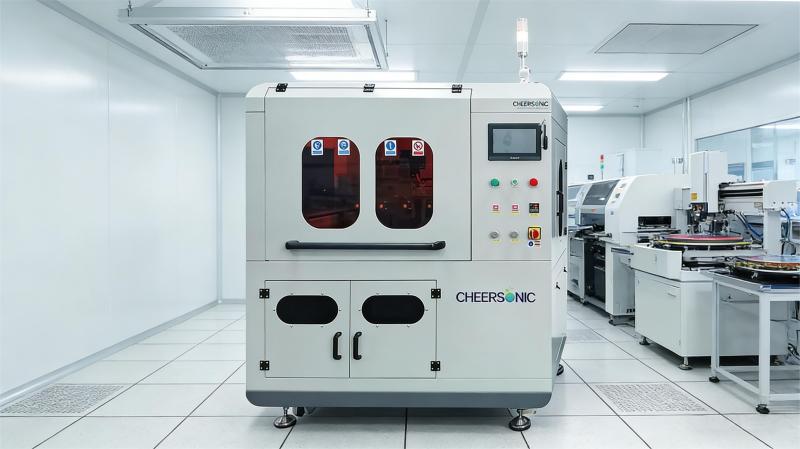
Ultrasonic Spraying of RuO₂ Catalyst for PEMWE Membrane Electrode Preparation
Ultrasonic spraying is the preferred process for preparing the RuO₂ catalyst layer of the anode in PEMWE membrane electrodes. Utilizing high-frequency ultrasonic vibration, the RuO₂ catalyst slurry is atomized into uniform micron-sized droplets, gently deposited onto the proton exchange membrane surface, effectively preventing nano-catalyst aggregation and significantly increasing the exposed area of active sites.
This process allows for precise control of coating thickness and loading, constructing interconnected proton, electron, and gas transport channels, significantly enhancing the catalytic activity of the oxygen evolution reaction (OER). The low-impact spraying method does not damage the proton exchange membrane, ensuring the integrity of the MEA structure, while achieving a material utilization rate of over 90%, reducing precious metal consumption. The prepared catalyst layer has a uniform pore structure, combining high activity with long-term stability, contributing to improved efficiency and reduced cost of PEMWE water electrolysis for hydrogen production, making it suitable for industrial-scale mass production.
About Cheersonic
Cheersonic is the leading developer and manufacturer of ultrasonic coating systems for applying precise, thin film coatings to protect, strengthen or smooth surfaces on parts and components for the microelectronics/electronics, alternative energy, medical and industrial markets, including specialized glass applications in construction and automotive.
Our coating solutions are environmentally-friendly, efficient and highly reliable, and enable dramatic reductions in overspray, savings in raw material, water and energy usage and provide improved process repeatability, transfer efficiency, high uniformity and reduced emissions.
Chinese Website: Cheersonic Provides Professional Coating Solutions
