
MIP Packaging Carrier Coating
MIP Packaging Carrier Coating – Ultrasonic Coating – Cheersonic
The coating on the MIP packaging carrier is a multi-layered composite system, mainly including an insulating/solder resist layer, a metal/conductive layer, an optical coating, a protective layer, and a thermal management coating. Together, they provide electrical isolation, mechanical enhancement, optical optimization, and environmental protection for high-density Micro LED packaging.
Core Coating Material System
Insulating/Solder Resist Layer (Basic Protection)
- Materials: Epoxy resin-based solder resist ink (green/black), PI, SiO₂/Si₃N₄
- Thickness: 20–50μm (organic), 0.1–2μm (inorganic)
- Processes: Coating photolithography or dry film lamination (organic), PVD/CVD (inorganic)
Metal/Conductive Layer (Interconnect Core)
- Seed Layer: Ti/Cu, Cr/Cu (50–200nm), sputtered deposition, providing a conductive substrate for electroplating
- Conductive Circuit: Electrolytic copper (5–50μm), patterned electroplating, forming a fine interconnect network
- Pad Protection Layer: Ni/Au (nickel 5–8μm, gold 0.025–0.05μm) or OSP, preventing oxidation and improving solderability

Optical Coating (Key to Display Performance)
- High-transmittance encapsulating adhesive: Silicone (refractive index ≥1.5), coated and cured, protects the chip and improves light efficiency.
- Quantum dot coating: Quantum dot material composite with silicone, covering the blue LED chip, expanding the color gamut to NTSC 110%+.
- Black matrix (BM): Black solder resist or absorbent material, photolithographically patterned, reduces light crosstalk, and improves contrast.
Protective layer (long-term reliability)
- Transparent passivation layer: Silicone or epoxy, 50–100μm thick, moisture-proof and dust-proof, mechanical protection.
- Abrasion-resistant outer layer: Polyimide or nanocomposite coating, 2–5μm, scratch-resistant and chemical-resistant.
Thermal management coating (performance optimization)
- High thermal conductivity interface layer: Graphene/carbon nanotube composite coating, in-plane thermal conductivity >1500W/m·K, improves heat dissipation efficiency.
- Metal heat dissipation layer: Cu/Al thin film (1–5μm), covering the back of the substrate, increasing the heat dissipation area.
Five Core Functions of the Coating
Electrical Insulation and Circuit Protection
- Isolates adjacent lines, preventing short circuits; insulation resistance >10¹⁴Ω
- Prevents copper layer oxidation and corrosion, extending lifespan (>10 years)
- Constrains solder during soldering, preventing bridging and ensuring solder joint quality
Metallization and Interconnect Enhancement
- Seed layer enhances glass/PCB and metal adhesion (>5N/cm), preventing peeling
- Supports high-density RDL (linewidth/spacing ≤50μm), enabling fine interconnection of Micro LEDs
- Forms conformal coverage in deep vias (>10:1), ensuring reliable electrical connections
Optical Performance Optimization
- High-transmittance coating (transmittance >95%) reduces light loss, increasing brightness by 50%+
- Black matrix suppresses crosstalk, achieving a contrast ratio of 1,000,000:1, enhancing image depth
- Quantum dot conversion enables a wider color gamut, increasing color purity by 30%
Mechanical Enhancement and Environmental Protection
- Coating mitigates the CTE difference between the substrate and the chip (chip ≈ 2.6 ppm/℃, PCB ≈ 16 ppm/℃), preventing cracking.
- Sealed structure blocks moisture (WVTR < 0.1 g/m²·day) and oxygen, preventing chip corrosion.
- Carrier adhesive layer (50–200 μm) fills the pixel gaps, fixing the chip and improving impact resistance.
Thermal Management and Heat Dissipation
- Constructing efficient heat dissipation channels, controlling chip junction temperature < 85℃ at 10000 nit brightness.
- Thermal resistance is reduced from 4.5℃/W in traditional SMD to 1.2℃/W in MIP, improving heat dissipation efficiency by 73%.
- Glass substrate + thermal management coating combination increases thermal conductivity by 5 times, solving the thermal bottleneck of Micro LED.
Coating Synergistic Working Mechanism
The MIP coating forms a “multi-layer composite protective network,” with each layer working synergistically:
1. Bottom layer: Insulating layer (SiO₂/Si₃N₄) provides basic electrical isolation.
2. Intermediate Layer: Metallic circuit layer (Cu) enables signal transmission.
3. Functional Layer: Optical coating (quantum dot/black matrix) optimizes display performance.
4. Top Layer: Protective layer (silicone/epoxy) provides comprehensive environmental protection.
Summary
The MIP packaging substrate coating is not a single material, but a precisely coordinated multi-layered composite system, acting as an “invisible guardian” between the Micro LED chip and the substrate. They work synergistically in electrical insulation, metallization enhancement, optical optimization, mechanical protection, and thermal management, making MIP technology a key support for next-generation displays, particularly suitable for high-end displays, virtual photography, and wearable devices. With technological advancements, coating materials are evolving towards ultra-thinness, high light transmittance, high thermal conductivity, and high integration to meet the demands of future higher-performance displays.
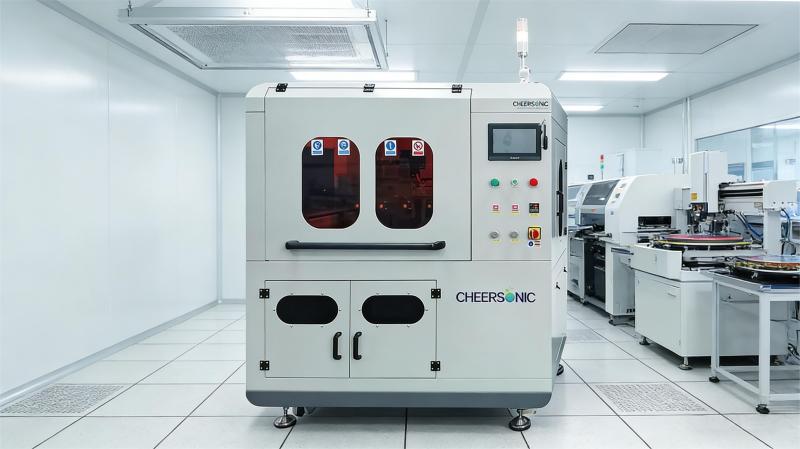
Ultrasonic spraying is the core preparation process for the MIP packaging substrate coating, precisely matching the optical and reliability requirements of its high-density Micro LED packaging. This process can uniformly deposit insulating solder resist coatings such as PI and epoxy resin to achieve circuit isolation and pad protection. It is compatible with optical coatings such as quantum dot materials and high-transmittance silicone to optimize color gamut (NTSC 110%+) and light efficiency, and is combined with a black matrix coating to suppress optical crosstalk. It boasts high atomization precision, with a coating thickness deviation of <±5%, forming conformal coverage between fine lines and pixel gaps, exhibiting strong adhesion and low porosity. The low-temperature process avoids damage to the substrate and chip, while simultaneously improving coating density, strengthening moisture barrier and mechanical protection, providing stable support for high-end displays, virtual imaging, and other scenarios, and helping the substrate achieve high contrast, long lifespan, and high integration.
About Cheersonic
Cheersonic is the leading developer and manufacturer of ultrasonic coating systems for applying precise, thin film coatings to protect, strengthen or smooth surfaces on parts and components for the microelectronics/electronics, alternative energy, medical and industrial markets, including specialized glass applications in construction and automotive.
Our coating solutions are environmentally-friendly, efficient and highly reliable, and enable dramatic reductions in overspray, savings in raw material, water and energy usage and provide improved process repeatability, transfer efficiency, high uniformity and reduced emissions.
Chinese Website: Cheersonic Provides Professional Coating Solutions
