
Mini/Micro LED Glass Substrate Core Coating
The core coatings applied to the surface of the Mini/Micro LED glass substrate include: a conductive circuit layer, an insulating/passivation layer, an optical functional layer, and auxiliary process layers. These coatings work together to provide the glass substrate with conductivity, insulation, optical optimization, and process adaptability, thereby supporting high-resolution, high-contrast, and high-reliability display effects.
Core Coating Structure and Materials
1. Conductive Circuit System (Multi-layer Composite Structure)
Undercoat/Adhesion Layer
- Materials: Molybdenum (Mo), Titanium (Ti), Titanium Oxide (TiO₂), Nickel-Chromium Alloy (NiCr), Silicon Nitride (Si₃N₄)
- Thickness: 80-200nm
- Function: Solves the adhesion problem caused by the inertia and smoothness of the glass surface, ensuring a firm bond with subsequent metal layers.
Stress Relief Layer (Commonly Used in Mini LEDs)
- Materials: Tin-Lead Alloy (Sn-Pb, tin content 60-95%), Nickel-Copper Alloy
- Thickness: 120-300nm
- Function: Buffers the thermal stress of the thick copper film, reduces glass substrate warping and cracking, and improves structural stability.

Main Conductive Layer
- Materials: Copper (Cu, most commonly used), Silver (Ag), Gold (Au), Aluminum (Al)
- Thickness: Mini LED: 1-10μm (usually 6-7μm); Micro LED: 0.1-2μm
- Function: Forms fine circuits, enabling conductive interconnection between the chip and external circuits, and also provides heat dissipation.
Top Conductive/Contact Layer
- Materials: Silver (Ag), Gold (Au), Copper-Tin Alloy
- Thickness: 0.1-5μm
- Function: Provides a low contact resistance bonding interface, enhances oxidation resistance and wear resistance, and ensures long-term reliability.
2. Insulation/Passivation Protection System
Insulation Layer
- Materials: Silicon nitride (Si₃N₄), Silicon dioxide (SiO₂), Polyimide (PI), SU-8
- Thickness: 0.1-5μm
- Function: Provides insulation between circuits to prevent short circuits; optimizes dielectric properties, reduces high-frequency signal loss; provides physical protection for precision circuits.
Passivation Protection Layer (Chip-Level)
- Materials: Aluminum oxide (Al₂O₃, ALD deposition), silicon nitride (Si₃N₄), organic passivation adhesive
- Thickness: Micro LED: 50-500nm; Mini LED: 1-3μm
- Function: Protects the sidewalls and surface of the LED chip, preventing water and oxygen erosion; reduces surface defect density and improves luminous efficiency (by 14-20%).
- Process characteristics: ALD (Atomic Layer Deposition) can form a uniform, conformal passivation layer on complex microstructure surfaces.
3. Optical Functional Coatings
High Reflectivity Layer (Commonly used in Mini LED backlighting)
- Materials: White solder resist ink (high reflectivity >90%), silver/aluminum metal reflective layer, titanium dioxide (TiO₂) high reflectivity coating
- Thickness: 5-30μm (white ink); 0.1-1μm (metal)
- Function: Improves backlight efficiency (by 20-30%), reduces light energy loss, and enhances LCD display contrast.
Black Matrix (BM, commonly used in Micro LED direct-view displays)
- Materials: Black photoresist, chromium (Cr) metal layer
- Thickness: 3-10μm
- Function: Separates pixels, suppresses light crosstalk, improves contrast ratio (up to 20,000:1), and enhances display sharpness
Quantum Dot Color Conversion Layer (QCCL, full-color implementation solution)
- Materials: Red/green quantum dots (PMMA/silicone matrix), perovskite quantum dot composite
- Thickness: 2-5μm
- Function: Converts blue LED light into red/green light, achieving full-color display; high color purity, color gamut coverage up to 115% NTSC
- Process: Inkjet printing (accuracy ±1.5μm), microfluidic filling, photolithographic patterning
4. Special Process Auxiliary Coatings
Temporary Bonding/Release Layer (Micro LED Mass Transfer)
- Materials: DRL (Dynamic Release Layer), photoresist, thermally reversible adhesive
- Functions: Achieves temporary fixation and precise release in mass transfer, with a transfer yield of up to 99.9%.
Planarization/Filling Layer
- Materials: Photosensitive resin, insulating adhesive (OC)
- Function: Fills in circuit bumps, forming a smooth surface and providing a uniform foundation for chip mounting and optical layers.
Optical Matching Layer (Light Emission Optimization)
- Materials: High refractive index transparent adhesive (n=1.7-2.1), OCA optical adhesive
- Function: Optimizes light extraction efficiency (up to 30%), reduces total internal reflection, and lowers light loss.
Core Functions and Value of the Coating
1. Electrical Performance Realization
– Insulation-Conductivity Synergy: The glass substrate itself is insulating; a multi-layer conductive/insulating composite structure constructs a high-density, high-precision three-dimensional circuit network (linewidth/spacing down to the micrometer level).
– Signal Transmission Optimization: Low-resistance metals (mainly copper) ensure low-loss transmission of high-frequency, high-speed signals, meeting the needs of 5G/6G and AI displays.
2. Enhanced Mechanical and Thermal Stability
– Stress Management: Multi-layer composite design effectively mitigates warping and cracking caused by CTE (coefficient of thermal expansion) mismatch.
– Enhanced Heat Dissipation: The metallic conductive layer acts as a heat sink, rapidly dissipating chip heat (reducing thermal resistance by 40-60%), improving stability under high-temperature environments.
3. Improved Optical Performance (Key to Display Quality)
– Leap in Contrast Ratio: The combination of a black matrix and a high-reflectivity layer increases the contrast ratio from 1000:1 for ordinary LCDs to 1,000,000:1 (Micro LED).
– Color Gamut Expansion: The quantum dot coating expands the color gamut from 72% NTSC to over 115% NTSC, surpassing OLED in color performance.
– Optimized Light Efficiency: Through the synergy of the passivation layer/reflective layer/optical matching layer, light extraction efficiency is improved by 50-80%.
4. Environmental Adaptability and Reliability
– Tri-Protection: The dense passivation layer effectively blocks water, oxygen, and acid/alkali corrosion, increasing lifespan from 1000 hours to over 50,000 hours.
– High Temperature Resistance: Withstands reflow soldering at 250℃+ and long-term humid heat environments of 85℃/85%RH with stable performance.
Application Scenarios and Coating Selection Strategies
– Mini LED Backlight: Focus on high-reflectivity layers + thick copper conductive layers to improve backlight efficiency and heat dissipation.
– Micro LED Direct Display: Emphasize ultra-thin multi-layer conductive layers + precision insulation + ALD passivation + black matrix to achieve high resolution and high reliability.
– Automotive/Outdoor: Utilize high-weather-resistant passivation layers + thermally stable optical layers to adapt to extreme temperatures and harsh environments.
– AR/VR Microdisplay: Optimize optical matching layers + ultra-thin coating structure to improve luminous efficiency and wearing comfort.
Summary:
The coating system of Mini/Micro LED glass substrates is a highly synergistic functional whole: the conductive circuit layer provides the insulating glass with circuit functionality; the insulation/passivation layer ensures reliability and stability; the optical functional layer determines core display indicators such as color and contrast; and the process auxiliary layer supports key manufacturing processes such as mass transfer. This complete coating system makes glass substrates an ideal carrier for Mini/Micro LED displays, driving the evolution of display technology towards higher resolution, higher brightness, wider color gamut, and lower power consumption.
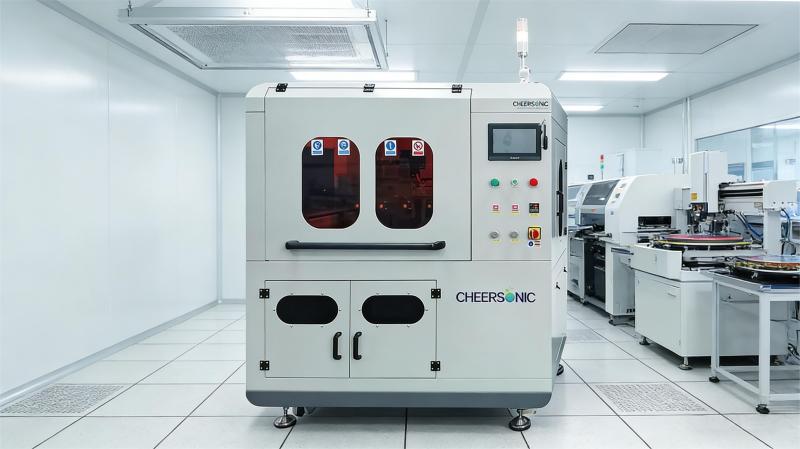
Ultrasonic spraying is a key preparation process for the core coating of Mini/Micro LED glass substrates. Leveraging its high-precision atomization and uniform coating advantages, it is suitable for the core coating requirements of conductive layers, insulating layers, and optical functional layers. It can precisely coat metal pastes (copper, silver) to form micron-level fine conductive lines, ensuring low-resistance interconnection and efficient heat dissipation; uniformly deposit insulating/passivating materials such as silicon nitride and polyimide to achieve circuit isolation and water/oxygen protection; and it can also be adapted to optical coatings such as quantum dot color conversion layers and highly reflective white oil to optimize luminous efficacy and color gamut. This process has a coating thickness deviation of <±5%, low porosity, strong adhesion, and the low-temperature process does not damage the glass substrate, meeting the high resolution and high reliability requirements of Mini/Micro LEDs, providing core process support for improving the contrast and extending the lifespan of display panels.
About Cheersonic
Cheersonic is the leading developer and manufacturer of ultrasonic coating systems for applying precise, thin film coatings to protect, strengthen or smooth surfaces on parts and components for the microelectronics/electronics, alternative energy, medical and industrial markets, including specialized glass applications in construction and automotive.
Our coating solutions are environmentally-friendly, efficient and highly reliable, and enable dramatic reductions in overspray, savings in raw material, water and energy usage and provide improved process repeatability, transfer efficiency, high uniformity and reduced emissions.
Chinese Website: Cheersonic Provides Professional Coating Solutions
