
FTO Coating Spraying Technology and Parameter Specifications
In the field of optoelectronic material preparation, FTO coating spraying technology, due to its excellent conductivity and light transmittance, has become a core process step in the fabrication of many micro-devices. Ultrasonic spraying machines, with their advantages of uniform atomization and strong coating adhesion, are ideal for implementing this technology. Their precise control capabilities effectively ensure that all performance indicators of the coating meet the requirements of precision devices.

The core functional component of the coating is anatase titanium dioxide. This crystal form of titanium dioxide possesses excellent photocatalytic activity and chemical stability, which can enhance the functionality of the FTO coating while extending the device’s lifespan. Compared with other crystal forms, the anatase structure has higher surface activity and better adhesion to the substrate material. Combined with the atomization technology of ultrasonic spraying, a uniform and dense film structure can be formed, avoiding defects such as pinholes and cracks that are prone to occur in traditional spraying.
The parameter control of the FTO substrate directly determines the overall performance of the coating. The thickness must be strictly controlled below 1 mm, with an optimal value of 0.5 mm. This thickness ensures sufficient structural strength of the substrate while reducing light loss during propagation, thereby improving the photoelectric conversion efficiency of the device. The resistance parameter is set to 7Ω, achieving a perfect balance between conductivity and cost. This value meets the current transmission requirements of micro-devices while avoiding energy loss due to excessive resistance. The substrate size is set at 1.5x2cm, adaptable to the packaging specifications of most micro-optoelectronic devices, and facilitating precise positioning and processing in mass production.
The TiO2 coating thickness employs a graded control strategy, meeting three specifications: 1µm, 3µm, and 5µm. A 1µm thickness is suitable for applications with extremely high light transmittance requirements, minimizing light absorption; a 3µm thickness is a general specification, balancing light transmittance and catalytic performance; and a 5µm thickness is suitable for fields with stringent catalytic activity requirements, increasing the reaction contact area through coating thickness. The 5x5mm active layer size is the optimal value determined by combining coating uniformity and device power requirements, ensuring the active material functions fully and avoiding material waste.
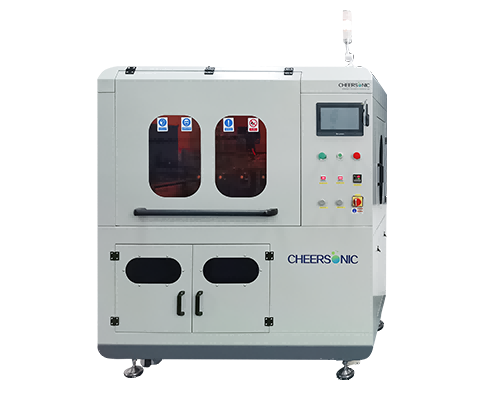
Through precise control of an ultrasonic spraying machine, these parameters are strictly implemented in the production process, resulting in a stable and highly consistent FTO coating. The synergistic effect of these parameters not only ensures the core functions of the coating but also takes into account production feasibility and cost control, providing reliable technical support for the high-quality production of micro optoelectronic devices.
About Cheersonic
Cheersonic is the leading developer and manufacturer of ultrasonic coating systems for applying precise, thin film coatings to protect, strengthen or smooth surfaces on parts and components for the microelectronics/electronics, alternative energy, medical and industrial markets, including specialized glass applications in construction and automotive.
Our coating solutions are environmentally-friendly, efficient and highly reliable, and enable dramatic reductions in overspray, savings in raw material, water and energy usage and provide improved process repeatability, transfer efficiency, high uniformity and reduced emissions.
Chinese Website: Cheersonic Provides Professional Coating Solutions