
A Comprehensive Analysis of CPO Coating Coatings
A Comprehensive Analysis of CPO Coating Coatings: Material System and Core Functions
In CPO (Co-Packaged Optics) co-packaging, coatings are applied to the substrate, chip surface, and optical interface to form a multi-layered composite protection and functional enhancement system.
Core Coating Types and Materials
Passivation/Insulating Coatings
- Silicon Dioxide (SiO₂): CVD/PVD deposition, 0.1–2 μm thick, provides insulation and moisture barrier.
- Silicon Nitride (Si₃N₄): Covers the chip surface, excellent moisture and ion barrier, enhances mechanical strength.
- Polyimide (PI): Post-coating curing, insulating, temperature resistant (>250℃), corrosion resistant, suitable for multilayer wiring isolation.
- Tantalum Oxide (TaOx): Ultra-thin (5–20nm) tunneling passivation, used for silicon photonics chip surface protection.

Thermal Interface Coating (TIM)
- Thermal Grease: Fills gaps, thermal resistance <0.1℃·in²/W, ensures tight thermal contact.
- Graphite Sheets: High thermal conductivity (~1500W/m·K), large-area heat diffusion.
- Metal Heat Dissipation Coatings: Such as aluminum/copper thin films, expand heat dissipation area, improve thermal conductivity.
Optical Functional Coatings
- Anti-reflective coating (AR): Reduces reflection to <0.5% at 1310/1550nm wavelengths, improving coupling efficiency.
- Waveguide cladding: Such as EpoClad 20 (refractive index 1.571), used in polymer waveguide structures to constrain light transmission.
- Filter coating: Selectively transmits/blocks specific wavelengths, optimizing signal detection.
Fiber optic protective coating
- Acrylic resin: Standard coating, temperature resistant up to 85℃, providing mechanical protection.
- Polyimide (PI): High temperature resistant (>300℃), suitable for high-power optical modules.
- Composite coating: Dual-layer structure (soft inner, hard outer), balancing elasticity and abrasion resistance.
Four Core Functions of Coatings
Insulation and Circuit Protection
- Isolate adjacent conductive lines, preventing short circuits and ensuring electrical reliability.
- Shield external electromagnetic interference, stabilizing high-speed signal transmission.
- Protect chips from ionic contamination and chemical corrosion.
Thermal management optimization.
- Constructing efficient thermal paths reduces thermal resistance, ensuring optimal operating temperatures for both optical chips (<70℃) and electronic chips (<125℃).
- Mitigating CTE differences between silicon photonic chips, III-V lasers, and metal interconnects, reducing warpage and breakage caused by thermal stress.
- Enhancing heat dissipation efficiency and improving overall power consumption (CPO can reduce system power consumption by 25–30%).
Improved optical performance.
- Reducing interface reflection loss (to <1%), improving optical transmission efficiency.
- Optimizing optical path design to achieve high-density optical interconnects (>140G/mm bandwidth density).
- Providing optical isolation and signal filtering enhances the signal-to-noise ratio.
Mechanical protection and environmental isolation.
- Preventing fiber microcrack propagation and improving mechanical strength (>100MPa).
- Sealed encapsulation prevents moisture (WVTR <0.01g/m²·day) and oxygen (OTR <0.1cm³/m²·day) intrusion.
- Enhanced vibration and shock resistance, extending device lifespan (>10 years)
Coating Synergy: Integrated Protection from Chip to System
In CPO packaging, the coating forms a “multi-layered composite protective network”:
- Bottom layer: SiO₂/Si₃N₄ insulating layer on the silicon substrate, providing basic electrical isolation.
- Middle layer: PI or polyimide/silicon dioxide composite coating, achieving multi-layer wiring insulation and stress buffering.
- Functional layer: Thermal interface coating + optical coating, respectively addressing heat dissipation and optical path optimization.
- Outer layer: Passivation/protective coating, acting as an environmental barrier.
Summary
The CPO coating is the invisible guardian of optoelectronic co-packaging. Through the synergy of insulation, thermal management, optical and mechanical protection, it ensures stable operation in high-speed, highly integrated environments. As CPO evolves towards 102.4Tbps and higher computing power, the coating will continue to innovate towards ultra-thin, high thermal conductivity, high light transmittance, and low stress, becoming a key support for breaking through performance bottlenecks.
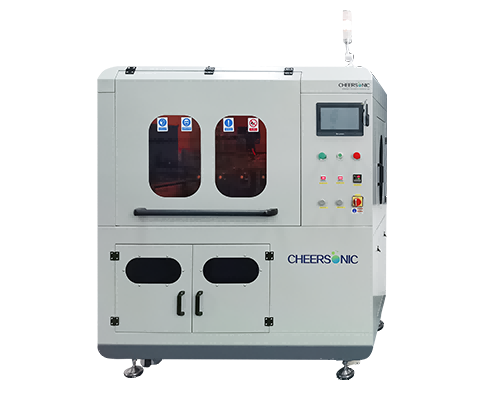
Ultrasonic spraying is the core fabrication process for CPO (Chip-on-Poly) optoelectronic co-packaging coatings. Leveraging its precise atomization and uniform coating characteristics, it is suitable for various critical coating requirements. It can efficiently deposit passivation/insulating materials such as SiO₂, Si₃N₄, and PI to form a dense protective layer, achieving circuit isolation and water/oxygen barrier; it can precisely coat thermally conductive coatings, optimizing thermal management efficiency and alleviating the heat dissipation pressure brought by the high integration of CPO; and it can also prepare low-reflection AR coatings, improving the optical coupling efficiency at 1310/1550nm wavelengths. This process exhibits a coating thickness deviation of <±5%, low porosity, strong adhesion, and the low-temperature process does not damage the chip or optical path, making it suitable for the high-speed signal transmission and high reliability requirements of CPO, providing stable process support for 102.4Tbps and above computing power packaging.
About Cheersonic
Cheersonic is the leading developer and manufacturer of ultrasonic coating systems for applying precise, thin film coatings to protect, strengthen or smooth surfaces on parts and components for the microelectronics/electronics, alternative energy, medical and industrial markets, including specialized glass applications in construction and automotive.
Our coating solutions are environmentally-friendly, efficient and highly reliable, and enable dramatic reductions in overspray, savings in raw material, water and energy usage and provide improved process repeatability, transfer efficiency, high uniformity and reduced emissions.
Chinese Website: Cheersonic Provides Professional Coating Solutions