
Nanopowders Important Materials in the Microscopic World
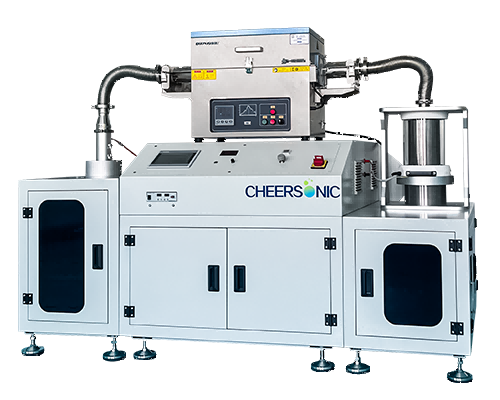
Ultrasonic spray pyrolysis is an advanced and efficient process for preparing nanoparticles. Its core principle involves using ultrasonic energy to atomize a precursor solution into micron-sized droplets, which are then converted into high-purity nanoparticles through a pyrolysis reaction. The process can be divided into three steps: First, an ultrasonic transducer generates high-frequency vibrations, causing the precursor solution (containing solutes such as metal salts and oxides) to form uniformly dispersed micro-droplet clusters. Second, the droplets are transported by a carrier gas (such as nitrogen or argon) to a high-temperature reactor, where the solvent rapidly evaporates at 200-1000°C, while thermal decomposition and redox reactions occur simultaneously. Finally, the reaction products are cooled and collected to obtain nanoparticles with a particle size of 10-100 nm.
This technology offers significant advantages: high droplet atomization uniformity ensures a narrow powder particle size distribution (typically with a coefficient of variation < 20%); rapid and complete pyrolysis results in powder purity exceeding 99% with no significant agglomeration; and a high degree of process continuity allows for precise control of powder composition, morphology, and particle size by adjusting parameters such as ultrasonic power, reaction temperature, and precursor concentration.
In applications, this technology is widely applicable in electronics, catalysis, and medical fields, enabling the preparation of nano-oxides (such as TiO₂ and ZnO), elemental metals (such as Ag and Cu), and composite nanopowders (such as ZrO₂-Al₂O₃). It provides core raw material support for semiconductor materials, catalysts, and biomedical coatings, making it one of the mainstream technologies in the current field of nanomaterial preparation.
1. Definition and Classification
Definition: Nanopowders refer to powdery materials with particle sizes at the nanoscale (1-100 nanometers). Due to their tiny size, nanopowders exhibit many physical and chemical properties different from traditional materials. These properties enable nanopowders to play a crucial role in numerous fields.
Classification By composition:
Metal nanopowders: such as nano-gold, nano-silver, nano-copper, etc. Metal nanopowders possess excellent electrical and thermal conductivity and unique optical properties. For example, nano-gold powder exhibits a strong surface plasmon resonance effect in the visible light range, giving it a unique color and wide applications in fields such as biolabeling and sensors.
Metal oxide nanopowders: including nano-titanium dioxide, nano-zinc oxide, nano-iron oxide, etc. These nanopowders typically possess high chemical stability, excellent photocatalytic performance, and good adsorption properties. For example, nano-titanium dioxide powder is a well-known photocatalyst that can be used in environmental purification and self-cleaning materials.
Ceramic nanopowders: such as nano-silicon carbide, nano-boron nitride, etc. Ceramic nanopowders often possess characteristics such as high hardness, high strength, and high temperature resistance, and are widely used in wear-resistant materials and high-temperature structural materials.
Organic nanopowders: These are nanoparticles mainly composed of organic compounds, such as certain polymer nanopowders. Organic nanopowders exhibit different solubilities, flexibility, and biocompatibility depending on the properties of their organic components, and are used in drug carriers, coating additives, and other fields.
Classification by structural morphology: Spherical nanopowders: This is the most common form, with particles that are approximately spherical. Their advantage lies in the relatively easy control of size and uniformity during preparation. For example, spherical polymer nanopowders are easily obtained in some emulsion polymerization processes.
Rod-shaped or linear nanopowders: These have one-dimensional shape characteristics and a large aspect ratio. This morphology of nanopowder has unique advantages in certain electrical and optical applications. For example, carbon nanotubes are typical linear nanopowders, possessing extremely high electrical conductivity and excellent mechanical properties, and are widely used in electronic devices and composite materials.
Laminar nanopowders: These particles exhibit a two-dimensional laminar structure. Flaky nanoparticles exhibit excellent barrier properties and in-plane electrical and optical properties. For example, flaky nanoparticles such as mica flakes can be used to improve the barrier properties and gloss of coatings.
2. Performance Characteristics
High specific surface area: The small particle size of nanoparticles results in a very large specific surface area (surface area per unit mass of material). For example, a cubic particle with a side length of 10 nanometers has a specific surface area of approximately 600 square meters per gram, while a cubic particle with a side length of 1 micrometer has a specific surface area of only about 0.6 square meters per gram. This high specific surface area makes nanoparticles highly active in adsorption, catalysis, and other reactions. In the field of catalysts, nanoparticles can provide more active sites, thereby improving reaction efficiency.
Quantum size effect: When the particle size of nanoparticles becomes small enough, the energy state of their electrons changes, producing a quantum size effect. This effect makes the optical and electrical properties of nanoparticles significantly different from those of macroscopic materials. For example, the band gap of nanoscale semiconductor powders increases as the particle size decreases, thereby changing its emission color and absorption spectrum. In quantum dot materials, this quantum size effect is used to fabricate displays and biomarkers with different emission colors.
The small size effect of nanoparticles causes their physical and chemical properties to differ from those of bulk materials. Mechanically, the hardness and toughness of nanoparticles may change. For example, the hardness of sintered nanoceramic powders may be higher than that of traditional ceramics. Thermally, properties such as thermal conductivity of nanoparticles also change. In magnetic materials, the magnetic properties of nanoparticles (such as coercivity and saturation magnetization) change due to the small size effect, which can be used to manufacture high-performance magnetic materials.
About Cheersonic
Cheersonic is the leading developer and manufacturer of ultrasonic coating systems for applying precise, thin film coatings to protect, strengthen or smooth surfaces on parts and components for the microelectronics/electronics, alternative energy, medical and industrial markets, including specialized glass applications in construction and automotive.
Our coating solutions are environmentally-friendly, efficient and highly reliable, and enable dramatic reductions in overspray, savings in raw material, water and energy usage and provide improved process repeatability, transfer efficiency, high uniformity and reduced emissions.
Chinese Website: Cheersonic Provides Professional Coating Solutions
