
Application Principle of Ultrasonic in Spray Pyrolysis
1. Application principle of ultrasonic in spray pyrolysis
Enhancement of atomization process: ultrasound plays a key role in the spray system of spray pyrolysis equipment. When ultrasonic waves act on the surface of a liquid, high-frequency vibrations are generated. This vibration will form capillary waves on the surface of the liquid. When the amplitude of the capillary waves reaches a certain level, the liquid droplets will be thrown out from the peak, thereby atomizing the liquid into tiny droplets. Compared with traditional pressure spray, ultrasonic spray can produce smaller and more uniform droplets. For example, in the spray pyrolysis process of some drug preparation, ultrasonic atomization can make the solution containing drug precursors form nano level droplets, which is very important for the subsequent accurate preparation of drug nanoparticles.
Improving mixing effect: The cavitation effect of ultrasound can enhance the mixing inside the liquid and between the liquid and gas. During spray pyrolysis, the precursor solution and reaction gas (such as oxygen, nitrogen, etc.) need to be fully mixed to ensure the uniformity of pyrolysis reaction. The cavitation bubbles generated by ultrasound will produce strong local high temperature, high pressure, and high-speed microjets when they collapse. These effects can promote the mixing of solutes and gases in the solution, making the pyrolysis reaction more complete.
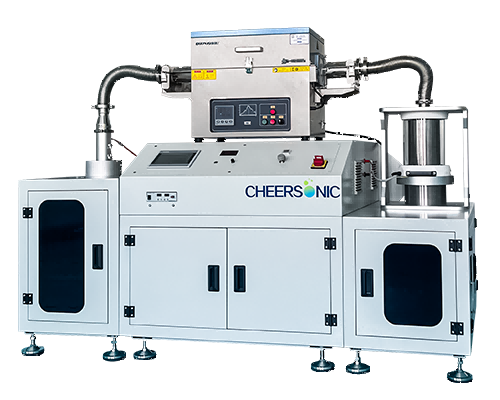
2. Advantages of ultrasonic assisted spray pyrolysis
Improving product quality: Better particle uniformity: Due to ultrasonic atomization, droplets with more uniform sizes can be produced, and the product particles (such as nanoparticles) obtained after pyrolysis have a more uniform particle size distribution. For example, in the preparation of metal oxide nanoparticles, uniform droplets can undergo more uniform thermal decomposition during the pyrolysis process, resulting in the generation of nanoparticles with similar particle sizes. This is crucial for applications such as medical materials that require precise control of particle size, such as drug carriers and biosensor materials.
Better material properties: better mixing effect leads to more complete pyrolysis reaction, higher purity of products, and better crystallinity. Taking the preparation of hydroxyapatite bioceramic materials as an example, ultrasonic assisted spray pyrolysis can make the generated hydroxyapatite materials have higher crystallinity and better biocompatibility, and show better performance in medical applications such as bone repair.
Expanding application range: applicable to high viscosity solutions: ultrasonic spray has strong adaptability to solution viscosity. For some precursor solutions with high viscosity, traditional spray may be difficult to effectively atomize, but ultrasonic spray can still atomize them into suitable droplets. This enables some special medical material precursor solutions containing high concentration solutes or complex chemical compositions to be used for spray pyrolysis preparation, such as the preparation of some composite drug carrier materials containing polymer and metal ions.
Ability to prepare special structural materials: By controlling the parameters of ultrasound, different atomization effects can be achieved, thereby preparing materials with special structures. For example, hollow or core-shell structured nanomaterials can be prepared, which have unique application advantages in medical fields such as drug delivery and biological imaging.

3. Practical application cases of combination of ultrasonic and spray pyrolysis
Preparation of drug nanoparticles: In the pharmaceutical field, ultrasonic assisted spray pyrolysis technology can be used to prepare a variety of drug nanoparticles. For example, the organic salt solution of the drug is used as the precursor, and the solution is pyrolyzed by ultrasonic spray, and then the solution is atomized and pyrolyzed at an appropriate temperature to form drug nanoparticles. The drug nanoparticles prepared by this method have the advantages of small particle size, uniform distribution, and good drug release performance, which can be used to improve the bioavailability and targeting of drugs.
Biosensor material preparation: For sensitive materials used in biosensors, such as metal oxide – carbon nanocomposites, ultrasonic assisted spray pyrolysis can atomize and pyrolysis the precursor solution containing metal salts and carbon sources. In this process, the action of ultrasound makes the composition of the material more evenly mixed, and the composite material obtained by pyrolysis has good conductivity and biological sensitivity, which can effectively detect biomolecules such as blood glucose, proteins, etc.
About Cheersonic
Cheersonic is the leading developer and manufacturer of ultrasonic coating systems for applying precise, thin film coatings to protect, strengthen or smooth surfaces on parts and components for the microelectronics/electronics, alternative energy, medical and industrial markets, including specialized glass applications in construction and automotive.
Our coating solutions are environmentally-friendly, efficient and highly reliable, and enable dramatic reductions in overspray, savings in raw material, water and energy usage and provide improved process repeatability, transfer efficiency, high uniformity and reduced emissions.
Chinese Website: Cheersonic Provides Professional Coating Solutions
