
Ultrasonic Spraying of Highly Conductive Films
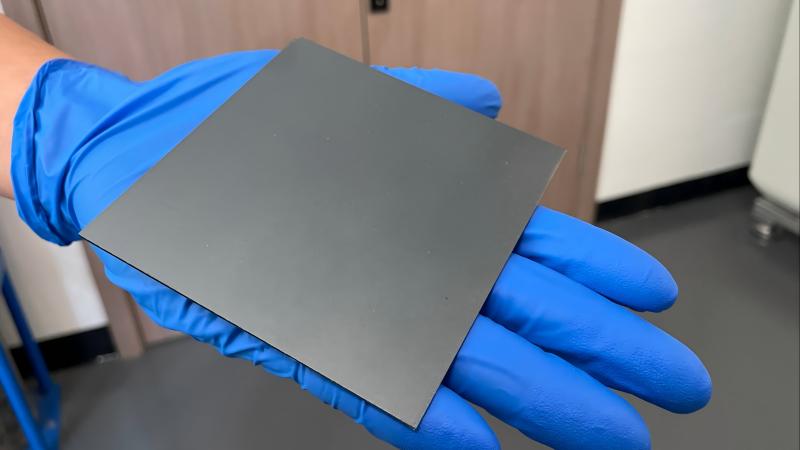
Ultrasonic spraying machine applies a layer of highly conductive film such as graphene or copper on plastic film
Ultrasonic spraying machine, with its advantages of uniform atomization, dense coating, and strong controllability, has become one of the key technologies for preparing highly conductive films such as graphene and copper on flexible substrates such as plastic films. This technology can effectively solve the problems of poor coating uniformity, high material waste, and significant damage to flexible substrates in traditional coating processes such as scraper coating and dip coating. It is widely used in flexible electronics, electromagnetic shielding, energy storage, and other fields.
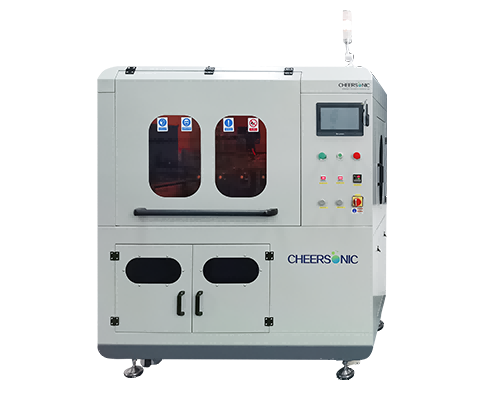
Core principles and advantages of ultrasonic spraying machine
The core of ultrasonic spraying is to use ultrasonic vibration energy to atomize conductive paste (graphene paste, copper paste, etc.) into uniform droplets with a diameter of only a few micrometers to tens of micrometers, and then precisely transport the droplets to the surface of plastic film through low-pressure airflow. After drying/curing, a conductive film is formed.
Compared to traditional coating, the core advantages are:
- The coating uniformity is extremely high: the particle size distribution of atomized droplets is narrow (usually 5-50 μ m), and the coating thickness deviation can be controlled within ± 5%, avoiding the “stripe” and “pinhole” defects of traditional processes.
- Low damage flexible substrate: The atomization pressure is extremely low (0.01-0.1MPa), far lower than high-pressure spraying, and will not cause stretching or damage to easily deformed plastic films such as PET, PI, PP, etc.
- High material utilization rate: Mist titration has good directionality, minimal splashing, and a material utilization rate of over 80% (traditional spraying only 30-50%), especially suitable for high priced materials such as graphene and nano copper.
- Accurate and controllable thickness: By adjusting parameters such as spraying speed, slurry concentration, and ultrasonic power, coating thickness can be controlled within the range of 10nm-10 μ m to meet different conductivity requirements.
- Low temperature compatibility: It can be combined with room temperature drying or low-temperature curing processes (such as infrared and UV curing) to avoid plastic film shrinkage or degradation due to high temperature.
Complete Coating Process Flow Chart
1. Substrate preparation: Cut the plastic film to the target size and perform dust removal treatment (such as vacuum suction and ion air cleaning).
2. Substrate pretreatment: Select plasma/chemical etching/primer treatment according to the type of film, and apply coating within 1 hour after treatment (to avoid surface energy drop).
3. Slurry preparation:
- Graphene: Mix graphene powder with dispersants and solvents, disperse by ball milling/ultrasound (20-60 minutes) to form a uniform slurry, and filter to remove agglomerated particles.
- Copper: Mix nano copper powder with binder, antioxidant (such as vitamin C), and solvent, disperse with ultrasound for 30-40 minutes, and control the viscosity of the slurry at 50-200cP.
- Set parameters: ultrasonic power 50-150W, spraying speed 5-20mm/s, atomization pressure 0.02-0.05MPa, liquid flow rate 0.1-1mL/min.
- Substrate temperature: from room temperature to 60 ℃ (to avoid coating cracking caused by rapid solvent evaporation).
5. Post processing:
- Graphene: Dry at 60-120 ℃ for 1-2 hours. If it is oxidized graphene, further thermal reduction (150-300 ℃, inert atmosphere) or chemical reduction (such as hydroiodic acid treatment) is required.
- Copper: Curing at 80-120 ℃ for 1-3 hours, fully protected by N ₂ to prevent copper oxidation.
6. Performance testing: Test the square resistance (four probe method), thickness (step gauge), adhesion (grid method/tape method), and flexibility (bending test) of the coating.
Application scenarios and industry requirements
Flexible electronics: Preparation of graphene conductive film on PET/PI film for electrodes in flexible display screens, flexible touch screens, and wearable devices.
Electromagnetic shielding: Copper conductive film can be used as a shielding layer for electronic device casings and communication cables to block electromagnetic interference (EMI).
Energy storage: Coating graphene on plastic film as a flexible electrode for supercapacitors or as a current collector coating for lithium batteries to reduce internal resistance.
Intelligent packaging: Integrating conductive film into plastic packaging to create smart labels that can detect temperature and humidity.
In summary, ultrasonic spraying technology provides an efficient and precise solution for high conductivity coating of plastic films. With the optimization of material processes and equipment upgrades, its application in emerging fields such as flexible electronics will continue to expand.
About Cheersonic
Cheersonic is the leading developer and manufacturer of ultrasonic coating systems for applying precise, thin film coatings to protect, strengthen or smooth surfaces on parts and components for the microelectronics/electronics, alternative energy, medical and industrial markets, including specialized glass applications in construction and automotive.
Our coating solutions are environmentally-friendly, efficient and highly reliable, and enable dramatic reductions in overspray, savings in raw material, water and energy usage and provide improved process repeatability, transfer efficiency, high uniformity and reduced emissions.
Chinese Website: Cheersonic Provides Professional Coating Solutions