
Core Coating of Infrared Detector (metal/ceramic shell)
Core Coating of Infrared Detector – Ultrasonic Coating – Cheersonic
The infrared detector housing is used to package both non cooled and cooled infrared focal plane detectors. Widely used in infrared night vision, security, firefighting, maritime applications, monitoring and night vision observation, power monitoring, smart grid online monitoring, visual enhancement assisted driving systems, and railways.
Metal casing (including metal chassis/wall, copper exhaust pipe, metal ring)
The core pain points of metal shells are easy corrosion, high temperature oxidation, and low temperature brittleness, and it is necessary to avoid coating interference with infrared detection (such as not absorbing/reflecting target infrared signals). Based on its characteristics of high reliability, resistance to -200 ℃ low temperature (refrigeration type), and multi scenario adaptation (maritime/firefighting/outdoor), it is speculated that the following coatings are commonly used:
1. Ceramic based high-temperature and corrosion-resistant coatings (such as alumina and zirconia coatings)
- Adaptability: Adhered to metal surfaces through plasma spraying technology, it has a high degree of matching with the thermal expansion coefficient of metals such as aluminum alloy, stainless steel, and copper, and can withstand extreme temperature differences of -200 ℃ to 500 ℃ or more (perfectly suitable for the low-temperature requirements of cold detectors and short-term high temperatures in firefighting scenarios).
- Core role:
– Weather resistant and corrosion-resistant: resist salt spray in maritime scenarios, wind and rain erosion in outdoor power monitoring, and prevent metal oxidation and rusting;
– Infrared compatibility: Aluminum oxide/zirconia coatings have extremely low absorption/reflectivity in the mid infrared band (the core operating band of infrared detectors), and will not obstruct or interfere with the target’s infrared signal;
– Wear resistant and impact resistant: Suitable for scenarios such as railways and assisted driving that are susceptible to mechanical collisions, protecting the metal casing from scratches.
2. Polyimide (PI) coating
- Adaptability: Among organic polymer coatings, polyimide has the best high and low temperature resistance (long-term temperature resistance -269 ℃ to 260 ℃), and has strong adhesion to metal substrates, which will not peel off during high and low temperature cycles (such as when a refrigeration detector switches from room temperature to -200 ℃, the coating has no risk of embrittlement or cracking).
- Core role:
– Insulation protection: The metal shell needs to be coordinated with the internal ceramic insulator to achieve insulation. The high insulation of the PI coating can avoid leakage between metal leads and is suitable for “multi lead” design;
– Weather resistance: UV resistant, moisture and heat resistant, suitable for long-term outdoor use scenarios such as security and monitoring;
– Lightweight: The coating thickness is thin (usually 10-50 μ m), does not increase the weight of the shell, and is suitable for portable devices (such as night vision observation devices).
3. Low infrared absorption fluorocarbon coating
- Adaptability: Fluorocarbon coatings (such as polytetrafluoroethylene modified coatings) are the outdoor weather resistant “ceiling”, but low infrared absorption models need to be selected (to avoid the infrared occlusion problem of conventional fluorocarbon coatings).
- Core role:
– Ultimate weather resistance: resistant to salt spray, acid rain, and UV aging, especially suitable for high corrosion scenarios such as maritime and coastal security, with a coating life of over 10 years;
– Easy to clean: The surface is hydrophobic and oil repellent, reducing the adhesion of outdoor dust and oil stains, and avoiding pollutants from blocking infrared signals (such as dust accumulation on the outer shell in power monitoring affecting temperature measurement accuracy).

Ceramic shell (including LCC/PGA type ceramic parts, circular ceramic parts)
Ceramics themselves have the characteristics of weather resistance, corrosion resistance, and high temperature resistance. The core requirements for coatings are to optimize infrared detection performance, improve mechanical strength, and solve electrostatic problems. Combined with their “TEC free packaging, low cost, and multi pin” characteristics, it is speculated that the following coatings are commonly used:
1. Infrared anti reflective coating (such as magnesium fluoride, silicon dioxide coating)
- Adaptability: Ceramics (such as alumina ceramics) have a certain reflectivity (about 8% -15%) in the mid infrared band, which can cause some target infrared signals to be reflected and lost, affecting the sensitivity of the detector. The anti reflective coating uses the principle of “optical interference to counteract reflection” to reduce the reflectivity to below 1%.
- Core role:
– Improve detection accuracy: adapt to core scenarios such as infrared night vision, monitoring, and assisted driving, allowing the detector to receive target infrared signals more clearly (such as nighttime pedestrians, thermal radiation from faulty electrical equipment);
– Strong compatibility: The magnesium fluoride/silicon dioxide coating matches the thermal expansion coefficient of ceramic substrates (alumina, beryllium oxide), with no risk of cracking at low temperatures (-200 ℃) and low cost, meeting the “low-cost” requirements of ceramic shells.
2. Wear resistant hard coatings (such as silicon nitride and silicon carbide coatings)
- Adaptability: Although ceramic shells have high hardness, they are brittle and prone to scratches during installation, transportation, or outdoor use (such as collisions with railway inspection equipment). The hardness of silicon nitride coating can reach HV1500 or above (far exceeding that of ceramics themselves), and its toughness is better than that of ceramics.
- Core role:
– Scratch resistance: Protect the surface integrity of the ceramic shell and avoid infrared signal scattering caused by scratches (such as scratches causing infrared signal refraction disorder and affecting monitoring accuracy);
– Wear resistant: Suitable for frequently moving devices such as handheld night vision goggles and car mounted driver assistance detectors, extending the service life of the casing.
3. Anti static conductive coating (such as indium tin oxide ITO, tin oxide coating)
- Adaptability: Ceramics are insulators that are prone to accumulating static electricity (such as in online monitoring scenarios of smart grids, where high voltage environments can generate static electricity). Static electricity may interfere with the internal circuits of detectors or break down sensitive components.
- Core role:
– Electrostatic discharge: ITO coating has low resistance (10 ² -10 ⁴ Ω/□), which can quickly dissipate the accumulated static electricity in the shell and ensure circuit safety;
– Infrared compatibility: ITO has a transmittance of over 80% in the mid infrared band (3-14 μ m, commonly used for infrared detectors), which does not block infrared signals and perfectly balances the requirements of “conductivity” and “detection”.
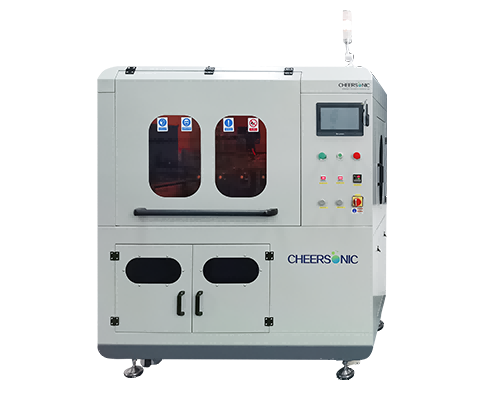
Ultrasonic spraying machine: an efficient coating equipment suitable for various coatings
Ultrasonic spraying machine relies on high-frequency vibration atomization technology, with the core advantages of fine atomized particles and controllable coating thickness, becoming an ideal equipment for various coating applications. It does not require high-pressure air flow assistance, which can avoid the waste and uneven coating problems of traditional spraying, and its adaptability covers multiple types of material coatings.
Whether it is conductive silver paste and copper based coatings for metals, high-temperature resistant alumina and zirconia coatings for ceramics, organic anti-corrosion resins and insulating paints, or even biocompatible coatings for medical fields and lithium battery electrode coatings for new energy fields, it can operate stably. In industries such as electronics, healthcare, and new energy, it can adjust parameters according to different coating characteristics to accurately meet coating requirements ranging from thin to micrometer level and thick to millimeter level. This not only ensures coating performance but also expands the application scenarios of various coatings, becoming a key equipment for modern coating processes.
About Cheersonic
Cheersonic is the leading developer and manufacturer of ultrasonic coating systems for applying precise, thin film coatings to protect, strengthen or smooth surfaces on parts and components for the microelectronics/electronics, alternative energy, medical and industrial markets, including specialized glass applications in construction and automotive.
Our coating solutions are environmentally-friendly, efficient and highly reliable, and enable dramatic reductions in overspray, savings in raw material, water and energy usage and provide improved process repeatability, transfer efficiency, high uniformity and reduced emissions.
Chinese Website: Cheersonic Provides Professional Coating Solutions
