
Preparation of the Ceramic Dielectric Layer
The ceramic dielectric layer is the supporting framework of the AMB copper-clad laminate (CCL). Its quality directly impacts the thermal conductivity, mechanical strength, and reliability of the circuit board. The preparation process requires strict control of raw material purity and process parameters. The main steps are as follows:
Raw Material Selection and Pretreatment
Ceramic Powders:
– Alumina (Al₂O₃): Purity ≥99.5%, low cost, suitable for conventional circuits;
– Aluminum Nitride (AlN): Purity >99%, thermal conductivity >170 W/mK, suitable for high-power applications;
– Silicon Nitride (Si₃N₄): Thermal conductivity >90 W/mK, flexural strength >800 MPa, used in high-reliability applications.
Pretreatment Requirements:
– Powder particle size control (D50 ≤ 1 μm) to ensure sintering density;
– Nitride powders must be stored in an inert atmosphere to prevent hydrolysis and oxidation.
2. Powder Mixing and Plasticization
Mixing Process:
– Ball Milling: Wet-mill the ceramic powder with a binder (e.g., PVA) and a dispersant in appropriate proportions for 4-6 hours.
– Goal: Achieve uniform powder dispersion and a stable slurry viscosity of 3000-5000 cps.
Granulation and Drying:
– Spray drying to form granules with good flowability (particle size 50-100 μm).
– Low-temperature drying at 80°C to a moisture content of <0.5%.
3. Precision Machining and Testing
Surface Treatment:
– Double-sided grinding: Substrate flatness ≤ 5μm/100mm;
– CMP polishing: Surface roughness Ra < 0.1μm.
Performance Testing:
– Pore size distribution (SEM analysis);
– Thermal conductivity (laser flash method);
– Flexural strength (three-point bend test).
Process Difficulties and Solutions
1. Aluminum Nitride Hydrolysis Control:
– Maintain humidity <40% RH throughout powder processing;
– Pre-bake (200°C x 2h) before sintering to remove adsorbed water.
2. Silicon Nitride Densification:
– Add Y₂O₃-Al₂O₃ sintering aid (5wt%) to promote liquid-phase sintering;
– Apply 10MPa nitrogen pressure during the GPS process to suppress decomposition pores.
3. Sintering Deformation Prevention:
– Optimize green body density uniformity;
– Use zirconia backing plates to reduce high-temperature adhesion.
Technical Value: Precision fabrication of ceramic dielectric layers is the core foundation for achieving high-performance AMB copper-clad laminates. Silicon nitride substrates, in particular, can achieve both thermal conductivity >90W/mK and mechanical strength >800MPa through process optimization, providing critical support for extreme operating conditions such as new energy vehicles and aerospace power modules.
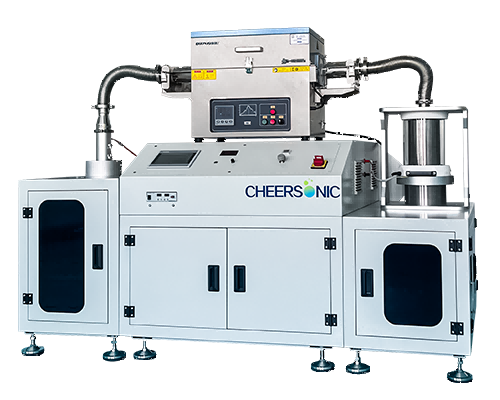
Spray pyrolysis ultrasonic nozzles can be used in R&D, pilot-scale, and industrial-scale spray pyrolysis systems to produce ultrafine powders. Using ultrasonic atomization nozzle technology, precursor solutions or suspensions are uniformly atomized and then sprayed into a tubular furnace for high-temperature thermal decomposition to produce ultrafine powders. This system is a key atomization device in spray pyrolysis (also known as spray pyrolysis) systems. Cheersonic provides complete ultrasonic spray pyrolysis system solutions, including ultrasonic atomization, high-temperature furnaces, powder collection, exhaust gas treatment, carrier gas control, and precursor liquid supply and distribution. Ultrasonic nozzles utilize high-frequency ultrasonic oscillations to atomize liquids into uniform micron-sized particles. Compared to traditional two-fluid nozzles, ultrasonic nozzles produce more uniform and finer atomized particles and are less prone to nozzle clogging. Depending on the viscosity of the liquid, ultrasonic nozzles are selected at different frequencies, producing atomized particle diameters ranging from 0.5 to 40 microns. These nozzles are widely used in fine coating, spray pyrolysis, spray drying, and other fields.
About Cheersonic
Cheersonic is the leading developer and manufacturer of ultrasonic coating systems for applying precise, thin film coatings to protect, strengthen or smooth surfaces on parts and components for the microelectronics/electronics, alternative energy, medical and industrial markets, including specialized glass applications in construction and automotive.
Our coating solutions are environmentally-friendly, efficient and highly reliable, and enable dramatic reductions in overspray, savings in raw material, water and energy usage and provide improved process repeatability, transfer efficiency, high uniformity and reduced emissions.
Chinese Website: Cheersonic Provides Professional Coating Solutions</a
