
Regarding Proton Exchange Membrane
Regarding Proton Exchange Membrane – Catalyst Coating – Cheersonic
About Proton Exchange Membrane – the path for protons to migrate in the membrane is relatively short, which helps the rapid conduction
Proton conduction
Thinner proton exchange membrane: When the proton exchange membrane is thinner, the path for protons to migrate in the membrane is relatively short, which helps the rapid conduction of protons. During the operation of the fuel cell, the migration speed of protons from the anode through the proton exchange membrane to the cathode will be accelerated, thereby reducing the resistance in the proton transmission process. For example, in a proton exchange membrane fuel cell (PEMFC), a thinner proton exchange membrane can increase the rate of electrochemical reactions, allowing the battery to operate at a lower ohmic polarization, and the output voltage is relatively high, which helps to increase the power density of the battery.

Thicker proton exchange membrane: A thicker proton exchange membrane will increase the path length of proton transmission, resulting in increased proton conduction resistance. This will prolong the migration time of protons from the anode to the cathode. During the electrochemical reaction, the reaction rate may be limited because the protons cannot reach the cathode in time. At high current density, this restriction on proton transmission will be more obvious, increasing the ohmic polarization of the battery and reducing the output voltage, thereby affecting the performance of the battery.
Gas permeation
Thinner proton exchange membrane: Although thin proton exchange membrane is conducive to proton conduction, it may also increase the permeability of gases (such as hydrogen and oxygen). In fuel cells, hydrogen at the anode and oxygen at the cathode need to react in their respective catalyst layers, and the proton exchange membrane should mainly play the role of conducting protons and preventing direct permeation of gases. If the proton exchange membrane is too thin, the gas may directly permeate the membrane, resulting in the mixing of hydrogen and oxygen on both sides of the membrane, which will reduce the open circuit voltage of the battery and may also cause safety issues such as hydrogen leakage and the risk of combustion and explosion.
Thicker proton exchange membrane: Thick proton exchange membrane can effectively reduce the permeability of gas and better separate the reaction gases at the anode and cathode. This ensures that hydrogen and oxygen react on their respective electrode sides and improves the safety and stability of the fuel cell. However, an overly thick proton exchange membrane will increase the internal resistance of the battery and reduce the energy conversion efficiency of the battery.
Mechanical properties
Thinner proton exchange membrane: Thin proton exchange membranes are relatively weak in mechanical strength. During the preparation of fuel cells, such as hot pressing and other operations, and during actual use, thinner proton exchange membranes may be more prone to rupture and damage due to mechanical factors such as pressure and vibration. Once the proton exchange membrane is mechanically damaged, the battery performance will drop sharply or even fail to work properly.
Thicker proton exchange membrane: Thicker proton exchange membranes have better mechanical properties and can withstand greater mechanical stress. This makes it less likely to be damaged during the assembly and use of fuel cells, helping to maintain the structural integrity of the battery. However, thick proton exchange membranes increase the volume and weight of the battery, which is not very beneficial for some application scenarios with strict requirements on volume and weight (such as portable fuel cell devices).
Water management
Thinner proton exchange membranes: Thin proton exchange membranes may be affected in terms of water adsorption and transport. In fuel cells, the presence of water is very important for proton conduction, and an appropriate amount of water can form a proton conduction channel. However, too thin proton exchange membranes may not be able to effectively adsorb and retain enough water, especially under dry working conditions, which may cause a decrease in proton conductivity and affect the performance of the battery.
Thicker proton exchange membrane: Thicker proton exchange membranes can absorb and store more water, which is beneficial to proton conduction to a certain extent. However, if water management is not appropriate, thick proton exchange membranes may accumulate water, leading to flooding inside the battery. Flooding will hinder gas diffusion, making it impossible for the reaction gas to reach the catalyst layer in time, thereby reducing battery performance.
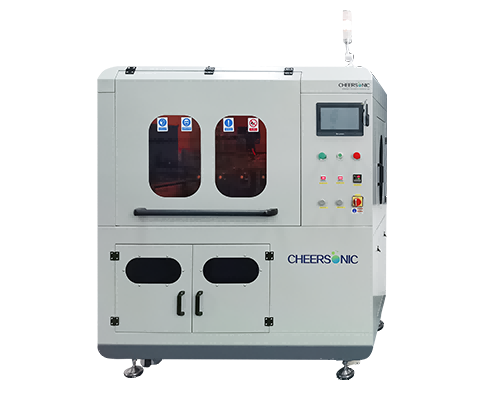
Ultrasonic spray fuel cell catalyst coating system can produce highly uniform, repeatable and durable coatings. Our ultrasonic spraying can well control coating properties, significantly reduce material usage, and reduce maintenance and downtime.
Our company’s ultrasonic spraying equipment can be sprayed on a variety of different metal alloys, including the preparation of platinum, nickel, iridium and ruthenium-based fuel cell catalyst coatings, as well as PEMs, GDLs, DMFCs (direct methanol fuel cells) and SOFCs (solid Oxide fuel cell) manufacturing. The battery manufactured by this technology has the characteristics of high battery load and high battery efficiency.
The optional ultrasonic dispersion system can uniformly disperse the catalyst solution without blocking the ultrasonic nozzle, thereby providing a uniform and homogeneous fuel cell catalyst coating, and has a controlled droplet size from ultra-low flow to production-scale flow.
About Cheersonic
Cheersonic is the leading developer and manufacturer of ultrasonic coating systems for applying precise, thin film coatings to protect, strengthen or smooth surfaces on parts and components for the microelectronics/electronics, alternative energy, medical and industrial markets, including specialized glass applications in construction and automotive.
Our coating solutions are environmentally-friendly, efficient and highly reliable, and enable dramatic reductions in overspray, savings in raw material, water and energy usage and provide improved process repeatability, transfer efficiency, high uniformity and reduced emissions.
Chinese Website: Cheersonic Provides Professional Coating Solutions