
Uniform Thin Film Fabrication for Porous Electrodes and GDL
Ultrasonic Spraying Technology: Uniform Thin Film Fabrication for Porous Electrodes and Gas Diffusion Layers
Ultrasonic spraying technology is an advanced process that uses high-frequency acoustic energy to atomize liquid precursors into micron-sized droplets, which are then guided to the substrate surface by a carrier gas to form a uniform thin film. This technology can achieve precise coating of complex morphologies and porous structures without direct contact with the substrate, making it particularly suitable for the manufacturing of energy devices such as fuel cells, electrolyzers, and battery electrodes. Specifically, ultrasonic spraying can deposit high-quality thin film layers on the surfaces of the following key components: anode electrodes, cathode electrodes, and porous structures including porous transport layers and gas diffusion layers (GDLs).

Firstly, for anode and cathode electrodes, the uniformity and structural integrity of the catalyst layer directly determine the efficiency and durability of the electrochemical reaction. Traditional coating methods such as blade coating or slot coating often struggle to form uniform, crack-free catalyst films on micron-sized rough or porous electrode surfaces. The droplets generated by ultrasonic spraying typically have a diameter between 20 and 50 micrometers, are concentrated, and have low momentum, thus avoiding erosion or blockage of electrode pores. By precisely controlling the atomization frequency, carrier gas flow rate, and solution concentration, thin films ranging from submicrometers to tens of micrometers can be constructed layer by layer on the anode and cathode surfaces, while maintaining good dispersion of catalyst particles. This layered structure is beneficial for increasing the length of the three-phase reaction interface, promoting proton/electron conduction and reactant gas diffusion, thereby significantly improving electrode utilization and power density. Furthermore, ultrasonic spraying supports the design of gradient catalytic layers—for example, using thin layers with high ionomer content near the electrolyte membrane and high-porosity thin layers near the porous transport layer, thereby optimizing hydrothermal management and slowing catalyst degradation.
Secondly, regarding the porous transport layer (typically referring to porous titanium or porous nickel plates in electrolyzers, or carbon paper substrates in fuel cells), its surface and internal pore walls also need to be coated with functional films. The porous transport layer is responsible for both conducting electrons and heat and transporting reactants/products. Two major challenges exist in thin-film coating on such substrates: avoiding clogging of the pores and ensuring a strong bond between the film and the pore walls. Ultrasonic spraying, with its low-velocity droplets, can deposit on the pore openings and inner walls of the pores through inertial impaction or diffusion, forming a continuous nanoscale coating without creating liquid bridges that clog the pores. For example, spraying a thin iridium or ruthenium-based catalytic film onto the porous transport layer of the anode in a proton exchange membrane water electrolyzer can significantly reduce contact resistance and improve oxygen evolution reaction (OER) activity; spraying a platinum or carbon-based film onto the porous transport layer of the cathode helps promote the hydrogen evolution reaction (HER). By controlling the number of sprays and the solution concentration, the coating distribution in the thickness direction can be precisely adjusted—either forming a dense functional layer on the surface or penetrating to a certain depth to construct a gradient structure, thus achieving both high conductivity and high mass transfer rate.
Finally, the gas diffusion layer (GDL), typically made of hydrophobically treated carbon fiber paper or carbon cloth, serves to uniformly distribute the reactant gases, expel generated water, and support the catalytic layer. When directly coating microporous layers or catalytic films onto GDLs, the coating must not excessively penetrate the fiber gaps, otherwise it will disrupt the hydrophobic network and gas pathways. Ultrasonic spraying, due to its fine and dispersed droplets, can form a thin-shell coating on the raised fiber bundles of GDLs, while the open gaps between fibers remain largely unobstructed. This “semi-encapsulated” structure enhances the electron collection path while maintaining excellent permeability. Furthermore, ultrasonic spraying can also prepare patterned films with alternating hydrophilic and hydrophobic properties on the GDL surface to guide droplet directional discharge, effectively preventing flooding. In practical processes, spraying parameters such as atomization power (1–5 W), carrier gas pressure (0.1–0.5 bar), substrate temperature (40–120°C), and nozzle-to-substrate distance (30–100 mm) need to be optimized based on the specific material system. Simultaneously, the viscosity, surface tension, and solids content of the precursor solution also need strict control to obtain a stable and controllable atomized flow.
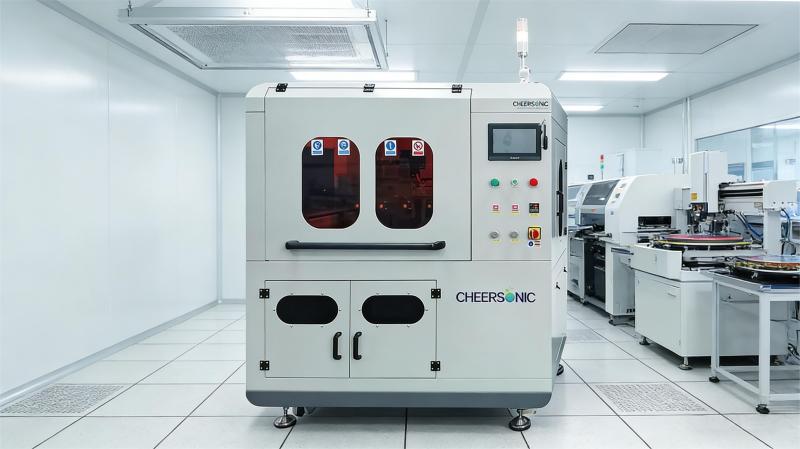
In summary, ultrasonic spraying technology, with its advantages of being gentle, precise, having high material utilization, and being suitable for large-scale roll-to-roll production, has become an ideal process for preparing high-quality thin films on anodes, cathodes, porous transport layers, and gas diffusion layers. With the development of fuel cells, electrolyzers, and next-generation metal-air batteries and solid-state batteries, the requirements for the uniformity and structural controllability of functional thin films on porous electrode surfaces are increasing. The application prospects of ultrasonic spraying technology in the coating of these key components will be even broader. Through continuous optimization of atomization mechanisms, online monitoring and closed-loop control, and the integration of automated multi-nozzle arrays, it is expected to achieve a seamless transition from laboratory research to industrial mass production in the future, providing solid technical support for the development of high-efficiency energy conversion devices.
About Cheersonic
Cheersonic is the leading developer and manufacturer of ultrasonic coating systems for applying precise, thin film coatings to protect, strengthen or smooth surfaces on parts and components for the microelectronics/electronics, alternative energy, medical and industrial markets, including specialized glass applications in construction and automotive.
Our coating solutions are environmentally-friendly, efficient and highly reliable, and enable dramatic reductions in overspray, savings in raw material, water and energy usage and provide improved process repeatability, transfer efficiency, high uniformity and reduced emissions.
Chinese Website: Cheersonic Provides Professional Coating Solutions