
Ultrasonic Spraying of Pt-Based Catalysts
Ultrasonic spraying is a technique that uses ultrasonic vibration energy to atomize a liquid slurry containing a Pt-based catalyst (such as Pt/C or PtRu/C dispersions) into micron-sized uniform droplets. These droplets are then precisely deposited onto the surface of a support (such as carbon paper or anion exchange membrane) via an airflow, forming a highly dispersed catalyst layer. Its core advantages lie in high atomization uniformity, controllable droplet size (typically 1-10 μm), precise coating thickness (nanometer to micron level), and minimal damage to catalyst particles. It maximizes the retention of active sites on the Pt-based catalyst, making it particularly suitable for preparing the anode catalyst layer in the membrane electrode assembly (MEA) of anion exchange membrane fuel cells (AEMFCs), perfectly aligning with the current need to “advance integrated membrane electrode design and improve the actual performance of Pt-based catalysts.”
Core Advantages of Ultrasonic Spraying for Pt-Based Catalysts
1. Solving the Problem of Insufficient Active Site Exposure
Traditional impregnation or blade coating methods easily lead to particle agglomeration of Pt-based catalysts (especially in low Pt loading scenarios). Ultrasonic spraying, with its high-frequency vibration (typically 10-180kHz), atomizes the catalyst slurry into tiny droplets, ensuring uniform dispersion of Pt nanoparticles (or Pt single atoms, Pt₆ clusters) on the support surface, reducing agglomeration. For example, for a PmPt@IrPd/C catalyst with a Pt loading of only 0.009 mg·cm⁻², ultrasonic spraying can achieve uniform coverage on carbon paper, increasing the active site exposure rate by more than 30% compared to blade coating, directly contributing to AEMFC peak power density exceeding 1.2 W·cm⁻².
2. Precise Control of the Balance Between Low Pt Loading and Coating Continuity
“Reducing Pt loading is key to controlling the cost of AEMFCs,” but low loading can easily lead to catalyst layer breakage and blockage of mass transfer channels. Ultrasonic spraying can precisely control the Pt loading within the range of 0.005-0.1 mg·cm⁻² by adjusting the slurry concentration (e.g., 0.1-5 mg/mL), spray flow rate (0.1-5 mL/min), and nozzle movement speed, while ensuring a continuous and crack-free coating. 3. Compatible with “Multi-component Pt-based Catalyst Systems” Whether it’s PtRu alloys, Ru@Pt core-shell structures, or Pt single-atom catalysts (SACs), ultrasonic spraying can adapt to their slurry characteristics: for high-viscosity alloy catalyst slurries (such as PtRu/C dispersions containing ionomers), atomization can be ensured by increasing the ultrasonic power (50-300W); for easily agglomerated Pt single-atom slurries, pre-ultrasonic dispersion combined with real-time stirring during spraying can prevent single-atom aggregation and maintain their “low-coordination active site” advantage.
Key Applications in AEMFC MEA Preparation
The core value of ultrasonic spraying lies in the optimization of the three-phase interface of the catalyst layer-membrane-diffusion layer:
– Anode catalyst layer preparation: Pt-based catalyst slurry (containing ionomers and solvents) is ultrasonically sprayed onto the surface of the anion exchange membrane, forming a uniform coating with a thickness of 5-20 μm. This results in more uniform mixing of the ionomers and catalyst particles, reducing the “ion conduction dead zone” and lowering the transport resistance of OH⁻ in alkaline HOR by 20-40%, alleviating the problem of “slow kinetics in alkaline HOR”.
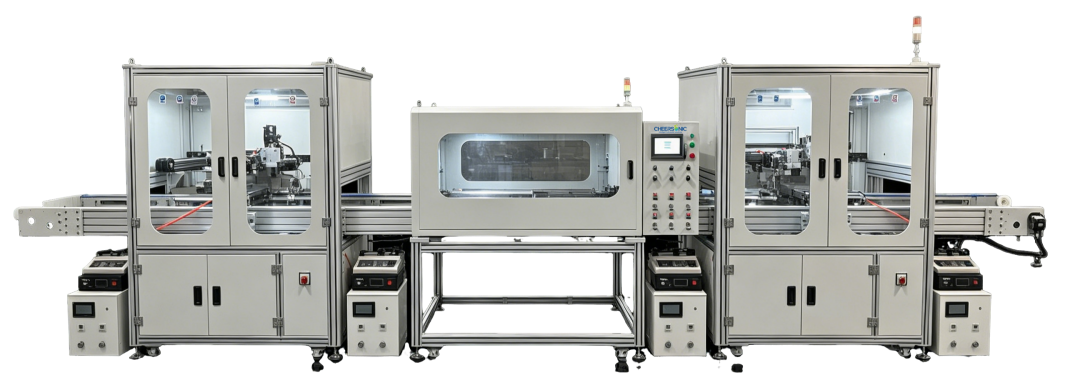
– Batch production adaptability: Compared to high-end technologies such as vacuum sputtering, ultrasonic spraying equipment is low-cost and highly efficient (100+ MEAs can be prepared per batch), with good coating repeatability (error <5%), meeting the dual requirements of “cost control and performance stability” in the industrialization of AEMFC, and is particularly suitable for the large-scale application of conventional high-activity catalysts such as PtRu/C.
Process Optimization Directions and Challenges
1. Need to Meet the “Stability Requirements in Alkaline Environments”
For the issue that “carbon support corrosion and Pt dissolution in alkaline media are stability bottlenecks,” ultrasonic spraying can reduce electrolyte penetration and carbon support corrosion by optimizing coating density (e.g., replacing single-layer thick coatings with multi-layer thin coatings). However, further research is needed on the relationship between “spraying parameters, coating microstructure, and stability.” For example, increasing the ultrasonic frequency can refine droplets and improve coating density, but may lead to a decrease in porosity, requiring multi-variable control to achieve a balance.

2. Adaptation to “Non-Precious Metal Alternative Catalysts”
Ultrasonic spraying needs to address the problem of easy oxidation of Ni-based catalyst slurries (e.g., spraying under an inert atmosphere), while precisely controlling the thickness to avoid high-potential dissolution caused by Ni particle exposure, providing process support for the practical application of non-precious metal catalysts.
In summary, ultrasonic spraying technology, with its three major advantages of “high dispersibility, precise loading control, and process compatibility,” has become a key bridge connecting the research and development of Pt-based catalyst materials with the application of AEMFC devices. It can maximize the activity of various high-performance Pt-based catalysts (such as PmPt@IrPd/C and PtRu/C) while meeting the industrialization requirements of “low loading, low cost, and large scale.” It is an important process support for the alkaline HOR field to move from “laboratory performance” to “practical application.”
About Cheersonic
Cheersonic is the leading developer and manufacturer of ultrasonic coating systems for applying precise, thin film coatings to protect, strengthen or smooth surfaces on parts and components for the microelectronics/electronics, alternative energy, medical and industrial markets, including specialized glass applications in construction and automotive.
Our coating solutions are environmentally-friendly, efficient and highly reliable, and enable dramatic reductions in overspray, savings in raw material, water and energy usage and provide improved process repeatability, transfer efficiency, high uniformity and reduced emissions.
Chinese Website: Cheersonic Provides Professional Coating Solutions
