
Ultrasonic Spraying of Microporous Carbon-Coated Aluminum Foil
Ultrasonic Spraying: A New High-Efficiency and Uniform Coating Process for Microporous Carbon-Coated Aluminum Foil
In the current era of rapid iteration in new energy batteries, energy storage systems, and high-end electronic devices, the performance of current collector materials directly determines the energy density, cycle life, and safety stability of products. Microporous carbon-coated aluminum foil, with its advantages of lightweight, high conductivity, high wettability, and structural stability, has become a key basic material for new electrochemical systems such as lithium batteries and sodium-ion batteries. Traditional coating processes have significant shortcomings in uniformity, thickness control, micropore protection, and material utilization. Ultrasonic spraying machines, with their micron-level precise atomization, non-contact and gentle deposition, and fully controllable film formation, provide an ideal solution for the efficient, stable, and large-scale preparation of microporous carbon-coated aluminum foil, driving the upgrade of current collector coating processes towards precision, greenness, and intelligence.
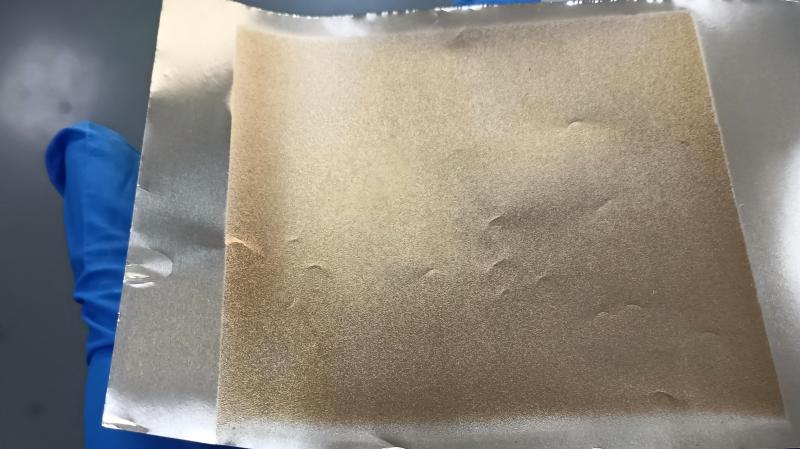
Microporous carbon-coated aluminum foil uses high-purity microporous aluminum foil as a base, with a layer of conductive carbon material uniformly coated on its surface, forming a composite current collector that combines structural support, electron conduction, electrolyte wetting, and interface stability. Microporous structures can enhance electrolyte penetration rates, alleviate electrode expansion stress, and improve ion transport efficiency; while surface carbon coatings can reduce interfacial contact resistance, improve adhesion, inhibit aluminum foil corrosion, and improve the uniformity of active material loading. The synergistic effect of these two processes results in lower battery internal resistance, higher rate performance, and longer cycle life, making them widely used in power lithium batteries, energy storage batteries, lightweight power batteries, and high-end capacitors.
Traditional carbon coating processes often employ roller coating, blade coating, or high-pressure air spraying. In microporous aluminum foil processing, these methods are prone to problems such as uneven coating thickness, edge buildup, localized missed coatings, pore blockage, and slurry splashing and waste. High-pressure airflow can also impact the fragile microporous structure, causing pore deformation and foil wrinkling, affecting product consistency and yield. Ultrasonic spraying machines overcome these traditional limitations by using high-frequency ultrasonic atomization combined with low-speed, gentle deposition to achieve non-destructive, uniform, and precise coating of microporous aluminum foil.
Its workflow is clear and controllable: First, the prepared conductive carbon slurry (graphite, carbon nanotubes, conductive carbon black, etc.) is stably delivered to the ultrasonic nozzle; the piezoelectric transducer converts electrical energy into high-frequency mechanical vibrations of 20kHz–120kHz, causing the liquid to form uniform capillary waves on the atomization surface, breaking into droplets with uniform height and particle size of 1–50μm; the droplets settle at low speed under the guidance of a small amount of low-pressure carrier gas, non-contactly covering the surface of the microporous aluminum foil; after drying and curing, a continuous, dense, and uniformly thick conductive carbon layer is formed, while completely preserving the unobstructed microporous structure.
Ultrasonic spraying machines have four core advantages in preparing microporous carbon-coated aluminum foil:
First, high coating uniformity. Narrow droplet size distribution and consistent deposition density result in a coating uniformity of over 95%, with thickness precisely controllable from nanometer to micrometer level, free from sagging, pinholes, and agglomeration, ensuring stable surface conductivity at every point.
Second, protection of the microporous structure. Non-contact, low-flow-rate deposition avoids impacting or clogging micropores, maintaining pore integrity and permeability, ensuring rapid electrolyte wetting and efficient ion transport.
Third, high material utilization. No high-pressure splashing or over-coating; slurry utilization can reach over 90%, far exceeding traditional processes, significantly reducing raw material costs and waste liquid treatment pressure.
Fourth, stable process suitable for mass production. The equipment supports roll-to-roll continuous production, closed-loop parameter control, strong consistency, and is suitable for both laboratory R&D and large-scale industrial production, compatible with water-based and solvent-based carbon slurries.
In practical applications, microporous carbon-coated aluminum foil prepared by ultrasonic spraying can significantly improve battery performance: reduced interface impedance, improved charge/discharge efficiency; strong coating adhesion, less prone to peeling during cycling, extending battery life; micropores and carbon layer synergistically improve rate performance and low-temperature performance; simultaneously reducing the current collector’s weight and increasing battery energy density. With the continued growth in demand for high-safety, long-life, and low-cost batteries in the new energy industry, the market space for microporous carbon-coated aluminum foil is rapidly expanding, and ultrasonic spraying technology will become the mainstream direction for current collector coating upgrades.
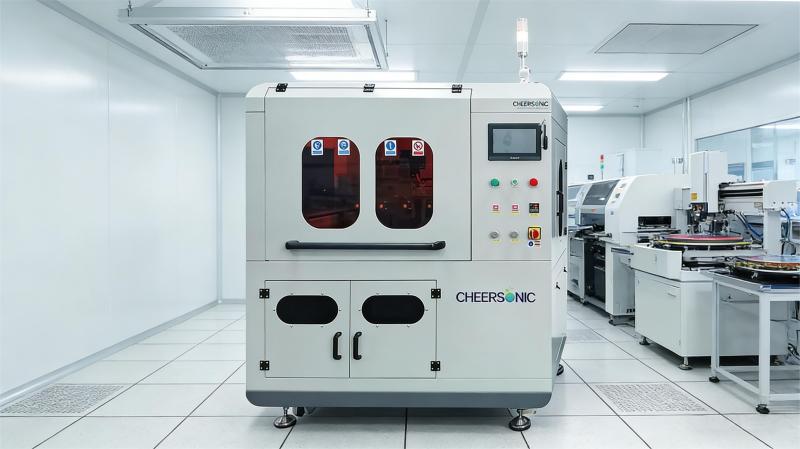
In the future, with the continuous optimization of technologies such as ultrasonic nozzles, intelligent feeding, online monitoring, and roll-to-roll high-speed lines, ultrasonic spraying machines will further improve the precision, efficiency, and stability of carbon coating, driving the development of microporous carbon-coated aluminum foil towards thinner coatings, higher uniformity, and lower costs. It is not only advanced coating equipment but also a key technology supporting the innovation of new energy materials and contributing to dual-carbon goals, providing solid support for performance breakthroughs in power batteries, energy storage systems, and novel electrochemical devices.
About Cheersonic
Cheersonic is the leading developer and manufacturer of ultrasonic coating systems for applying precise, thin film coatings to protect, strengthen or smooth surfaces on parts and components for the microelectronics/electronics, alternative energy, medical and industrial markets, including specialized glass applications in construction and automotive.
Our coating solutions are environmentally-friendly, efficient and highly reliable, and enable dramatic reductions in overspray, savings in raw material, water and energy usage and provide improved process repeatability, transfer efficiency, high uniformity and reduced emissions.