Ultrasonic Spraying of Ab Adhesive
The combination of ultrasonic spraying technology and two-component adhesive (AB adhesive) is one of the core technical solutions in the field of high-precision coating and bonding. Its essence is to solve the accuracy, uniformity, and performance stability problems of two-component adhesives in the entire process of “atomization deposition bonding” through the physical properties of ultrasonic energy, especially suitable for industrial scenarios with extremely high requirements for process details, becoming a key path to break through the limitations of traditional coating processes.
The core principle of technological collaboration
The combination of the two is not simply a “technical overlay”, but a deep adaptation based on process logic, and the core can be divided into two key links:
1. Precise atomization mechanism driven by ultrasonic waves
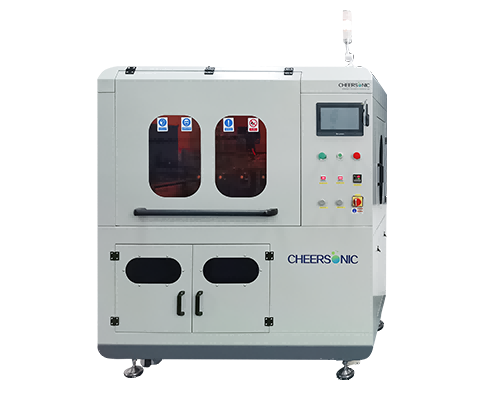
Ultrasonic spraying equipment converts high-frequency electrical energy into mechanical vibration (usually with a frequency of 20-180kHz) through a transducer, and the vibration energy directly acts on the mixed fluid of two-component adhesives. Unlike traditional pressure spraying, this vibration can break the adhesive material into small droplets with uniform particle size (deviation can be controlled within ± 5%) and no agglomeration without high-pressure impact. The direction of droplet movement has directionality – it can accurately focus on the surface of the target substrate, avoiding splashing or edge accumulation of the adhesive material.
2. Dynamic mixing and synchronous deposition of AB adhesive
Two component adhesives require uniform mixing of components A and B before curing, and ultrasonic spraying technology can integrate an “online dynamic mixing” module: before the adhesive enters the atomization chamber, the ratio of components A and B is controlled by a precision metering pump (with a ratio accuracy of ± 1%), and the auxiliary stirring effect of ultrasonic vibration is used to ensure that the mixed fluid maintains component uniformity at the moment of atomization; Subsequently, the atomized mixed droplets are synchronously deposited onto the substrate, avoiding the problems of premature curing and decreased flowability of the adhesive material caused by the traditional “mixing before coating” approach.

Core advantages of technology combination
The core value of this collaborative solution lies in meeting the dual stringent requirements of “process accuracy” and “final performance” simultaneously. The specific advantages can be summarized into four points:
1. Ultimate uniformity of droplets and coatings
The droplet size of ultrasonic atomization can usually be controlled between 1-50 μ m, and the standard deviation of droplet distribution is extremely small – this means that the adhesive layer deposited on the substrate surface has no “local accumulation”, “pinholes” or “leakage” problems, and the surface roughness (Ra) of the coating can be as low as 0.1 μ m. For scenarios that rely on the uniformity of the adhesive layer to achieve sealing or insulation (such as micro sensor packaging), this advantage directly determines the product qualification rate.
2. Precise control of micrometer level thickness
By adjusting the ultrasonic frequency, amplitude, spraying speed, and distance, coating thickness control within the range of 0.5-100 μ m can be achieved, and the deviation of single spraying thickness can be stabilized within ± 3%. Compared to traditional scraping and dispensing processes, there is no need for subsequent polishing or trimming, especially suitable for ultra-thin coating scenarios (such as conductive adhesive coatings for flexible electronic components).
3. Significant enhancement of adhesive strength
On the one hand, uniform droplet deposition maximizes the contact area between the adhesive material and the substrate surface, avoiding “stress concentration points” caused by uneven adhesive layers; On the other hand, the online dynamic mixing of AB adhesive ensures sufficient component reaction, resulting in a denser adhesive layer structure after curing, which increases the bonding strength by 15% -30% compared to traditional coating processes, and significantly improves the stability of peel strength and shear strength.
4. Comprehensive improvement of environmental resistance performance
A dense and uniform adhesive layer can effectively block the penetration of water vapor, dust, or chemical media. Combined with the temperature resistance (usually -40 ° C to 150 ° C), heat and humidity resistance, and aging resistance of AB adhesive itself, the bonding area can still maintain long-term stability in complex environments (such as automotive electronic cabins and industrial control equipment), and the service life is extended by 2-3 times compared to traditional processes.
Matching typical application scenarios with requirements
The application scenarios of this technology combination revolve around the core requirements of “high precision and high reliability”. The following are specific implementation cases in the two core areas:
1. Electronic component packaging field
Bottom filling of chip: An ultra-thin and bubble free adhesive layer needs to be filled in the gap between the chip and the substrate to alleviate thermal stress. Ultrasonic spraying can atomize AB glue into droplets of 5-10 μ m, accurately filling gaps (usually only 20-50 μ m), and the thickness deviation of the glue layer is less than 5%, avoiding poor chip heat dissipation or solder joint detachment caused by bubbles.
Mini/Micro LED package: For micro sized LED chips, insulation and protective adhesives need to be sprayed on their sides or top. The directionality of ultrasonic spraying ensures that the adhesive material only covers the target area, does not contaminate the electrode, and the uniformity of the adhesive layer directly determines the consistency of the LED’s light efficiency.
2. Precision component assembly field
Micro motor rotor bonding: The bonding surface between the rotor and shaft of a micro motor is only a few square millimeters, and the adhesive layer thickness needs to be uniform (deviation<3%) to ensure rotor dynamic balance. Ultrasonic spraying can achieve precise control of the adhesive layer thickness within 5-20 μ m, and the high-strength bonding of AB adhesive can withstand centrifugal forces of high-speed rotation (in the tens of thousands of revolutions per minute).
Optical component bonding: The bonding of optical components such as lenses and prisms requires a colorless and transparent adhesive layer, no bubbles, and uniform thickness, otherwise it will affect optical accuracy. The uniformity of mist droplets in ultrasonic spraying can avoid uneven refractive index of the adhesive layer, while the anti yellowing and temperature resistance characteristics of AB adhesive can ensure long-term stability of optical performance.
In summary, the combination of ultrasonic spraying technology and two-component adhesive (AB adhesive) is not only a “technical solution” for high-precision coating processes, but also a key support for promoting the development of high-end manufacturing towards “more precision, reliability, and efficiency”.
About Cheersonic
Cheersonic is the leading developer and manufacturer of ultrasonic coating systems for applying precise, thin film coatings to protect, strengthen or smooth surfaces on parts and components for the microelectronics/electronics, alternative energy, medical and industrial markets, including specialized glass applications in construction and automotive.
Our coating solutions are environmentally-friendly, efficient and highly reliable, and enable dramatic reductions in overspray, savings in raw material, water and energy usage and provide improved process repeatability, transfer efficiency, high uniformity and reduced emissions.
Chinese Website: Cheersonic Provides Professional Coating Solutions
