
Ultrasonic Spraying Ink on IC Cover Surface
Ultrasonic spraying equipment is an advanced and efficient solution for IC cover ink spraying, especially suitable for semiconductor packaging fields that require extremely high coating uniformity, thickness accuracy, material utilization, and environmental protection. The following is a detailed analysis based on the characteristics, advantages, and practical application logic of ultrasonic spraying technology in the field of IC manufacturing:
Technical principles and core advantages
1. Precise atomization mechanism
Ultrasonic spraying converts electrical energy into mechanical vibration through a high-frequency piezoelectric transducer (typically between 20-180 kHz), causing ink to flow through the vibrating surface at the top of the nozzle and form uniform droplets at the micrometer to submicron level. This atomization method does not require high-pressure gas drive (traditional pneumatic spraying relies on high-pressure air flow), and only relies on acoustic energy to deconstruct the liquid, thereby eliminating the problems of droplet rebound, splashing, and uneven film thickness caused by high-pressure air flow. Mist droplets are precisely deposited on the IC cover under the guidance of low-pressure carrier gas, forming a dense and uniform ink coating.
2. High precision and controllability
– Nano level uniform coating: The atomized particle size is controllable (usually 5-50 μ m), ensuring that the coating has no bubbles, orange peel effect, or edge diffusion, significantly improving the optical, electrical, and protective properties of the cover ink.
– Precise adjustment of film thickness: It can achieve ultra-thin coating (0.1-50 μ m), meeting the thickness sensitive requirements of cover ink (such as anti reflection, insulation or identification layer).
– Closed loop control: Integrated with precision metering pumps, flow sensors, and motion control systems, real-time adjustment of nozzle parameters (such as frequency, amplitude, spray path) to ensure batch consistency.
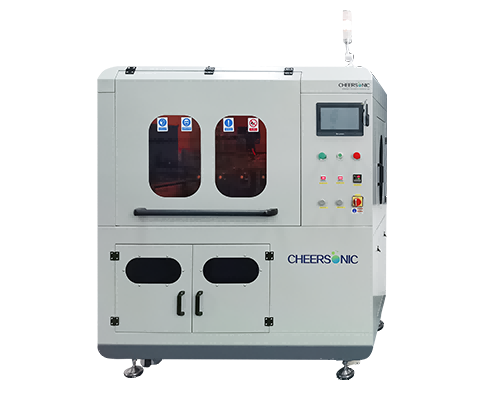
3. Efficient utilization of materials and environmental friendliness
– Material utilization rate of over 90%: Compared with traditional spraying (which causes serious waste due to overspray), the directional deposition characteristics of ultrasonic spraying greatly reduce the loss of precious metal inks (such as silver paste, copper paste) or special functional inks, reducing production costs.
– Low energy consumption and low pollution: No need for high-pressure gas source, energy consumption is only 30% of traditional pneumatic spraying; At the same time, it avoids solvent evaporation (low VOC emissions) and dust pollution, meeting the environmental requirements of semiconductor clean rooms.
4. Wide compatibility
– Strong substrate adaptability: Supports commonly used substrates for IC packaging such as ceramics, glass, silicon wafers, metals, and thermosensitive polymers (such as PI, PET), and low-temperature spraying (usually<80 ℃) will not damage the cover or internal chip structure.
– Ink type adaptation: It can handle various systems such as water-based, solvent based, nanoparticle (carbon nanotubes, graphene), conductive or photosensitive ink, and flexibly respond to different cover functional requirements (insulation, conductivity, corrosion resistance, etc.).
Specific application plan in IC cover ink spraying
1. Process flow design
- Pre treatment: The IC cover surface needs to be thoroughly cleaned (to remove oil stains and particles) and may undergo surface activation (such as plasma treatment) to enhance ink adhesion.
- Ink preparation: Select specialized ink (such as UV curing, thermosetting, conductive ink) according to functional requirements, ensuring that viscosity, solid content, and surface tension are suitable for ultrasonic atomization conditions (usually viscosity<20-30 CPS).
- Precision spraying:
– The nozzle maintains a constant distance from the cover (usually adjustable between 10-100 mm) and achieves uniform coverage of complex curved or irregular surfaces through a 6-axis robotic arm or X-Y-Z motion platform.
– Adopting low flow continuous spraying (with a minimum flow rate of 0.1 μ L/min) to avoid ink accumulation or edge flow, ensuring the accuracy of ultra-thin layer deposition.
– Gradually build the target thickness through multiple scans (rather than a single thick coating) to improve the density and uniformity of the film layer.
– Post treatment: Curing is carried out based on the characteristics of the ink (UV light exposure, hot air drying, baking), and quality testing is performed (film thickness, adhesion, optical performance).
2. Key points of equipment configuration
– Nozzle selection: Suitable for high-frequency (such as 120 kHz) or low-frequency (such as 36 kHz) transducers, balancing atomization fineness and adaptability to high viscosity inks; Made of titanium alloy or stainless steel material, resistant to chemical corrosion and not easily clogged.
– Liquid supply system: equipped with high-precision metering pumps (such as peristaltic pumps or diaphragm pumps) to ensure continuous and stable ink delivery; Integrated stirring device to prevent particle settling (especially nano ink).
– Clean environment integration: The system can be integrated into Class 100 cleanrooms, equipped with HEPA filtration and exhaust systems to avoid contaminating sensitive chip surfaces.
– Automated control: Linking with MES system to achieve parameter traceability, process monitoring, and defect warning, improving large-scale production efficiency and yield.
3. Addressing industry pain points
- Traditional process limitations: Screen printing is difficult to achieve ultra-thin and uniform layers with blurred edges; Pneumatic spraying causes serious waste and is prone to introducing impurities or bubbles; The spin coating method is not suitable for complex 3D surface structures.
- Advantages of Ultrasonic Technology:
– Micro sized droplets accurately fill small gaps or concave convex structures on the cover surface, avoiding coating defects;
– Closed loop control ensures batch consistency and reduces rework costs;
– Flexible adaptation research and development for small batch and mass production needs, reducing ink waste (precious metal ink loss reduced by more than 50%).
Typical application scenarios
1. Cover insulation and protective coating: Spray chemical resistant, moisture-proof, and high-temperature resistant dielectric ink (such as epoxy resin based) to enhance the IC’s resistance to environmental erosion.
2. Identification and anti-counterfeiting ink: Accurately spray UV cured ink to achieve small text, QR code or pattern markings, enhancing traceability and brand recognition.
3. Electromagnetic shielding layer: Spray silver/copper based conductive ink to form an ultra-thin EMI shielding film, reducing signal interference.
4. Optical functional layer: such as anti reflective coating (AR) or anti reflective film, optimizing the optical response of optoelectronic devices.
5. Replacement of laser cutting protective fluid: Similar to the protection requirements of Bump chips, the application of low viscosity ink for anti pollution in the cover cutting process can be explored (the ink formula needs to be optimized to adapt to atomization).
Challenge and Optimization Direction
1. Ink compatibility: High viscosity or high solid content inks may need to be diluted or modified to meet atomization conditions (to avoid clogging the nozzle). It is recommended to collaborate with ink suppliers to develop specialized formulas.
2. Complex structure coverage: The top of the irregular cover or ultra-high bump needs to optimize the nozzle path planning and airflow guidance design to ensure that there are no missed spraying areas.
3. Process validation: The optimal parameter combination (nozzle height, amplitude, scanning speed, curing conditions) needs to be determined through DOE experiments to balance efficiency and coating performance.
4. Cost effectiveness: The initial equipment investment is relatively high, but in the long run, cost recovery is achieved through yield improvement and material savings.
Summary
Ultrasonic spraying equipment, with its nanometer level uniform atomization, precise control of ultra-thin layers, efficient material utilization, and compatibility with clean processes, has become an ideal solution for IC cover ink spraying. Especially in the trend of semiconductor packaging evolving towards high density, high performance, and miniaturization, this technology significantly improves coating quality, production efficiency, and reliability, and is a key innovation to break through the bottleneck of traditional spraying and meet the stringent requirements of advanced electronic manufacturing. In the future, with the continuous optimization of ink technology and equipment integration, its application prospects in IC and broader microelectronics fields will be even broader.
About Cheersonic
Cheersonic is the leading developer and manufacturer of ultrasonic coating systems for applying precise, thin film coatings to protect, strengthen or smooth surfaces on parts and components for the microelectronics/electronics, alternative energy, medical and industrial markets, including specialized glass applications in construction and automotive.
Our coating solutions are environmentally-friendly, efficient and highly reliable, and enable dramatic reductions in overspray, savings in raw material, water and energy usage and provide improved process repeatability, transfer efficiency, high uniformity and reduced emissions.
Chinese Website: Cheersonic Provides Professional Coating Solutions
