
Ultrasonic Spraying High Light-transmitting and Refractive Material
Application of Ultrasonic Spraying Machines in Spraying High-Transmittance, Adjustable-Refractive-Coating Materials with Viscosities of 0-30 cps
In modern precision manufacturing, optoelectronics, optical devices, and other high-end fields, the requirements for spraying high-transmittance, adjustable-refractive-coating materials are becoming increasingly stringent. It is necessary to ensure that the high transmittance of the material is not compromised, to precisely control the uniformity of the refractive index, and to adapt to the spraying needs of materials with different viscosities. Ultrasonic spraying machines, with their unique atomization principle and precise process control capabilities, have become the ideal equipment for spraying high-transmittance, adjustable-refractive-coating materials with viscosities ranging from 0 to 30 cps. Their adaptability, stability, and high efficiency effectively solve many pain points of traditional spraying processes in handling these special materials, promoting the upgrading and innovation of product performance in related fields.
First, we need to clarify the connotation of the core concepts to lay the foundation for subsequent explanations. Materials with a viscosity range of 0-30 cps fall into the low to medium-low viscosity range. Their flowability is between that of pure water (approximately 1 cps) and dilute syrup (approximately 30 cps). These materials exhibit good flowability at room temperature without the problems of splattering or uncontrolled diffusion during spraying due to excessively low viscosity, nor the difficulties in atomization or uneven coating due to excessively high viscosity. High-transmittance, tunable refractive index materials are a type of specialty material that combines high light transmittance (typically ≥90%) with adjustable refractive index. Common types include optical-grade resins, nanocomposite coating materials, and sol-gel systems. Their refractive index can be adjusted between 1.4 and 1.6 through material formulation. They are widely used in the manufacture of optical lenses, display panels, photovoltaic modules, AR/VR devices, and other products. The core requirements are a uniform coating after spraying, free of pinholes and bubbles, and complete preservation of the material’s light transmittance and adjustable refractive index properties.
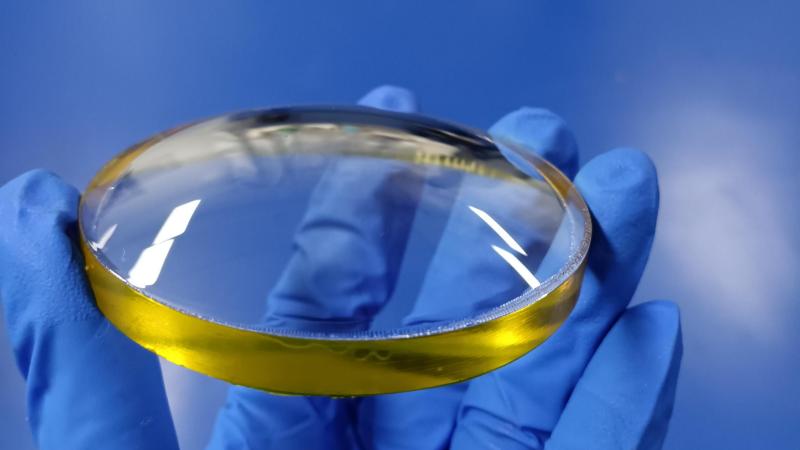
The reason ultrasonic spraying machines can perfectly adapt to these special materials with viscosities ranging from 0 to 30 cps lies in their unique high-frequency ultrasonic atomization principle. Unlike traditional air spraying which uses high-pressure airflow atomization, this fundamentally solves the contradiction between viscosity compatibility and coating quality. The core component of an ultrasonic spraying machine is the ultrasonic nozzle, which contains a piezoelectric transducer. When a high-frequency electrical signal (typically 20kHz to 120kHz) acts on the transducer, it generates mechanical vibrations of the same frequency. This vibration is transmitted through an amplitude transformer to an atomizing plate at the top of the nozzle, causing the coating liquid to form an extremely thin liquid film on the surface of the atomizing plate. Under the action of sound wave energy, the liquid film overcomes surface tension and is torn into countless uniform, fine-sized micron- or even nano-sized droplets, forming a gentle, low-speed mist-like jet. This eliminates the need for high-pressure airflow, fundamentally avoiding the damage to the material’s molecular structure caused by high-pressure airflow, while precisely adapting to the atomization requirements of materials with different viscosities.
For high-transmittance, adjustable-refractive materials with a viscosity range of 0-30 cps, the ultrasonic spraying machine achieves stable atomization and uniform spraying across the entire viscosity range by precisely controlling the ultrasonic frequency, amplitude, and liquid supply speed. When processing low-viscosity materials (0-10 cps), the equipment can reduce the ultrasonic amplitude and slow down the liquid supply speed to avoid over-atomization and droplet dispersion caused by excessive material flowability. Simultaneously, by optimizing the nozzle structure, it ensures uniform droplet distribution, controlling the coating thickness deviation within ±5% after spraying, effectively avoiding common defects such as sagging and pinholes in low-viscosity material spraying. When processing medium-low viscosity materials (10-30 cps), the equipment can appropriately increase the ultrasonic amplitude and accelerate the liquid supply speed, using high-frequency vibration to break down the material’s viscous resistance, atomizing it into uniform droplets. This ensures that the droplets do not agglomerate due to excessive viscosity during flight, guaranteeing a dense, smooth coating that does not affect the material’s high transmittance. This flexible controllability allows ultrasonic spraying machines to easily cover the entire viscosity range of 0-30 cps without requiring equipment or nozzle replacements, significantly improving production efficiency and reducing equipment investment costs.
The core characteristics of high-transmittance, adjustable-refractive-index materials are high transmittance and adjustable refractive index. The ultrasonic spraying process maximizes the preservation of these core properties, which is its key advantage over traditional spraying equipment. Traditional air spraying relies on high-pressure airflow to atomize the material. This airflow introduces numerous air bubbles, and the high-pressure impact damages the material’s molecular structure, leading to problems such as bubbles, increased haze, and decreased transmittance in the post-coating layer. It can even affect the uniformity of the material’s refractive index, failing to meet the requirements of high-end optical products. In contrast, the low-speed, gentle atomization method of ultrasonic spraying produces no bubbles during the atomization process. The droplets gently cover the substrate with extremely low kinetic energy, without damaging the material’s molecular structure. This fully preserves the material’s high transmittance, resulting in a post-coating haze controllable below 1.0% and a transmittance maintained above 90%, essentially consistent with the transmittance properties of the raw material.
Meanwhile, the precise control capabilities of ultrasonic spraying machines ensure a uniform distribution of the refractive index of high-transmittance, adjustable-refractive materials. The adjustability of the refractive index of such materials depends on the uniformity of the material formulation, and the uniformity of the coating thickness during the spraying process directly affects the refractive properties of the final product. Ultrasonic spraying machines, through PLC control and an XYZ three-axis servo motion system, can precisely control the spraying path and coating thickness, achieving a repeatability accuracy of 0.01mm. They can precisely control the coating thickness from tens of nanometers to tens of micrometers according to requirements, ensuring uniform coating thickness and thus guaranteeing the uniformity of the refractive index across the entire coating surface. This avoids excessive local deviations in the refractive index, meeting the stringent refractive performance requirements of products such as optical devices and display panels.
In practical applications, the advantages of ultrasonic spraying machines in spraying high-transmittance, adjustable-refractive materials with viscosities of 0-30 cps are fully demonstrated, covering multiple high-end manufacturing fields. In optical lens manufacturing, commonly used low-viscosity optical resins (5-15 cps) are applied using ultrasonic spraying machines to form a uniform, transparent coating with precisely controllable thickness. This effectively adjusts the lens’s refractive index, improving image quality while avoiding defects such as scratches and bubbles associated with traditional spraying methods. In the display panel industry, medium-to-low viscosity (15-30 cps) high-transmittance, adjustable-refractive coating materials are applied to the panel surface using ultrasonic spraying machines to form an anti-reflective, high-transmittance functional coating. This improves the panel’s light transmittance and allows for adjustment of the refractive index according to display requirements, optimizing display effects. This technology is widely used in high-end display products such as OLED and Micro-LED.
In photovoltaic module manufacturing, high-transmittance, tunable-refractive materials (0-10 cps) are used for surface coatings on photovoltaic glass. Applying these materials using an ultrasonic spraying machine creates an anti-reflective coating, adjusting the glass’s refractive index to reduce light reflection loss and improve the photovoltaic module’s photoelectric conversion efficiency. The coating also exhibits good wear resistance and weather resistance, extending the module’s lifespan. In AR/VR device manufacturing, high-transmittance, tunable-refractive materials are a core optical material, typically with a viscosity between 10 and 25 cps. Ultrasonic spraying machines can precisely control the coating thickness and uniformity, ensuring optimal optical imaging and contributing to the lightweight and high-precision development of AR/VR devices. Furthermore, in biomedical optics, these materials are used for endoscope lens encapsulation. Ultrasonic spraying coatings are sterilizable, transparent, and flexible enough to withstand repeated high-pressure sterilization, further expanding their application scenarios.
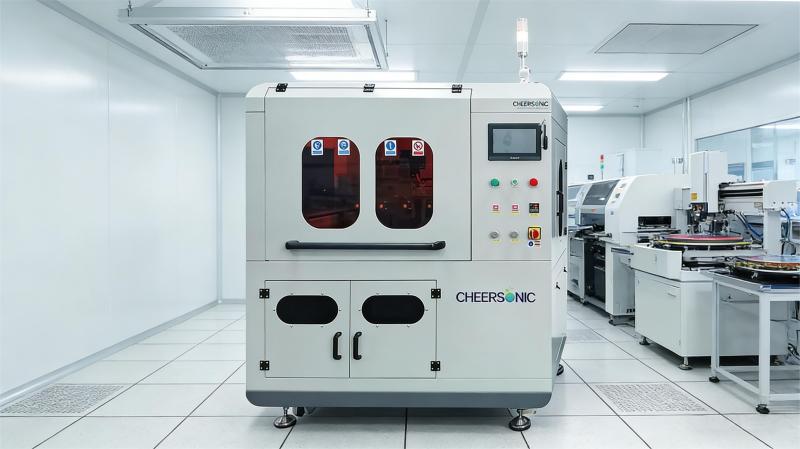
Compared to traditional spraying equipment, ultrasonic spraying machines offer advantages such as high material utilization and energy efficiency when processing these special materials. Due to its uniform atomization and absence of overspray, the ultrasonic spraying machine achieves a material utilization rate of over 90%, significantly reducing the consumption of expensive high-transmittance, adjustable-refractive materials and lowering waste disposal costs. Simultaneously, the equipment operates without high-pressure airflow, resulting in low noise and zero pollutant emissions, meeting the demands of modern green manufacturing and making it particularly suitable for high-end manufacturing sectors with stringent environmental requirements. Furthermore, the ultrasonic nozzle is made of corrosion-resistant materials such as titanium alloy, eliminating nozzle wear and clogging issues, and features a self-cleaning function, requiring no routine maintenance and further reducing production maintenance costs and improving production stability.
In summary, the ultrasonic spraying machine, with its unique ultrasonic atomization principle, flexible viscosity adaptation capabilities, and precise process control, perfectly meets the spraying needs of high-transmittance, adjustable-refractive materials within a viscosity range of 0-30 cps. It not only achieves stable atomization and uniform spraying across the entire viscosity range but also maximizes the preservation of the material’s high transmittance and adjustable-refractive properties, effectively solving many pain points of traditional spraying processes and playing an irreplaceable role in high-end manufacturing fields such as optics, displays, photovoltaics, and AR/VR. With the continuous advancement of materials science and the ongoing optimization of ultrasonic spraying technology, its application scenarios will be further expanded in the future, providing more efficient and precise spraying solutions for the industrial application of high-transmittance and tunable refractive materials, and promoting technological upgrading and industrial development in related fields.
About Cheersonic
Cheersonic is the leading developer and manufacturer of ultrasonic coating systems for applying precise, thin film coatings to protect, strengthen or smooth surfaces on parts and components for the microelectronics/electronics, alternative energy, medical and industrial markets, including specialized glass applications in construction and automotive.
Our coating solutions are environmentally-friendly, efficient and highly reliable, and enable dramatic reductions in overspray, savings in raw material, water and energy usage and provide improved process repeatability, transfer efficiency, high uniformity and reduced emissions.
Chinese Website: Cheersonic Provides Professional Coating Solutions