
Ultrasonic Spraying for WC-Mo₂C Powder Coating on Ceramics
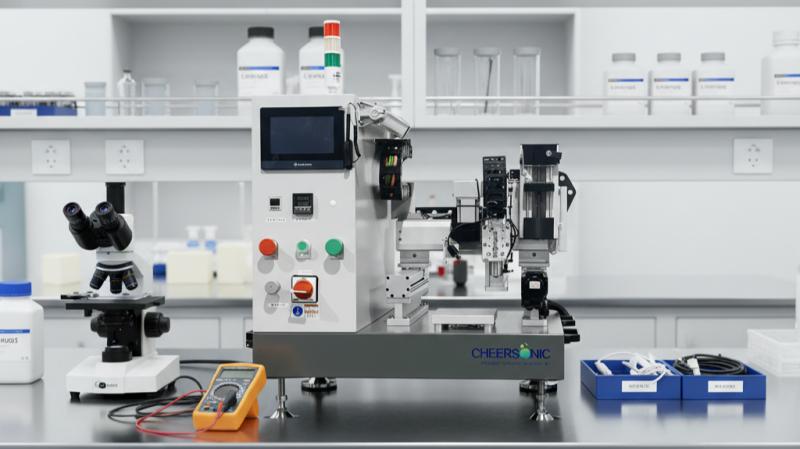
Ultrasonic spraying equipment for applying a mixture of tungsten carbide and molybdenum carbide powders onto ceramic surfaces
In the field of modern surface engineering, ultrasonic spraying technology is increasingly demonstrating unique advantages as a high-precision, high-efficiency method for thin-film deposition. It offers a near-ideal solution, particularly when processing high-performance ceramic components and coating them with ultra-hard, high-melting-point cermet powders—specifically mixtures of tungsten carbide and molybdenum carbide. The core objective of this process is to create a robust composite coating that significantly enhances the ceramic substrate’s wear resistance, corrosion resistance, and resistance to high-temperature oxidation under harsh operating conditions; this effectively expands the application scope of ceramic materials and extends the service life of critical components.
Achieving this goal begins with the meticulous pretreatment of the ceramic substrate. The surface to be coated must possess a high degree of cleanliness and appropriate surface activity, as even trace amounts of oil, moisture, or dust can compromise coating adhesion. Consequently, rigorous procedures—such as ultrasonic cleaning with organic solvents, rinsing with deionized water, and thorough drying—are typically required. For ceramics with smooth, dense surfaces, additional steps like controlled sandblasting (for roughening) or specific chemical activation may be necessary to increase surface roughness and chemical activity at the microscopic level, thereby establishing a stronger foundation for mechanical interlocking and physicochemical bonding with the subsequent coating.
Next comes one of the most critical stages of the entire process: the preparation of the spray slurry. This is far from a simple physical mixing task; rather, it is a precise process rooted in colloid chemistry and surface science. The particle size, morphology, and mixing ratio of the tungsten carbide and molybdenum carbide powders directly determine the microstructure and performance characteristics of the final coating. To ensure these fine powders—which are prone to agglomeration—are dispersed uniformly and stably within the liquid medium, one must carefully select an appropriate solvent system (such as water-based or alcoholic organic solvents) and incorporate effective dispersing agents. Through continuous mechanical stirring and ultrasonic agitation, inter-particle van der Waals forces are overcome, resulting in a highly dispersed and sedimentation-stable suspension system. Additionally, depending on processing requirements, a small amount of temporary binder may be introduced to impart sufficient green strength to the unsintered coating during the drying stage, thereby preventing damage during handling and furnace loading.
Next comes the core phase—precision coating—where the unique capabilities of ultrasonic spraying equipment are fully utilized. Unlike traditional spraying methods that rely on high-pressure gas to atomize the liquid, ultrasonic spraying employs high-frequency mechanical vibrations generated by a piezoelectric transducer. These vibrations create fine capillary waves on the nozzle surface; when the amplitude exceeds the liquid’s surface tension, the slurry breaks apart into uniform, finely atomized micron-scale droplets. This unique atomization mechanism, combined with a multi-axis motion platform driven by a CNC system, enables precise, uniform scanning-style coating of ceramic component surfaces. By precisely controlling parameters such as atomization frequency, feed rate, nozzle movement speed, and substrate preheating temperature, the thickness and morphology of the wet film can be meticulously regulated. This effectively prevents common coating defects—such as sagging, orange peel, or the “coffee-ring” effect—laying a solid foundation for producing high-quality coatings with uniform thickness and no macroscopic defects.
Following the spraying process, the component undergoes a gentle, controlled drying stage. The objective here is to allow the solvent within the slurry to evaporate slowly and evenly, preventing cracking or curling caused by internal stress concentrations resulting from rapid drying. This step is typically carried out by allowing the component to sit at room temperature or placing it in a low-temperature drying oven, ensuring the structural integrity of the coating framework—composed of powder particles, dispersants, and residual binder—is preserved.
Finally, the “finishing touch” that determines the coating’s ultimate performance and bond strength is high-temperature heat treatment, or the sintering process. This step is usually performed in a vacuum or under a high-purity inert gas atmosphere to prevent the oxidation of active components at elevated temperatures. The sintering process requires adherence to a carefully designed temperature profile: initially, organic additives within the coating are removed at a slow heating rate (the debinding stage); subsequently, the temperature is rapidly raised to a specific sintering window—close to the melting point of the powder materials yet below the deformation temperature of the ceramic substrate—where it is maintained. At this elevated temperature, material diffusion drives neck growth and densification between the tungsten carbide and molybdenum carbide powder particles; simultaneously, interdiffusion at the interface between the coating and the ceramic substrate may occur, establishing a robust metallurgical or strong chemical bond. The result is a cermet composite coating characterized by a dense structure, high bond strength with the substrate, and excellent performance.
In summary, the preparation of tungsten carbide-molybdenum carbide composite coatings on ceramic surfaces via ultrasonic spraying represents a systematic engineering technology that integrates advanced equipment, materials science, and precision processing. This approach not only leverages the significant advantages of ultrasonic spraying—namely uniformity, controllability, and high efficiency—but also, through an optimized subsequent heat treatment process, successfully imparts the superior properties of superhard materials to the ceramic surface. It thereby paves a reliable and promising technical pathway for manufacturing a new generation of high-performance ceramic composite components capable of stable operation in environments characterized by extreme wear, corrosion, or high temperatures.
About Cheersonic
Cheersonic is the leading developer and manufacturer of ultrasonic coating systems for applying precise, thin film coatings to protect, strengthen or smooth surfaces on parts and components for the microelectronics/electronics, alternative energy, medical and industrial markets, including specialized glass applications in construction and automotive.
Our coating solutions are environmentally-friendly, efficient and highly reliable, and enable dramatic reductions in overspray, savings in raw material, water and energy usage and provide improved process repeatability, transfer efficiency, high uniformity and reduced emissions.
Chinese Website: Cheersonic Provides Professional Coating Solutions
