
Ultrasonic Spraying Equipment for Proton Membrane Coating
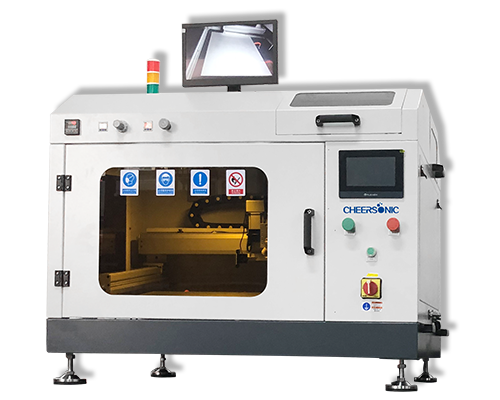
Proton exchange membrane coating ultrasonic spraying equipment is a key equipment for manufacturing hydrogen energy core components – proton exchange membrane electrolysis cells and fuel cell membrane electrodes. This equipment is designed specifically for precision coating of precious metal catalyst coatings, aiming to achieve high-performance, low load production goals.
Its core lies in using high-frequency ultrasonic energy to atomize expensive catalyst slurries (such as iridium black or platinum carbon) into micrometer sized, uniformly distributed fine droplets, and depositing them accurately and uniformly on fragile proton exchange membranes or gas diffusion layer substrates through non-contact nozzles. This process can form an ultra-thin and highly consistent active catalytic layer, greatly optimizing the three-phase interface of the reaction and significantly improving hydrogen/oxygen evolution or power generation efficiency.
The outstanding advantage of this device is its extremely high material utilization rate, which can accurately control the loading of precious metals at the lowest demand and significantly save costs. At the same time, it avoids the mechanical damage that traditional coating methods may cause to proton membranes, ensuring the integrity and durability of membrane electrodes. Therefore, this high-precision spraying equipment is an indispensable advanced manufacturing tool for promoting the commercialization of proton exchange membrane technology and reducing the cost of green hydrogen production.
Basic Principle:
Ultrasonic spraying devices primarily utilize the high-frequency vibrations of ultrasound. When spraying a proton membrane, an ultrasonic generator generates a high-frequency electrical signal. The transducer converts this electrical energy into mechanical energy, causing the nozzle to vibrate at a high frequency. This vibration acts on the spray liquid, causing it to form uniform droplets on the nozzle surface. Driven by the ultrasound, the droplets are ejected from the nozzle and deposited relatively evenly on the substrate, forming the proton membrane.
Compared to traditional spraying methods, ultrasonic spraying offers better control over droplet size and distribution. For example, traditional pneumatic spraying can result in uneven droplet size due to factors such as air pressure fluctuations. However, droplet formation in ultrasonic spraying relies primarily on stable factors such as the ultrasonic vibration frequency, resulting in a more uniform coating.
Device Components: Ultrasonic Generator:
This is the power source for the entire device. It generates an AC signal at a specific frequency (typically between tens of kilohertz and hundreds of kilohertz). Common frequencies include 40 kHz and 120 kHz. Its output power can also be adjusted as needed to control the intensity of the ultrasonic wave, thereby affecting droplet formation and spraying quality.
Transducer: Its function is to convert the electrical energy generated by the ultrasonic generator into mechanical energy. It is typically made of piezoelectric ceramic. When subjected to a high-frequency electrical signal, the piezoelectric ceramic deforms, generating mechanical vibrations. The frequency of this vibration is the same as the output frequency of the ultrasonic generator, and its amplitude is related to factors such as the input power.
Nozzle: The nozzle is the component that directly contacts the spray liquid and ejects the droplets. The structural design of the nozzle is crucial to spraying quality. The shape and size of its internal channels affect the flow characteristics of the liquid. Some nozzles also have special coatings or materials to prevent chemical reactions between the spray liquid and the nozzle head, while also promoting better droplet separation. For example, for highly acidic or alkaline solutions used in proton membrane spraying, the nozzle material must have excellent corrosion resistance.
Liquid supply system: This includes a liquid storage tank, infusion piping, and a pump. The liquid storage tank is used to store the spray liquid, and its capacity can be selected according to actual needs. The liquid delivery pipeline must possess excellent corrosion resistance and sealing properties to ensure stable delivery of the spray liquid to the nozzle. The pump controls the flow rate of the spray liquid. The pump speed and other parameters can generally be adjusted to precisely control the liquid delivery rate, thereby matching the spray speed of the ultrasonic nozzle.
Stage and motion control system: The stage is used to place the substrate material, such as a polymer sheet, on which the proton membrane will be sprayed. The motion control system precisely controls the stage’s movement, including speed, direction, and path. For example, when spraying a large area of proton membrane, the stage can be programmed to move in the X-Y direction to ensure uniform coating across the entire substrate surface.
About Cheersonic
Cheersonic is the leading developer and manufacturer of ultrasonic coating systems for applying precise, thin film coatings to protect, strengthen or smooth surfaces on parts and components for the microelectronics/electronics, alternative energy, medical and industrial markets, including specialized glass applications in construction and automotive.
Our coating solutions are environmentally-friendly, efficient and highly reliable, and enable dramatic reductions in overspray, savings in raw material, water and energy usage and provide improved process repeatability, transfer efficiency, high uniformity and reduced emissions.
Chinese Website: Cheersonic Provides Professional Coating Solutions
