
Ultrasonic Spraying Ceramic Materials
Ultrasonic spraying technology, as a new and versatile spraying method, has gained widespread application and recognition in the field of materials science in recent years. In particular, its unique advantages in the spraying of ceramic materials have made it a hot topic within the industry. This article will provide a detailed introduction to the application of ultrasonic spraying technology in ceramic spraying and the revolutionary changes it has brought.
1. Basic Principles of Ultrasonic Spraying Technology
Ultrasonic spraying technology uses ultrasonic vibrations to atomize liquid or powdered materials into micron- or even nanometer-sized particles. These tiny particles are then evenly sprayed onto the substrate using a spray gun. Compared to traditional pressure spraying, ultrasonic nozzles offer significant advantages in anti-clogging performance. Their large orifice design and high-frequency vibration technology not only improve spray efficiency but also avoid the clogging problems associated with high-pressure spraying.
2. Advantages of Ultrasonic Spraying of Ceramic Materials
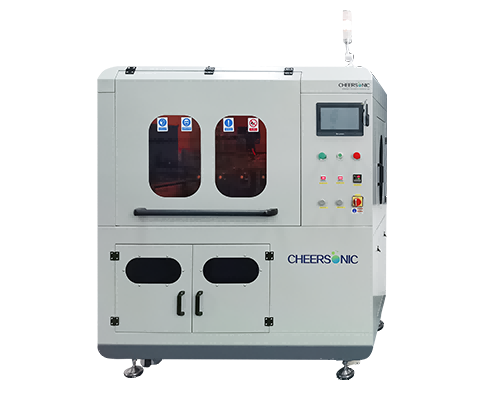
High-Efficiency Spraying: Ultrasonic spraying technology utilizes high-frequency vibrations to evenly disperse ceramic powder in a liquid, forming uniform, fine particles, significantly improving spraying efficiency. CHEERSONIC has developed ultrasonic spraying production line equipment to further enhance production efficiency.
High-Quality Coatings: During ultrasonic spraying, atomized particles impact the substrate at a constant velocity, rapidly spreading, flattening, and solidifying, forming a layered coating composed of stacked small flakes. This structure not only improves coating uniformity and density but also reduces porosity, significantly enhancing coating quality. Research shows that the porosity of ultrasonic atomized spraying is only 3%, far lower than that of plasma spraying and detonation spraying.
Wide Applicability: Ultrasonic spraying technology is suitable for a variety of ceramic materials, including ceramics. coatings have excellent conductivity, mechanical strength, and high-temperature resistance, making them widely used in aerospace, electronic circuits, and other fields. Ultrasonic spraying technology enables the uniform application of these high-performance ceramic materials onto a variety of substrates, meeting diverse and complex application requirements.
3. Applications of Ultrasonic Sprayed Ceramic Materials
Ultrasonic sprayed ceramic materials have a wide range of applications, including but not limited to the following:
- Aerospace: The aerospace industry places extremely high demands on materials, requiring them to possess excellent high-temperature resistance, corrosion resistance, and mechanical strength. Ultrasonic spraying technology can evenly apply high-performance ceramic materials to key parts of aerospace vehicles, improving their overall performance and safety.
- Electronic circuits: Electronic circuits require materials with excellent electrical conductivity and insulation. Ultrasonic spraying technology can evenly apply ceramic coatings to the surface of electronic circuits, improving their insulation performance and reliability.
- Thin-film photovoltaic cells: Thin-film photovoltaic cells require materials with excellent light transmittance and electrical conductivity. Ultrasonic spraying technology can evenly apply ceramic coatings to the surface of thin-film photovoltaic cells, improving their photoelectric conversion efficiency and stability.
- Other fields: Ultrasonic spraying of ceramic materials can also be used in fuel cells, graphene coatings, silicon photovoltaic cells, and other fields, providing high-performance, high-quality coating solutions for these applications.
When using ultrasonic spray equipment, please note the following points:
- Substrate pretreatment: Before spraying, the substrate must be pretreated to remove oil, impurities, and other substances to ensure coating quality.
- Parameter adjustment: Adjust ultrasonic spray equipment parameters, such as frequency, amplitude, and spray speed, based on the characteristics of the spray material and application requirements.
- Environmental Control: During the spraying process, factors such as humidity and temperature must be controlled to avoid adverse effects on coating quality.
4. Conclusion
Ultrasonic spraying technology, with its high efficiency, high quality, and wide applicability, demonstrates tremendous potential and value in the field of ceramic material spraying. With the continuous development and improvement of the technology, ultrasonic spraying technology will be applied and promoted in more fields, injecting new vitality into the development of materials science.
About Cheersonic
Cheersonic is the leading developer and manufacturer of ultrasonic coating systems for applying precise, thin film coatings to protect, strengthen or smooth surfaces on parts and components for the microelectronics/electronics, alternative energy, medical and industrial markets, including specialized glass applications in construction and automotive.
Our coating solutions are environmentally-friendly, efficient and highly reliable, and enable dramatic reductions in overspray, savings in raw material, water and energy usage and provide improved process repeatability, transfer efficiency, high uniformity and reduced emissions.
Chinese Website: Cheersonic Provides Professional Coating Solutions