
Ultrasonic Spray-Coated Batteries
Ultrasonic Spray-Coated Batteries – Coated Batteries – Cheersonic
Ultrasonic spray-coated batteries represent a cutting-edge advancement in electrochemical energy storage, leveraging ultrasonic atomization technology to revolutionize battery manufacturing. This technique uses high-frequency mechanical vibrations to break coating slurries into uniform, micron-scale droplets, enabling precise, controlled deposition onto battery components including electrodes, separators, and solid-state electrolyte interfaces.
Unlike traditional coating methods, ultrasonic spraying delivers exceptional uniformity with thickness errors controlled within ±5%, creating ultra-thin, compact functional layers. It boosts material utilization to over 90%, drastically cutting waste of expensive active materials and conductive pastes. The uniform coatings eliminate internal resistance imbalance, significantly enhancing battery energy density, power density, and charge-discharge efficiency.
This technology is widely applied in lithium-ion batteries, flow batteries, and solid-state batteries, improving electrode adhesion, cycle stability, and safety. Compatible with automated production lines, it facilitates scalable, high-precision manufacturing. As a key enabler for next-generation high-performance batteries, ultrasonic spray coating accelerates the development of longer-lasting, more efficient energy storage solutions for electric vehicles and renewable energy systems.
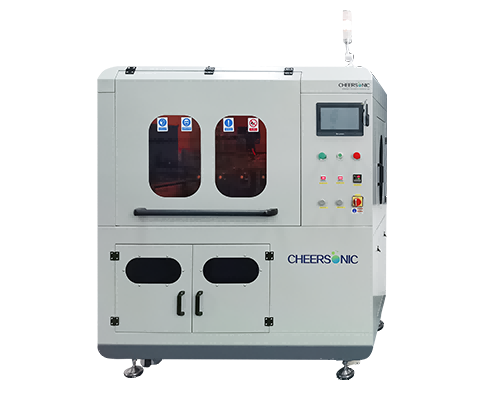
Spray-coated batteries are an innovative battery manufacturing technology. They form a battery structure by spraying battery materials onto a substrate. The following is a detailed overview of spray-coated batteries:
1. Definition and Principle
Spray-coated batteries refer to the process of uniformly coating battery materials (such as positive electrode materials, negative electrode materials, electrolytes, etc.) in liquid or slurry form onto a substrate (such as metal foil, plastic film, etc.) using spraying technology. After drying and curing, a thin-film structure with battery functionality is formed. The principle is to use spraying technology to form battery materials into tiny particles or droplets, which are then uniformly attached to the substrate, thus constructing the basic structure of the battery.
2. Development History and Current Status
The development of spray-coated battery technology can be traced back to the continuous exploration and research of new battery technologies in recent years. In 2012, Rice University in the United States developed a new type of battery that could be sprayed onto any surface like paint and turned into a lithium battery, marking the birth of spray-coated battery technology. Since then, with the continuous development of technologies such as ultrasonic spraying and 3D printing, spray-coated battery technology has been further optimized and improved. Currently, spray-coated battery technology has been initially applied in fields such as electric vehicles and energy storage devices, demonstrating broad application prospects.
3. Technical Characteristics and Advantages
- Flexibility: Spray-coated battery technology can adapt to substrates of various shapes and sizes, thus producing batteries with different shapes and capacities.
- High Efficiency: Spray coating technology enables rapid and uniform coating, thereby improving battery production efficiency and quality.
- Innovation: Spray-coated battery technology brings new ideas and methods to battery manufacturing, promoting innovation and development in battery technology.
- Environmental Friendliness: Compared with traditional battery manufacturing technologies, spray-coated battery technology can reduce material waste and environmental pollution, aligning with the concept of sustainable development.
4. Application Areas
- Electric Vehicles: Spray-coated battery technology can be applied to the manufacturing of power batteries for electric vehicles, improving battery performance and lifespan, thereby increasing the power and driving range of electric vehicles.
- Energy Storage Devices: Spray-coated battery technology can also be applied to energy storage devices, providing high-performance battery support for the storage and utilization of renewable energy.
- Other Fields: In addition, spray-coated battery technology can also be applied to smart homes, industrial automation, and healthcare, providing high-performance, flexible battery solutions for these fields.
5. Development Trends and Challenges
With the rapid development of new energy vehicles and the energy storage industry, spray-coated battery technology faces enormous market demand and development opportunities. However, it also faces challenges, such as how to improve battery energy density, reduce costs, and enhance safety. To overcome these challenges, future research needs to focus more on innovation in battery materials, optimization of spray-coating technology, and improvement of battery structure.
In conclusion, spray-coated battery technology, as an innovative battery manufacturing technology, has broad application prospects and development potential. With continuous technological advancements and in-depth research, spray-coated battery technology is expected to play an important role in more fields, bringing greater convenience and benefits to people’s lives and work.
About Cheersonic
Cheersonic is the leading developer and manufacturer of ultrasonic coating systems for applying precise, thin film coatings to protect, strengthen or smooth surfaces on parts and components for the microelectronics/electronics, alternative energy, medical and industrial markets, including specialized glass applications in construction and automotive.
Our coating solutions are environmentally-friendly, efficient and highly reliable, and enable dramatic reductions in overspray, savings in raw material, water and energy usage and provide improved process repeatability, transfer efficiency, high uniformity and reduced emissions.
Chinese Website: Cheersonic Provides Professional Coating Solutions